Understanding the cosmic dance that creates Earth's most spectacular light show
The Northern Lights result from a complex interaction between the Sun, solar wind, Earth's magnetic field, and our atmosphere - a cosmic process spanning 93 million miles that creates one of nature's most magnificent displays.
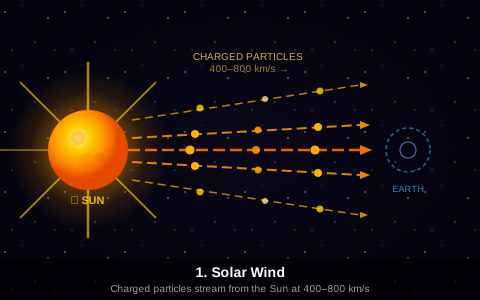
Our story begins 93 million miles away. The Sun's extreme heat (27 million °F at its core) strips electrons from atoms, creating plasma. This charged plasma streams away from the Sun at 250-500 miles per second - this constant flow is called the solar wind.
During solar storms, enormous coronal mass ejections hurl billions of tons of plasma toward Earth!
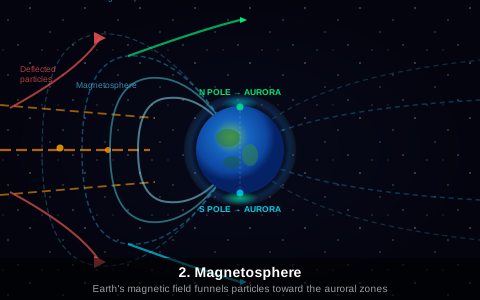
Earth's magnetosphere acts like an invisible force field, deflecting most solar wind around our planet. But when magnetic field lines from the Sun align opposite to Earth's field, they "reconnect" - creating openings that funnel solar particles toward the poles.
Without this magnetic shield, solar wind would strip away our atmosphere!
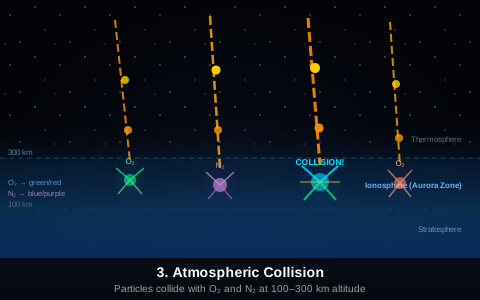
As charged particles accelerate down magnetic field lines toward the poles, they collide with oxygen and nitrogen molecules 60-200 miles above Earth. These collisions transfer energy, exciting the atoms.
The excited atoms release this energy as photons - creating the aurora's glow!
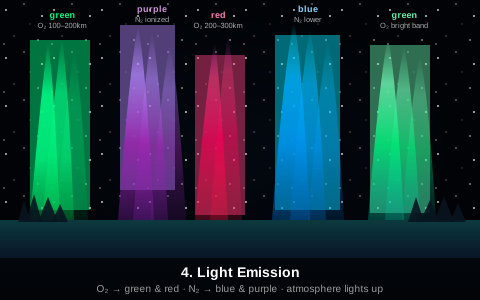
When excited atmospheric gases return to their normal state, they emit light at specific wavelengths. The color depends on which gas is involved and the altitude - creating the dancing curtains of green, red, purple, and blue we see as the Northern Lights!
This entire process from Sun to sky takes just 1-3 days!
Different atmospheric gases at different altitudes emit specific colors when energized by solar particles
Most Common Color
Produced by oxygen at 60-150 miles altitude. Wavelength: 557.7 nm. Occurs 96% of the time. Human eyes are most sensitive to green light, making these auroras appear brightest.
Rare & High Altitude
Produced by oxygen above 150 miles altitude. Wavelength: 630.0 nm. Requires strong solar activity and very high altitudes where the atmosphere is extremely thin.
Nitrogen Emissions
Produced by ionized nitrogen molecules. Wavelength: 428 nm. Usually appears at lower edges of aurora curtains during intense geomagnetic activity.
Nitrogen & Mixed
Created by nitrogen combined with other emissions. Appears during very active displays when multiple colors mix. Pink often indicates high-energy particle bombardment.
The science behind auroras reveals some truly amazing phenomena
Despite appearing as glowing "fire" in the sky, the temperature where auroras occur is actually near freezing (-100°F / -73°C). The glow comes from light emission, not heat!
Solar wind travels at 250-500 miles/second (400-800 km/s). During major solar storms, coronal mass ejections can reach speeds up to 1,900 miles/second - that's 0.5% the speed of light!
A strong aurora display releases energy equivalent to a million megawatts - enough to power a large city! Yet this represents only a tiny fraction of the total solar energy hitting Earth's magnetosphere.
Jupiter has auroras 100 times brighter than Earth's! Saturn, Uranus, Neptune, and even Mars have auroral displays. Any planet with a magnetic field and atmosphere can create auroras.
Cameras capture more vivid colors than our eyes see because long exposures gather more light. However, strong auroras (KP 4+) show brilliant colors clearly visible to the naked eye!
The Southern Lights (Aurora Australis) are identical to Northern Lights - they're mirror images created simultaneously by the same solar particles hitting both poles at once!
The Sun follows an 11-year activity cycle. We're currently in Solar Cycle 25 (peak 2024-2026), meaning excellent aurora viewing opportunities for the next few years!
Some people report hearing crackling or whooshing sounds during intense auroras. Scientists believe these may come from electrical discharges near the ground created by the same geomagnetic disturbances causing the lights!
While beautiful to us on the ground, the geomagnetic storms creating auroras can disrupt satellites, power grids, GPS navigation, and radio communications - prompting 24/7 space weather monitoring!
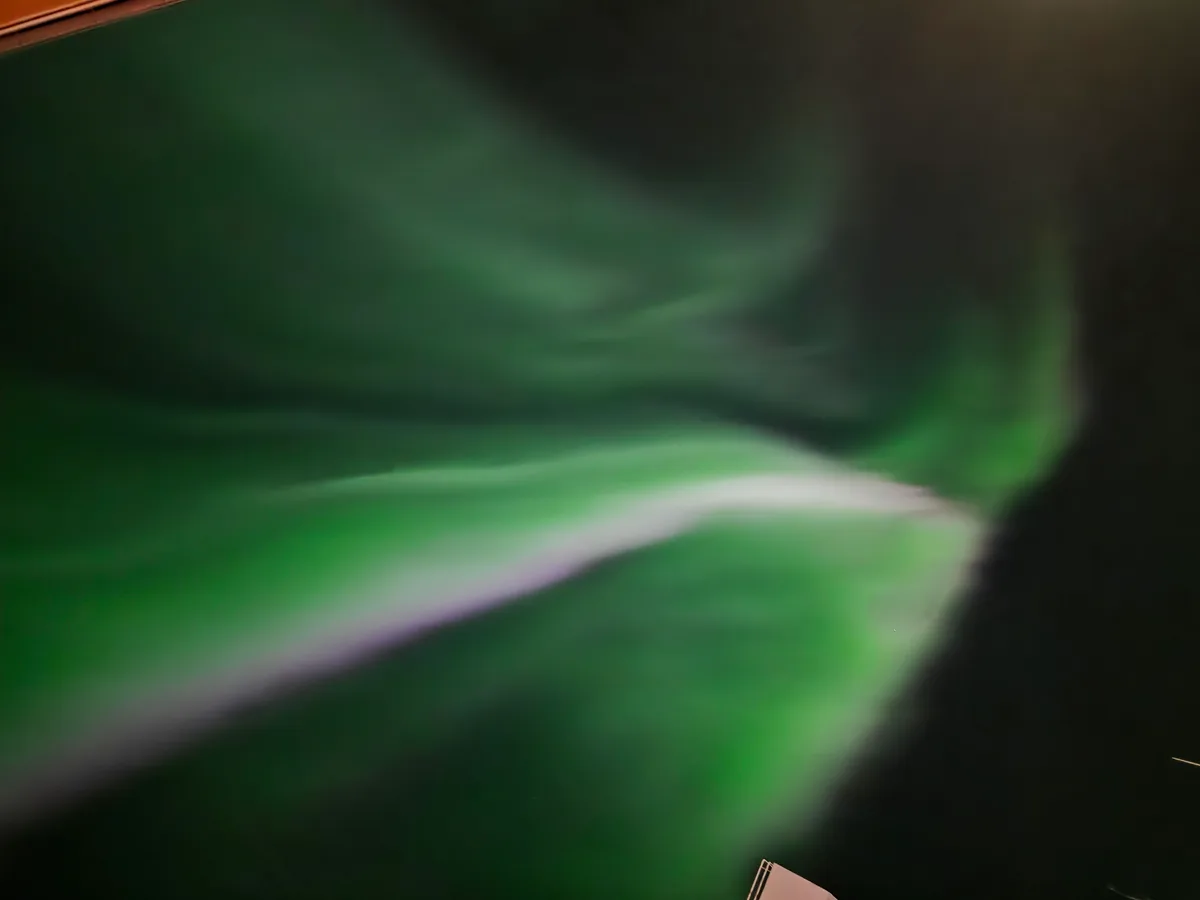
The Northern Lights are a perfect example of how cosmic processes millions of miles away create beauty we can experience right here on Earth. From the nuclear fusion in the Sun's core to the light dancing across Iceland's dark skies, aurora borealis connects us directly to the vast universe beyond our planet.
Now that you understand the physics, see it for yourself!