The Sun constantly emits a stream of charged particles β electrons and protons β called the solar wind, traveling at 400β800 km/s. During periods of high solar activity, the Sun also produces solar flares and Coronal Mass Ejections (CMEs): explosive bursts of billions of tonnes of magnetised plasma flung into space.
When an Earth-directed CME arrives 1 to 3 days after ejection, it compresses Earth's magnetic field on the day side and can trigger powerful geomagnetic storms β and brilliant aurora. Solar activity follows an 11-year cycle; we are currently near the peak of Solar Cycle 25, meaning heightened aurora activity through 2025β2026.
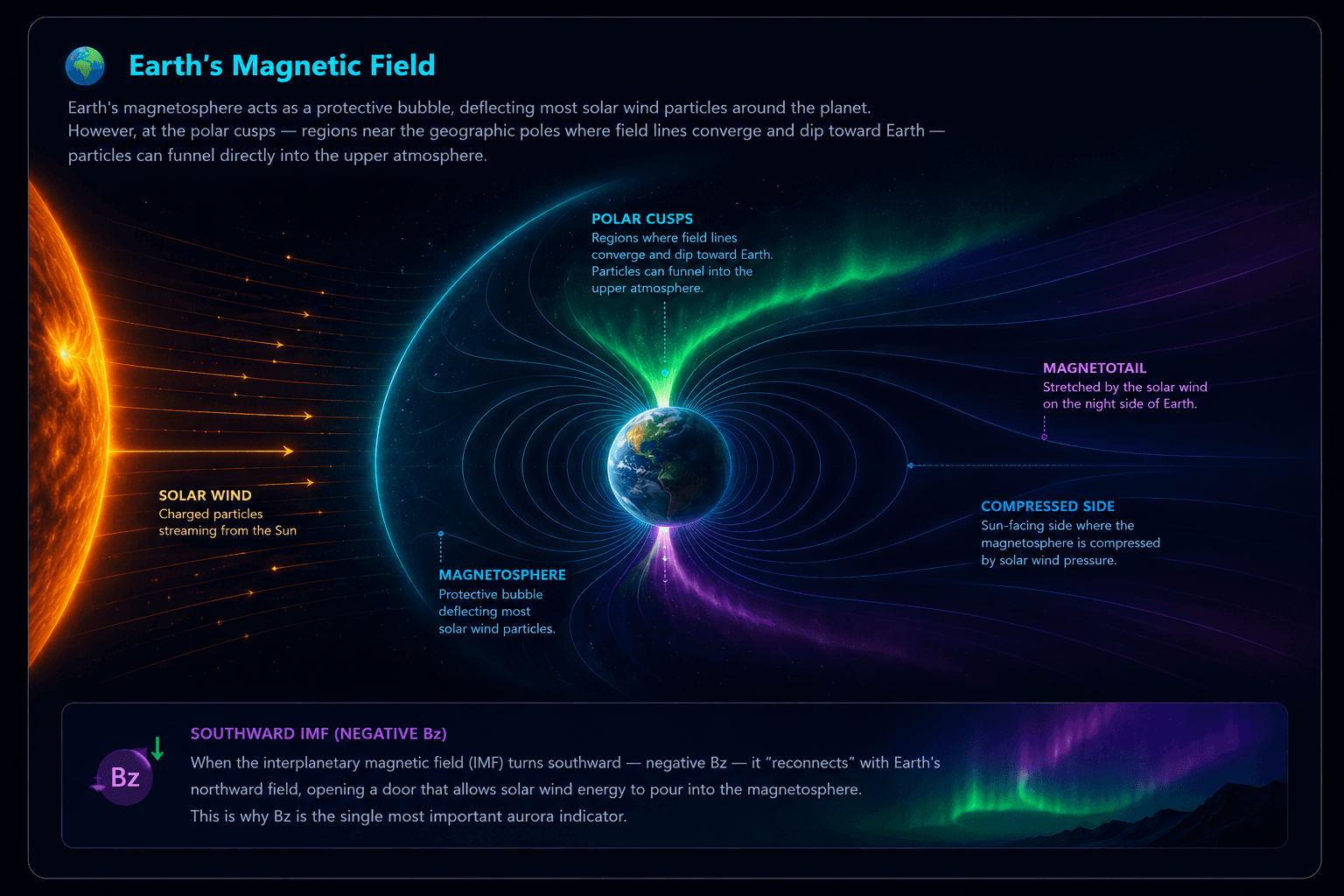
Earth's magnetosphere acts as a protective bubble, deflecting most solar wind particles around the planet. However, at the polar cusps β regions near the geographic poles where field lines converge and dip toward Earth β particles can funnel directly into the upper atmosphere.
When the interplanetary magnetic field (IMF) turns southward β negative Bz β it "reconnects" with Earth's northward field, opening a door that allows solar wind energy to pour into the magnetosphere. This is why Bz is the single most important aurora indicator.
When charged particles spiral down the magnetic field lines, they collide with oxygen and nitrogen molecules at altitudes of 80β300 km. These collisions excite the molecules, which release the absorbed energy as light β the aurora.
Aurora activity doesn't occur uniformly across the poles β it concentrates in an oval-shaped ring around each magnetic pole, roughly following the 65β70Β° magnetic latitude. This "auroral oval" is always present, even during quiet conditions, but at low activity it sits over northern Iceland and the Canadian Arctic.
During geomagnetic storms, the auroral oval expands equatorward. A KP 5 storm pushes the oval over Scotland and southern Norway. A rare KP 9 event can bring aurora over central Europe, the United States, and as far south as the Mediterranean. Iceland, sitting directly under the quiet-time oval, benefits from aurora even at low activity.
The Planetary K-index (Kp) measures global geomagnetic activity on a scale from 0 (very quiet) to 9 (extreme storm). It is derived from magnetometers at 13 stations worldwide and updated every 3 hours.
The north-south component of the interplanetary magnetic field (IMF). Negative Bz (southward) allows solar wind energy to flow into Earth's magnetosphere, triggering aurora. The single most important real-time aurora indicator.
The velocity of charged particles streaming from the Sun. Normal is 350-500 km/s. During solar storms it can exceed 800 km/s, dramatically increasing aurora activity.
A model from NOAA that predicts the intensity and location of the auroral oval in real time using solar wind data. AuroraVision uses OVATION power output as one input to the visibility score.
Coronal Mass Ejection β a massive burst of solar plasma and magnetic field ejected from the Sun's corona. When Earth-directed CMEs arrive (1-3 days after ejection), they cause geomagnetic storms and dramatic aurora events.
A major disturbance in Earth's magnetosphere caused by solar wind pressure changes. Classified by the Kp index: G1 (Kp5), G2 (Kp6), G3 (Kp7), G4 (Kp8), G5 (Kp9). G3+ storms produce aurora visible at mid-latitudes.
Learn how AuroraVision combines Bz, speed, cloud cover and Kp into a single actionable score.
Read more βDarkness windows, moon phases and peak aurora hours explained.
Read more βCheck real-time conditions and the best viewing window for your location right now.
Check now β