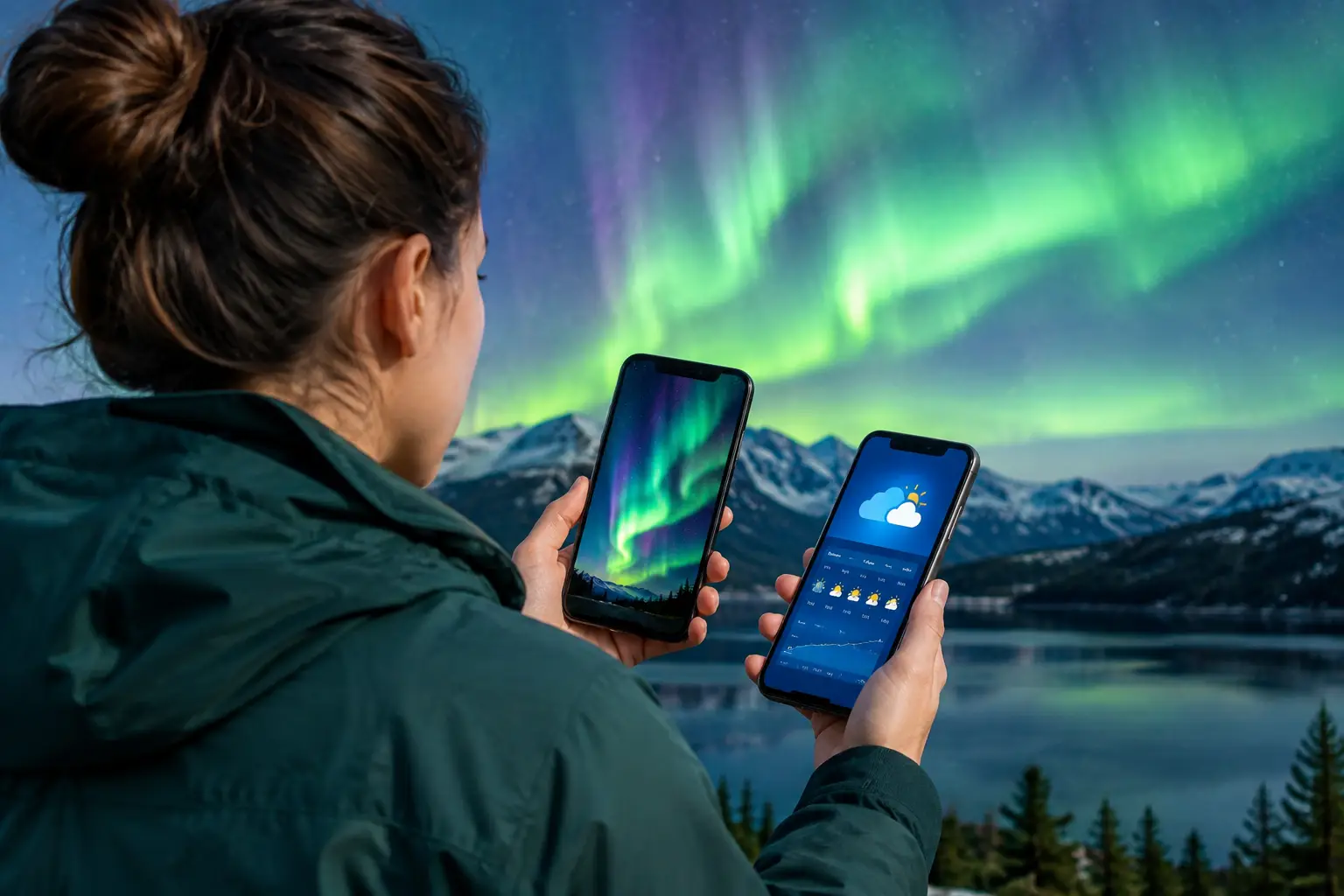
A weather app can tell you whether the sky above your hotel may clear. It cannot tell you whether the solar wind is delivering the energy needed to create aurora. That is the central difference in aurora alerts versus weather apps, and it matters when you have one cold, dark night in Iceland, Norway, Alaska, or Northern Canada to make your attempt count.
Many travelers check the forecast, see a cloud-free icon, and assume the Northern Lights are likely. Others see a high KP Index and drive for hours without looking at cloud cover. Both approaches use only half the picture. Seeing aurora requires activity in space and visibility on the ground. Miss either one, and even a promising night can become a long wait under an empty sky.
Aurora Alerts Versus Weather Apps: Different Jobs
A standard weather app is built to answer practical local questions. Will it rain? How strong will the wind be? What will the temperature feel like? Is cloud cover increasing after midnight? Those are useful questions for an aurora trip, especially if you are driving between viewing areas or deciding how many layers to wear.
An aurora alert is designed for a different decision: is there a realistic chance of visible Northern Lights from your location, and when should you pay attention? A useful alert combines space-weather conditions with local observing conditions. It should not treat the aurora as a simple weather event, because it is not one.
The lights begin far beyond the forecast map on your phone. Charged particles from the Sun interact with Earth’s magnetic field and upper atmosphere. Whether that interaction produces visible aurora at your latitude depends on several moving measurements, including solar wind speed, density, the direction of the interplanetary magnetic field, and geomagnetic activity. Then clouds, daylight, moonlight, terrain, and local light pollution determine whether you can actually see it.
Weather apps are excellent at their own job. They are simply not designed to interpret this full chain of events.
What a Weather App Gets Right
Do not delete your weather app before an aurora trip. It remains essential for safe, comfortable travel. In Arctic and subarctic destinations, conditions can change quickly. Wind can make a modest temperature feel far colder, roads can become hazardous, and a clear inland valley may be a better choice than a cloudy coast.
For aurora viewing, the most valuable weather information is cloud cover by hour, not a broad daily icon. A forecast that says “partly cloudy” can mean wide open gaps, a thin veil of cloud, or a fully overcast sky for most of the evening. Look for the timing and movement of cloud bands, particularly when planning a drive or choosing between two regions.
Weather also affects the quality of the experience even when the sky is clear. Strong winds can make tripod photography difficult. Snow, fog, and blowing ice crystals can obscure the horizon. A bright moon does not stop the aurora, but it can reduce contrast, especially for faint displays and wide landscape photos.
These details help you choose where to go and what to bring. They do not tell you whether an aurora display is likely to develop.
What an Aurora Alert Adds
Aurora alerts monitor the conditions that weather apps generally do not include. The most useful systems look beyond a single KP number and assess several real-time inputs together.
Solar wind is one of the key ingredients. Faster solar wind can transfer more energy into Earth’s magnetic environment, but speed alone is not a guarantee. Density and pressure can also matter, particularly when conditions shift suddenly. A quiet-looking evening can improve rapidly when a change in the solar wind reaches Earth.
IMF Bz is another measurement worth understanding. It describes the north-south direction of part of the magnetic field carried by the solar wind. When Bz turns southward, it can connect more effectively with Earth’s magnetic field and support auroral activity. A sustained negative Bz is often more encouraging than a single momentary dip, but it still needs to be considered alongside the wider data.
The KP Index measures global geomagnetic disturbance on a scale from 0 to 9. It is useful context, particularly for estimating how far south aurora may be visible. But it is not a live visibility promise and should never be the only number guiding your evening. KP is reported in intervals, represents a broad planetary index, and cannot tell you whether clouds are covering your exact viewing location.
A strong aurora alert turns these inputs into a practical signal: conditions are improving, activity may be visible soon, or the current window is worth watching. That is more actionable than making travelers interpret separate scientific charts in a parking lot at 11 p.m.
Why the KP Index Alone Can Mislead Travelers
The KP Index has become shorthand for Northern Lights forecasting, which is understandable. It is easy to recognize, and a larger number feels like a clearer answer. Yet travelers often give it more authority than it deserves.
At high aurora latitudes, such as northern Iceland, Tromso, Finnish Lapland, and much of Alaska, visible aurora can appear during relatively modest KP conditions if the local sky is dark and clear. A KP 2 or 3 can provide a memorable display when solar wind and Bz are favorable. Waiting only for KP 6 may cause you to miss several good nights.
The opposite is also true. A high KP reading does not remove cloud cover, create darkness during summer twilight, or guarantee that activity will remain elevated when you reach your viewing spot. If the sky is overcast, a high KP is mostly an interesting statistic.
Think of KP as one piece of the space-weather picture, not the finish line. The best decision comes from combining it with live solar-wind data, Bz, local clouds, and the time remaining before dawn.
The Real Test: Can You See It From Where You Are?
Aurora forecasting becomes useful when it answers a local question. You are not trying to predict the entire Northern Hemisphere. You need to know whether it is worth leaving a warm cabin, joining a tour pickup, or continuing down a dark road to a clearer area.
Start with darkness. In peak summer, even strong geomagnetic activity may be invisible because the sky never becomes dark enough. During the main viewing season, check the local evening window rather than assuming the lights will appear at a fixed time. Aurora can arrive early, surge after midnight, fade, and return without following a schedule.
Next, check cloud cover close to your actual location. In Iceland, conditions can differ dramatically across a short drive. In northern Norway, coastal cloud and inland clear skies can create very different opportunities on the same night. A tour guide may have local experience with these microclimates, while independent travelers need enough fuel, warm clothing, safe road conditions, and a realistic turnaround plan.
Finally, assess activity. If the sky is clear but the Live Aurora Score is low, you may choose a shorter watch rather than an all-night expedition. If cloud gaps are expected and solar conditions are improving, that is the moment to stay ready.
When a Weather App Is Enough - and When It Is Not
A weather app may be enough when your priority is travel safety or general outdoor planning. If heavy snow, dangerous winds, or low visibility make driving unwise, no aurora forecast should persuade you to take unnecessary risks. Stay put, watch from a safe nearby location if conditions allow, and try again.
It is also enough for deciding between clearly different skies. If one area is fully overcast all night and another is forecast to be clear, the clearer destination is usually the better starting point. But when both locations have possible breaks, or when you need to decide whether a late-night alarm is worthwhile, an aurora-specific forecast becomes far more valuable.
This is where AuroraVision is built to help. Its free app combines a Live Aurora Score with real-time solar wind, IMF Bz, KP Index, cloud cover, moon phase, and weather, then turns that mixed data into a clearer viewing decision. Instead of switching among separate charts, you can check the best time tonight and activate smart alerts when changing conditions deserve your attention.
A Better Nightly Routine for Aurora Chasing
Treat the forecast as an active plan, not a one-time check made at breakfast. Begin in the afternoon by reviewing darkness, cloud cover, road conditions, and the likely viewing area. If you have booked a Northern Lights tour, confirm pickup details and dress for standing outside longer than expected. If you are driving, choose a legal, safe stop before darkness arrives.
As evening approaches, check whether space-weather conditions are stable, improving, or fading. A favorable trend in solar wind and Bz can matter more than a static KP value. Keep expectations realistic: forecasts identify opportunities, not guaranteed performances.
Once you are outside, give your eyes time to adjust and scan the northern horizon as well as the full sky. Early aurora can look like a faint gray-green band or a soft cloud to the naked eye. Your camera may reveal more color, but do not spend the entire night looking at a screen. Watch for motion, structure, and a gradual brightening.
If clouds close in, do not assume the night is over. Check whether a gap is moving toward you, whether a nearby area is clearer, and whether activity remains favorable. Conversely, if the sky is perfectly clear but live aurora conditions are weak, enjoy the stars, stay warm, and avoid burning energy on an endless wait.
The Northern Lights reward prepared travelers, not travelers who gamble on one metric. Keep weather in your plan for safety and sky visibility, use real-time aurora data for timing, and be ready when both align. The best alert is the one that gets you outside at the right moment - with a clear horizon, warm hands, and enough patience to look up.