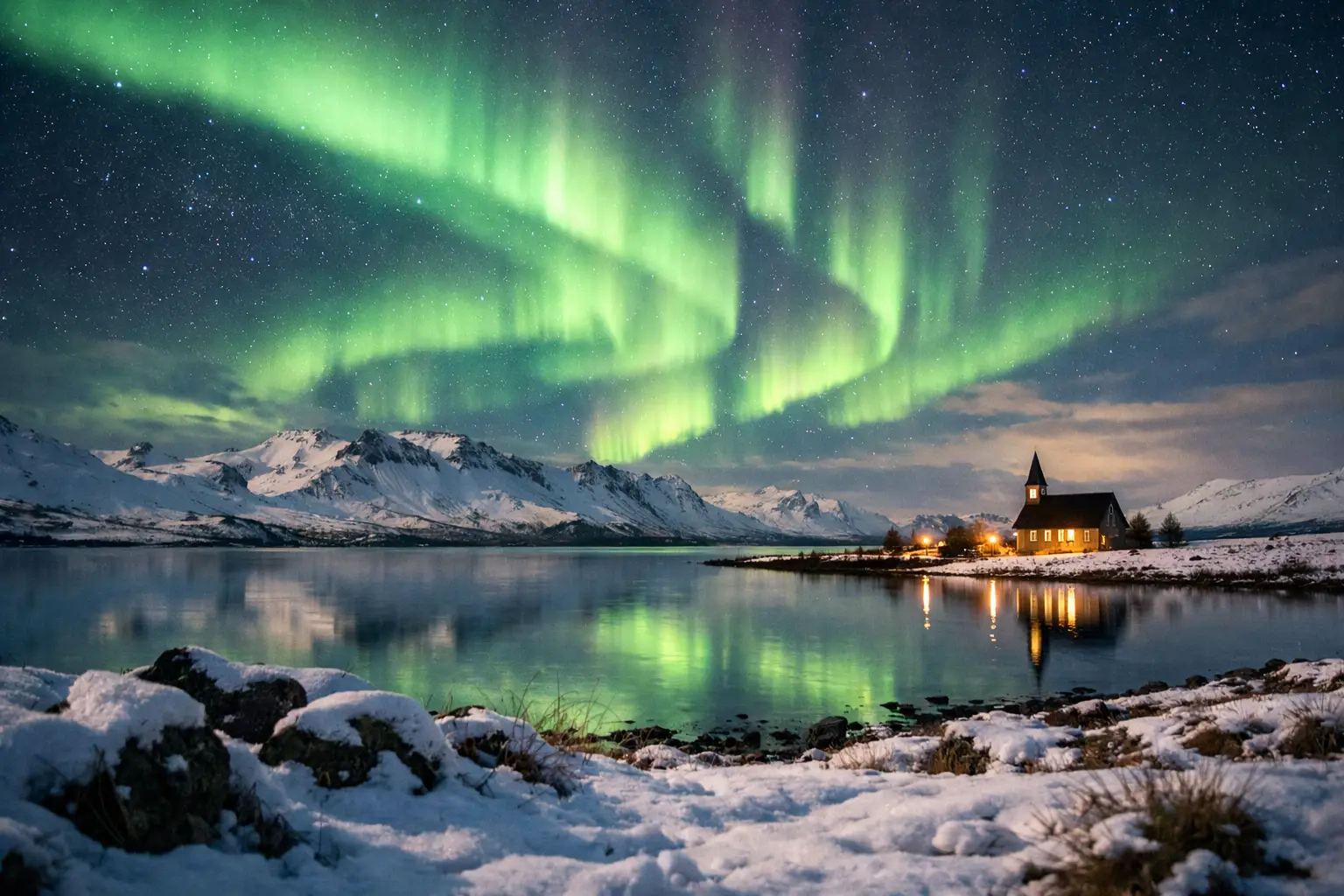
A clear night near Reykjavík can look completely ordinary at 9:30 p.m., then turn extraordinary before midnight. For travelers chasing the aurora borealis Iceland is one of the world’s most accessible destinations, but accessibility is not the same as certainty. The northern lights depend on a narrow overlap of darkness, clear sky, solar activity, and a viewing location away from city glow.
That overlap is why a low KP forecast does not automatically mean stay in your hotel, and a dramatic geomagnetic storm alert does not automatically mean you will see anything. The practical question is simpler: will the aurora be visible from where you are tonight, during the hours you can realistically go out?
What Makes the Aurora Visible in Iceland?
The aurora begins far above Iceland, where charged particles from the sun interact with Earth’s magnetic field and upper atmosphere. Solar-wind speed, particle density, and the direction of the interplanetary magnetic field all influence the display. A southward Bz is generally favorable because it allows more solar energy into Earth’s magnetic environment. When Bz stays northward, aurora activity can be suppressed even if other solar measurements appear promising.
But Iceland travelers cannot view solar wind. You view the sky. That means cloud cover and darkness carry equal weight with space weather. A moderate aurora beneath clear skies can be far more memorable than a powerful storm hidden behind solid cloud.
KP is useful as a broad measure of geomagnetic activity, especially when deciding how far from Reykjavík you may need to travel. Still, it is not a local visibility forecast. A KP 2 or KP 3 can produce a beautiful display from a dark, clear location in Iceland. A KP 5 can be a complete miss if clouds cover your area. Treat KP as one signal, not the verdict.
When to See the Aurora Borealis in Iceland
The aurora season generally runs from late August through mid-April, when Iceland has enough nighttime darkness. The deepest winter months provide the longest dark window, but they also bring more challenging weather, icy roads, and frequent cloud systems. September, October, March, and early April often offer a useful balance: meaningful darkness, less severe driving conditions, and more flexible sightseeing days.
Astronomical darkness matters most. Twilight can wash out faint aurora, particularly near Reykjavík, so the best viewing period often begins well after evening dinner and can continue into the early morning hours. There is no universal best time. Solar conditions can strengthen quickly, and a cloud break at 1:00 a.m. may be more valuable than a perfectly clear sky at 9:00 p.m. with no auroral activity.
This is where live monitoring changes the experience. Check the current visibility outlook before committing to a long drive, then check again during the evening. AuroraVision translates solar conditions, cloud movement, moonlight, local darkness, and light pollution into a practical score designed to answer whether leaving now makes sense.
Moonlight: Helpful for Landscapes, Harder on Faint Aurora
A bright moon does not stop the northern lights. Strong aurora can remain visible throughout a full-moon night, and photographers may welcome moonlight on mountains, snow, waterfalls, or black-sand beaches. The trade-off is contrast. Faint green bands and subtle red detail are harder to see against a bright sky, especially close to town.
If the moon is bright, prioritize stronger aurora forecasts, darker locations, and clear skies. If the moon is low or absent, even a quieter display can look more distinct to the eye.
Where to Go From Reykjavík
You do not always need to drive for hours. On a clear, active night, the lights can be visible from the capital region, particularly along darker waterfronts or on the outskirts. Yet city light pollution reduces contrast, and nearby cloud can make conditions look better on a map than they feel outside.
For independent travelers, the best location is usually not a famous landmark. It is the nearest safe place beneath clear sky with an open northern horizon and minimal artificial light. That may mean heading away from the city toward Þingvellir, Reykjanes, Hvalfjörður, or the south coast, depending entirely on the cloud forecast. Iceland’s weather systems move quickly, so a 30- to 60-minute drive can make the difference between overcast and clear.
Do not choose a route solely because it is labeled a northern lights spot. Remote roads add risk in winter, and stopping on a narrow road or shoulder is unsafe. Use established parking areas, keep well clear of traffic, and never stand in the roadway for a photo. If conditions are poor where you are, the right move may be to wait for a cloud break rather than chase a distant patch of clear sky across difficult roads.
North Iceland Has Different Advantages
Akureyri and surrounding areas can offer darker skies and less urban glow than Reykjavík, while still providing convenient services. The same rule applies: a favorable sky is local. A clear forecast near Lake Mývatn may be worth the effort, while a cloudy forecast makes even a high KP irrelevant. In the Westfjords and Eastfjords, dramatic landscapes can elevate the experience, but winter access and weather can be considerably more demanding.
Should You Book a Tour or Drive Yourself?
A guided northern lights tour is the easier choice for visitors who do not want to assess road conditions, study cloud maps, or make a late-night route decision. Experienced guides can reposition based on weather and typically know safe pullouts that are not obvious to first-time visitors. Tours are especially sensible for short stays, winter arrivals, solo travelers, and anyone uncomfortable driving in wind, snow, or darkness.
Driving yourself gives you flexibility. You can wait for a late alert, stay as long as the display lasts, and choose a quieter location. It also puts the operational responsibility on you. Check official road and weather conditions before leaving, fuel the vehicle, bring warm layers, and have a backup plan if visibility deteriorates.
Do not book or drive based on a single afternoon forecast. Conditions can improve sharply after sunset. Likewise, do not assume a scheduled tour guarantees aurora. Good operators can improve your odds by finding clearer skies, but no one can control cloud cover or solar activity.
What the Aurora Actually Looks Like
The first visible sign is often not a dramatic curtain. It may look like a pale gray-green arc, a soft cloud that does not move like cloud, or a faint glow low in the northern sky. Give your eyes time to adapt. Avoid staring at a bright phone screen, and use a red or dimmed display if you need to check updates.
When activity strengthens, the arc can brighten into green ribbons, folds, rays, and fast-moving curtains. During stronger events, you may see color overhead or toward the south as well. Cameras often reveal green, purple, and red more intensely than the human eye, so do not judge the experience against heavily edited social media images. A quiet, moving band above a dark Icelandic landscape can be astonishing without filling the entire sky.
Bring the Right Gear for a Long Night Outside
Aurora viewing is mostly waiting in cold conditions. Dress for standing still rather than walking: insulated boots, warm socks, a windproof outer layer, gloves, hat, and an extra midlayer matter more than fashionable outerwear. Bring a warm drink, a fully charged phone, and a power bank. Cold drains batteries quickly.
For photography, start with a tripod, a wide-angle lens, manual focus set carefully on a distant light or star, and a remote shutter or timer. Use a relatively wide aperture, then adjust shutter speed and ISO to the brightness and movement of the aurora. Long exposures can capture faint light, but they can also blur fast-moving curtains. Check your results often and reduce exposure as the display intensifies.
Most of all, protect the moment from unnecessary pressure. Check live conditions, make a safe and informed call, then give the sky enough time to change. The best aurora night in Iceland is rarely the one with the biggest number on a chart. It is the night you are outside, under clear skies, when the lights decide to move.