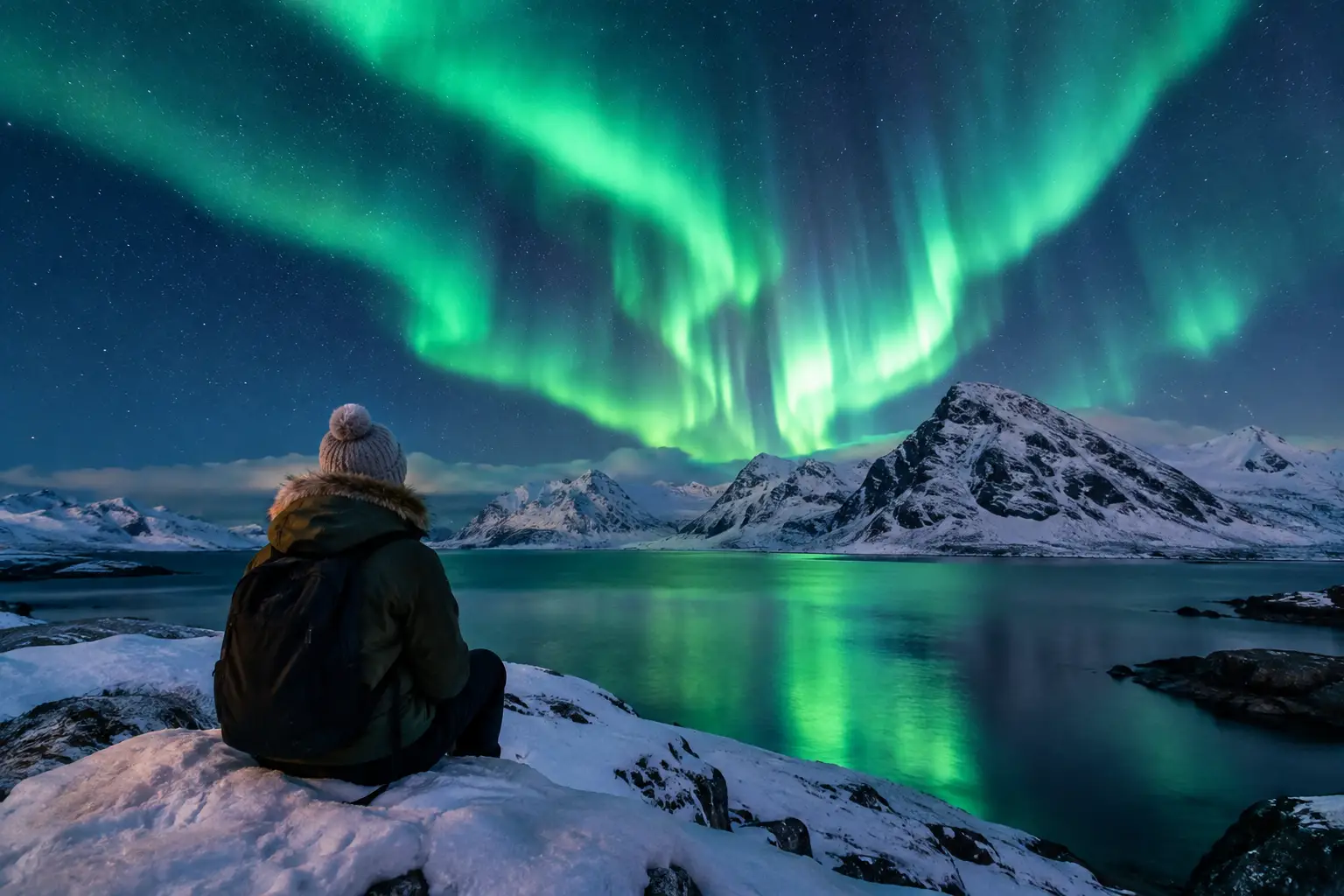
A trip planned around the aurora forecast 2026 should begin with one honest expectation: no annual forecast can tell you whether the sky above your hotel will light up on a particular night. It can, however, help you choose the right season, latitude, itinerary, and backup plan - then put you in position to act when the real conditions turn favorable.
For Northern Lights travelers, 2026 may still offer excellent opportunities across Iceland, northern Norway, Finnish Lapland, Alaska, Greenland, and Northern Canada. The key is not chasing a single dramatic number months in advance. It is planning for darkness and location first, then using live space-weather and cloud data when the trip begins.
Aurora Forecast 2026: What the Solar Cycle Means
Aurora activity is driven by the Sun, which follows an approximately 11-year cycle of changing magnetic activity. Solar Cycle 25 reached its most active period around 2024 and 2025. By 2026, activity may gradually trend downward, but that does not mean the Northern Lights disappear or become ordinary.
Solar cycles do not decline in a straight line. Active regions, solar flares, coronal mass ejections, and fast solar-wind streams can still create strong geomagnetic activity well after solar maximum. A single well-timed disturbance can produce a memorable display, especially in destinations beneath the auroral oval.
That distinction matters. A yearly outlook describes the general space-weather environment, not a nightly viewing guarantee. A quieter year can still deliver excellent aurora, while a major solar event is useless to a traveler standing under thick cloud cover at noon.
For 2026 travel planning, think in layers. First, choose a place with enough darkness and a realistic chance of clear skies. Next, allow several nights rather than booking one fixed evening. Finally, watch live conditions once you are on location.
The Best 2026 Travel Windows Depend on Daylight
At high latitudes, darkness sets the practical boundaries of aurora season. Iceland, Norway, Sweden, Finland, and much of Alaska generally offer usable dark skies from late August through early April. Farther north, places such as Svalbard and parts of Greenland have more extreme seasonal light patterns, which can be rewarding but require more deliberate planning.
September and October are strong choices for travelers who want milder road conditions, open landscapes, and a mix of evening darkness with daytime sightseeing. March often appeals to photographers and road trippers because the nights are still dark while daylight returns more generously. Midwinter provides the longest nights, though weather, driving conditions, and cold require more preparation.
The spring and fall equinox periods are frequently watched by aurora observers because Earth’s magnetic orientation can sometimes favor solar-wind coupling. This is a statistical tendency, not a promise. Do not plan an entire trip around the idea that an equinox automatically produces a major show. Plan around multiple nights and remain ready for the best forecast window.
Why KP Alone Cannot Forecast Your Night
KP is useful as a broad measure of global geomagnetic disturbance, but it is not a complete answer to “Will you see aurora tonight?” A moderate KP level can be enough for a bright display in Tromso, Abisko, Fairbanks, or northern Iceland, where travelers are already near the auroral oval. Conversely, a high KP reading cannot overcome dense cloud or daylight.
The most useful live forecast combines several signals. Solar wind shows whether charged particles are arriving from the Sun and how quickly they are moving. IMF Bz describes the orientation of the interplanetary magnetic field. When Bz turns southward, it can connect more effectively with Earth’s magnetic field and improve the odds of energy entering the magnetosphere.
Those space-weather ingredients still need a local viewing check. Cloud cover determines whether you can see the sky. Weather affects safety, driving, and comfort. Moon phase changes how bright the sky appears, particularly for faint aurora and photography. Your latitude, light pollution, horizon, and even the time of night all shape what you will actually experience.
This is why AuroraVision uses a Live Aurora Score alongside solar wind, IMF Bz, KP, cloud cover, moon phase, weather, and best-time indicators. Check the free app after arrival, enable alerts, and treat a favorable alert as a reason to get outside or move toward clearer skies - not as a reason to wait by the window.
Build a Trip That Can Respond to Conditions
The travelers who see the most aurora are rarely the ones who booked the most expensive single-night experience. They are the ones who protect their flexibility. Give yourself three to five nights if possible, particularly in cloud-prone coastal regions. If your itinerary has only one night, a guided tour can be a practical choice because local guides may know which roads, valleys, or coastlines are more likely to offer a break in the clouds.
Independent travelers should consider the trade-off between mobility and stress. A rental car can make it easier to leave city lights or follow clearer weather, but winter driving in Iceland, Norway, Alaska, and Northern Canada demands confidence, proper insurance, and a willingness to turn back when conditions deteriorate. A remote hotel with a dark horizon can be ideal, but only if it is accessible and you can stay long enough for weather to change.
For 2026, prioritize an itinerary with a base near dark skies, dependable accommodations, and a few alternate viewing areas. A hotel outside a city center may save you from a long late-night drive. On the other hand, a town base with several roads leading in different directions can be better when cloud patterns are unpredictable. There is no universal winner - it depends on season, driving ability, and how much flexibility your group has.
What to Watch on the Day of Your Aurora Hunt
A forecast becomes most valuable in the final hours before viewing. Check conditions in the afternoon, again after dinner, and whenever an alert signals a meaningful change. Strong activity can develop quickly, fade quickly, or arrive later than expected.
Use this short operational check before you head out:
- Confirm that darkness has fully arrived at your location.
- Compare local cloud cover with nearby alternatives, not just the forecast above your hotel.
- Look for supportive solar-wind conditions and a sustained southward or fluctuating negative Bz.
- Choose a safe, dark viewing site with a clear northern horizon where appropriate.
- Dress for standing still longer than you expect, and bring a charged phone, headlamp, and warm layers.
Do not abandon a promising night too early. Aurora often appears as a faint arc or low gray-green band before becoming more active. Your camera may record color before your eyes see vivid green, especially during weaker displays. Give your eyes time to adjust, avoid white-light screens, and scan more than one part of the sky.
A Better Way to Set Expectations for 2026
The best aurora forecast is not a headline about a “once-in-a-lifetime” solar event. It is a practical decision system: travel during dark season, stay multiple nights, understand your latitude, and respond to live space weather and local clouds.
2026 can be an excellent year to travel for the Northern Lights, including for first-time visitors. The Sun may not behave on a calendar, but a flexible plan gives you something nearly as valuable as a prediction: the ability to move when the sky is ready. Keep your evening open, check the live conditions, and do not miss the moment.