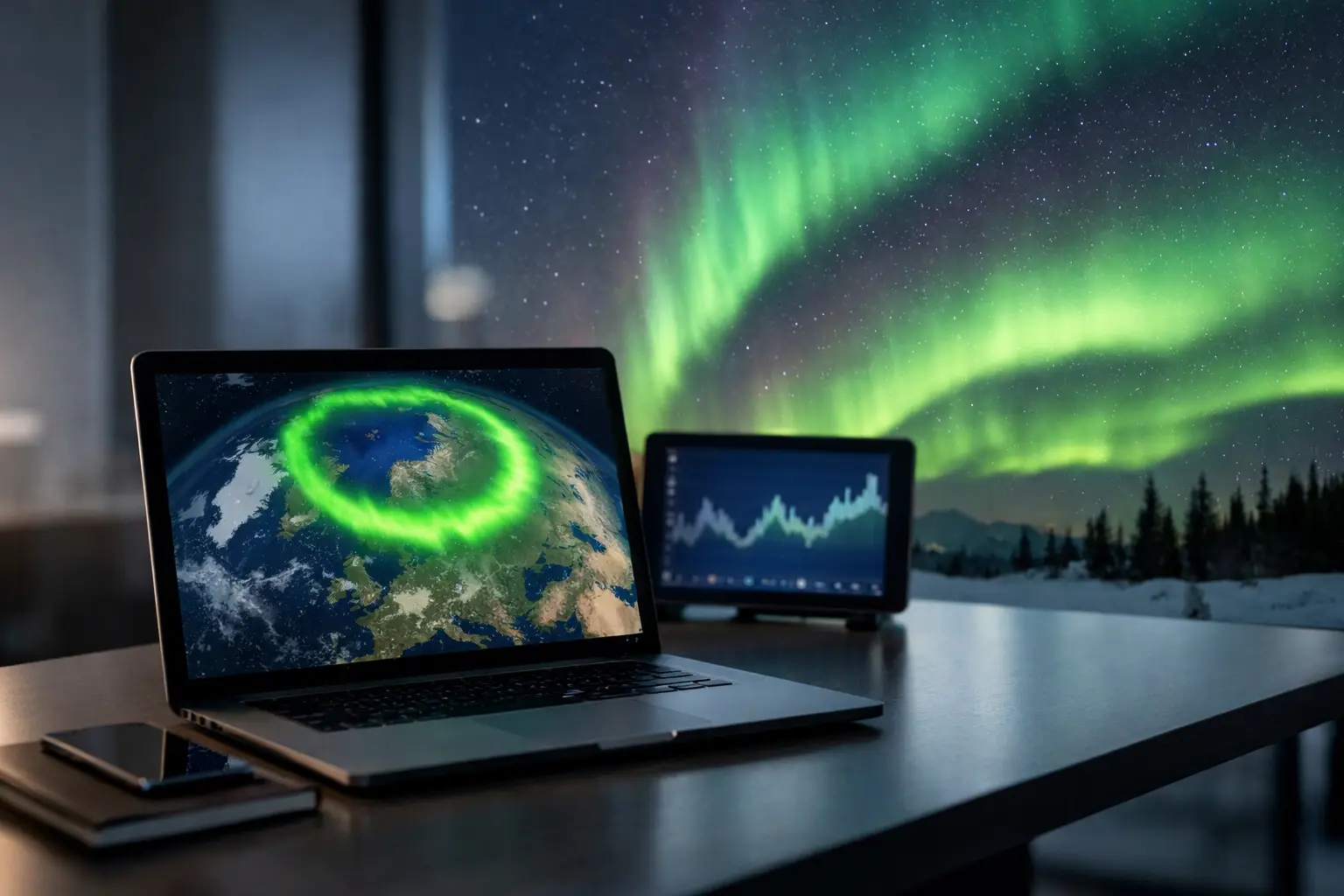
A forecast can say KP 5, yet the sky above your hotel may stay dark. On another night, a modest KP 2 can produce a clear, visible arc over Iceland or northern Norway. That is the reality behind aurora forecast accuracy: no single number can tell you exactly what you will see from one specific place at one specific time.
The Northern Lights are driven by activity on the Sun, but seeing them is a local travel decision. You need favorable space weather, darkness, a reasonably clear sky, and a view away from obstructing terrain and city lights. A useful forecast brings those moving parts together and tells you when it is worth putting on your boots, warming up the car, or joining a tour.
Why Aurora Forecast Accuracy Has Limits
Aurora forecasts are not guesses, but they are probabilistic. Space weather forecasters measure solar activity and track charged particles traveling from the Sun toward Earth. The challenge is that the solar wind is variable. Its speed, density, and magnetic orientation can change between measurements, and those changes affect how strongly Earth’s magnetic field responds.
Long-range forecasts are therefore best used for planning, not promises. If an elevated geomagnetic event is expected in three days, it may be a good reason to keep your evening flexible or reserve a tour with a clear cancellation policy. It cannot reliably tell you that the lights will appear at 10:15 p.m. above a particular fjord.
Forecast confidence improves as the event gets closer. Conditions measured upstream of Earth usually give a short window of warning, often around 30 to 60 minutes before the solar wind reaches our planet. That is when live data becomes far more valuable than a daily KP prediction.
Cloud cover creates a separate limit. Even perfect aurora conditions are useless from the ground when low, thick clouds cover the sky. Cloud forecasts also have their own uncertainty, especially in coastal and mountainous regions where conditions can shift quickly. Iceland is a classic example: one peninsula may be overcast while another has a clear northern horizon.
KP Index Is Useful, but It Is Not the Whole Forecast
The KP Index measures global geomagnetic disturbance on a scale from 0 to 9. It is useful for understanding how far south the auroral oval may expand and whether a wider area has a chance of seeing activity. For travelers in Alaska, northern Canada, or the high Arctic, an active display can occur at low KP. For people farther south, a higher KP may be necessary.
But KP has two major practical weaknesses. First, it is a broad, planet-scale index rather than a real-time local visibility score. Second, a forecast KP is often based on expected conditions, not the exact solar wind currently arriving at Earth.
Treat KP as context. It can help you understand the scale of an event, but it should not decide whether you leave your room tonight. A low KP does not mean “no aurora” in Tromso, Abisko, Fairbanks, or northern Iceland. Equally, a high KP does not cut through cloud cover or guarantee a dramatic overhead display.
The Data That Makes a Forecast More Useful
The most accurate practical aurora forecast combines several measurements rather than relying on one headline number. These are the signals worth watching when you are deciding whether to go out.
Solar wind speed and density
Solar wind is a stream of charged particles flowing outward from the Sun. Faster wind can deliver more energy to Earth’s magnetic environment, particularly when other conditions line up. Density matters too. A sudden increase in particle density can help trigger brighter or more active displays, sometimes for a short-lived period.
High solar wind speed is encouraging, not decisive. It becomes more meaningful when paired with a favorable magnetic field orientation.
IMF Bz
IMF Bz describes the north-south direction of the magnetic field carried by the solar wind. When Bz turns southward, it can connect more effectively with Earth’s magnetic field and transfer energy into the system that creates aurora.
In plain English, sustained negative Bz is often a positive sign for aurora watchers. A brief dip below zero may produce little change. A strongly negative Bz that holds for an extended period, combined with good solar wind, is a much better signal that the aurora may intensify.
This is one reason the sky can change so quickly. Bz can shift from favorable to unfavorable within minutes, and the aurora can respond just as abruptly.
Local cloud cover and weather
Space weather determines whether the aurora is active. Local weather determines whether you can see it. Check cloud layers, not only a single cloud percentage. Low clouds can block the entire display, while broken high cloud may still leave enough sky for a visible aurora or a successful photograph.
Wind, precipitation, road conditions, and temperature also matter when you are traveling independently. A clear opening is not worth chasing if icy roads, severe wind, or poor visibility make the route unsafe. A guided Northern Lights tour can be a smart option when you are unfamiliar with local winter driving or need a team that can adjust its route for clearer skies.
Moon phase and darkness
Moonlight does not stop the aurora. Bright displays can look spectacular under a full moon, and the landscape is often easier to photograph. The trade-off is contrast: faint aurora becomes harder to see against a bright sky, especially near urban light pollution.
A dark, moonless night favors subtle greens and weak arcs. A bright moon can be an advantage for photographers who want a visible foreground, snow texture, or mountain detail. Forecast accuracy means matching conditions to your goal, not calling every full-moon night poor.
How to Read an Aurora Forecast Tonight
Start with location. Are you inside or close to the auroral oval, or are you hoping to see an unusually strong storm from farther south? Your location changes what counts as promising activity.
Next, check the cloud forecast for the actual area you can reach safely. If you are on a road trip, identify two or three nearby viewing directions before sunset. In Iceland, conditions can vary sharply across a short drive. In northern Norway, mountains and fjords can block both weather systems and your northern horizon.
Then look at live solar wind and Bz. Favorable readings do not guarantee a show, but they explain why an alert is worth taking seriously. If activity is moderate, Bz is negative, and the cloud map shows a clear gap, that is often a stronger reason to go out than a high KP number paired with solid cloud.
Finally, allow time. The aurora does not run on a fixed schedule. Give yourself at least 60 to 90 minutes if conditions are promising. Scan the northern sky, but also look overhead and southward during stronger events. A faint arc may look like a pale gray cloud at first, especially to dark-adapted eyes. A camera can reveal green color earlier than your vision, but do not spend the entire night looking at a screen.
What “Accurate” Should Mean for Travelers
A good forecast should answer practical questions: Is there enough activity to justify going out? When is the best window tonight? Is the sky likely to be clear where I am? How quickly could conditions change?
It should not claim certainty where none exists. A forecast that says “excellent chance” during active solar wind and clear skies can still be wrong if Bz turns northward or clouds arrive early. That does not make the science unreliable. It reflects a dynamic system measured across millions of miles of space and experienced through one patch of weather on Earth.
For the best real-time decision, use the free AuroraVision app once you are at your destination. Its Live Aurora Score combines solar wind, IMF Bz, KP, cloud cover, moon phase, and weather into a clearer view of current viewing potential, while smart alerts help you react when the window improves.
Improve Your Odds Without Chasing Perfect Predictions
Build flexibility into your trip. Stay at least three nights in a northern destination when possible, and choose accommodation with a dark outdoor area or easy access to open sky. If you rent a car, plan safe pull-offs and daylight scouting routes rather than making navigation decisions in a snowstorm after midnight.
Photographers should prepare before the alert arrives. Keep batteries warm, set up a tripod, and learn your focus procedure in daylight. Travelers joining a tour should ask how the operator handles cloud cover, route changes, and cancellations. The best choice depends on your confidence driving in winter, your available time, and whether you value local guidance over independence.
The Northern Lights reward preparation more than prediction. Watch the live conditions, respect the weather, and be ready to step outside when the numbers and the sky finally agree.