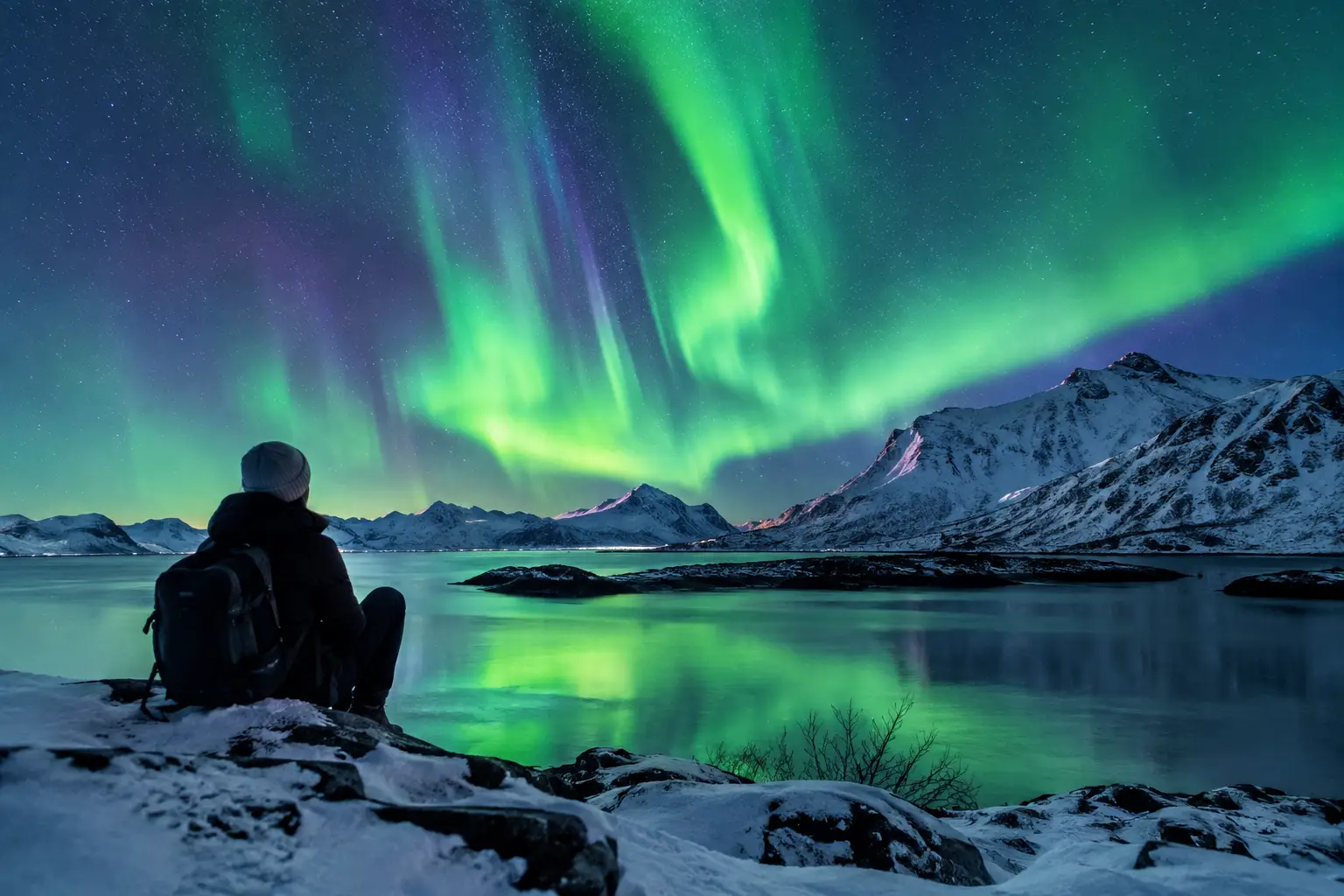
A Northern Lights trip can be booked months ahead, but the aurora itself works on a much shorter clock. Understanding aurora season dates helps you choose a destination and travel window with enough darkness to give you a real opportunity. It does not guarantee a display on a particular night. Clear skies, solar activity, the moon, and your ability to get away from city lights still decide whether you see it.
For most travelers, the right question is not simply, “When is aurora season?” It is: “When will this destination be dark enough, accessible enough, and likely to give me several chances to see the sky?” Those dates change with latitude, local weather patterns, daylight hours, road conditions, and the kind of trip you want.
Aurora Season Dates by Region
The aurora appears year-round in the upper atmosphere. We only call it “aurora season” when the sky becomes dark enough to see it. Near the Arctic Circle, that usually means late August through early April. Farther north, the season can begin earlier in late summer and continue later into spring because nights return sooner and last longer.
In Iceland, Norway, Sweden, Finland, Greenland, Alaska, and Northern Canada, September through March is the core travel season. This is the period when darkness is reliable, visitor services are open, and you can plan a multi-night stay around the possibility of clear skies. August and April can also be excellent, especially for travelers who prefer milder weather, shoulder-season pricing, or more daytime sightseeing.
Svalbard follows a very different calendar. Its long polar night provides extraordinary darkness from roughly November into February, while the midnight sun makes aurora viewing impossible through much of late spring and summer. The Faroe Islands share a broadly similar autumn-to-spring viewing window with Iceland, though rapidly changing cloud and wind conditions deserve extra attention.
Iceland: Late August Through Mid-April
Iceland’s season generally runs from late August to mid-April. September and October offer dark nights without the deepest winter conditions, while February and March often combine long darkness with improving daylight for waterfalls, ice caves, and road trips. December and January deliver the longest nights, but they also bring more demanding winter driving, limited daylight, and weather disruptions.
For a short Iceland trip, avoid building your entire plan around one night. Three nights is a sensible minimum. Five to seven nights gives you more flexibility to wait out cloud cover, move to a clearer region, or join a tour when forecasts suggest the best opportunity is outside Reykjavík.
Northern Norway, Sweden, and Finland
Northern Norway typically has an aurora viewing season from late August to early April. Tromsø, Alta, Senja, and the Lofoten region can all offer strong viewing opportunities, but coastal weather can be variable. Inland areas may have clearer, colder nights, although reaching them may require a rental car, a transfer, or a guided tour.
In Swedish and Finnish Lapland, the season also runs broadly from late August through early April. The forests, frozen lakes, and low light pollution can make these destinations especially appealing for photographers and travelers staying in wilderness cabins. December through March brings classic snow-covered landscapes, while September offers darker evenings alongside fall color and unfrozen roads.
Greenland, Alaska, and Northern Canada
Greenland’s practical season varies substantially by location. Southern towns regain dark nights earlier than high Arctic locations, while winter transportation and accommodation availability can be more limited. Plan around the destination’s local logistics as carefully as the sky.
In Alaska and Northern Canada, late August through early April is a useful planning range. Fairbanks is a popular base because it combines dark winter nights, road access, and a strong history of aurora viewing. Yukon and Northwest Territories destinations can provide very dark skies and dramatic winter scenery, but cold temperatures and remote travel require more preparation.
The Best Months Depend on Your Trip
There is no single best month for every Northern Lights traveler. The best dates depend on whether you value long nights, easier driving, snow activities, lower crowds, or photography conditions.
September and October are strong choices for travelers who want a balance of darkness and easier travel. Nights are long enough for viewing in many Arctic destinations, while roads may be less challenging than midwinter. Open water, autumn landscapes, and relatively moderate temperatures can also make foreground photography more varied. The trade-off is that snow activities may not yet be available, and cloud cover can still end a promising night.
November through January are ideal if your priority is maximum nighttime. In high-latitude destinations, darkness can begin in the afternoon and last well into the morning. This creates more viewing hours, but it does not create more solar activity. You will need warm layers, patience, and a realistic plan for storms, icy roads, and reduced daylight sightseeing.
February and March are often a sweet spot. There is still plenty of darkness, snow landscapes are usually established, and daylight returns enough for full days of touring. These months work well for first-time visitors combining the aurora with dog sledding, skiing, glaciers, or a self-drive itinerary. March can be particularly attractive for photographers because twilight adds color to daytime landscapes without removing nighttime viewing hours.
April is an overlooked option in places where nights remain adequately dark. It can offer more comfortable temperatures and longer days, though the viewing window becomes shorter every week. By late April, many locations south of the Arctic Circle no longer have enough true darkness for reliable viewing.
Why Darkness Is Only the Starting Point
Aurora season dates tell you when a display is possible, not when it will be visible. A bright aurora can occur above thick cloud, while a modest aurora can look memorable from a dark, clear location. This is why travelers should not rely on the KP Index alone.
KP is a broad measure of geomagnetic activity. It can help describe the scale of an event, but it does not tell you whether your local sky is clear, whether the aurora oval is positioned over your destination, or whether incoming solar wind is creating favorable conditions right now. A lower KP can still produce a beautiful show in Iceland, northern Norway, or Lapland when other conditions line up.
For a practical decision, look at several signals together: local cloud cover, weather, darkness, moon phase, solar wind speed and density, and IMF Bz. IMF Bz is a component of the solar magnetic field. When it turns southward, it can connect more favorably with Earth’s magnetic field and increase the chance of auroral activity. It is not a promise, but it is much more useful in context than a single number.
AuroraVision brings these signals together in its Live Aurora Score, including real-time solar wind, IMF Bz, cloud cover, moon phase, weather, and the KP Index. Check it on the afternoon of your viewing night, then check again as conditions change. Smart alerts are especially useful when you are eating dinner, warming up at your hotel, or deciding whether to drive toward clearer skies.
How to Choose Dates That Give You More Chances
The most effective strategy is to book enough nights, not chase a perfect calendar date. Space weather cannot be scheduled months ahead with precision. Weather forecasts also become meaningfully useful only close to your travel date. A flexible itinerary gives you far better odds than arriving for a single “high KP” prediction.
If you are booking a guided Northern Lights tour, schedule it early in your stay when possible. If clouds cancel the outing or the aurora is quiet, you may have time to reschedule. For independent travelers, choose accommodation outside major light pollution where practical, but do not sacrifice safe access and warm shelter just to be remote. A hotel with open northern views and a nearby parking area can be more useful than an isolated viewpoint reached by hazardous roads.
A rental car creates options in Iceland, northern Norway, Alaska, and parts of Lapland, but winter driving is a real trade-off. Check road conditions, wind warnings, fuel range, and your comfort level before heading out. If conditions are difficult, a local guide can be the safer choice. Guides know which valleys, coastlines, and inland areas may sit beneath clearer gaps in the clouds, and they handle the driving while you watch the sky.
Plan for the Best Time Tonight
During aurora season, viewing generally improves once twilight has ended, often between 9 p.m. and 2 a.m. local time. But that is a useful starting range, not a rule. A display may begin shortly after dark, fade for an hour, then return after midnight. Stay flexible, keep warm, and give your eyes time to adjust.
Moonlight matters most when the aurora is faint. A full moon does not erase a strong display, but it brightens the landscape and makes weak detail harder to see. For photography, moonlight can be helpful when you want a lit foreground. For your first viewing experience, clear skies and active auroral conditions matter more than chasing a moonless date.
Pack insulated boots, windproof outer layers, gloves that let you operate a camera or phone, and a warm drink. Set expectations with your travel companions before you go outside: the first sign may look like a pale arc or a gray-green cloud rather than the bright green ribbons seen in edited photos. When the activity increases, movement and color can become unmistakable.
Choose your aurora season dates for the trip you want, then leave room for the night the sky decides to perform. The best plan is the one that lets you check conditions, respond safely, and stay outside long enough not to miss the moment.