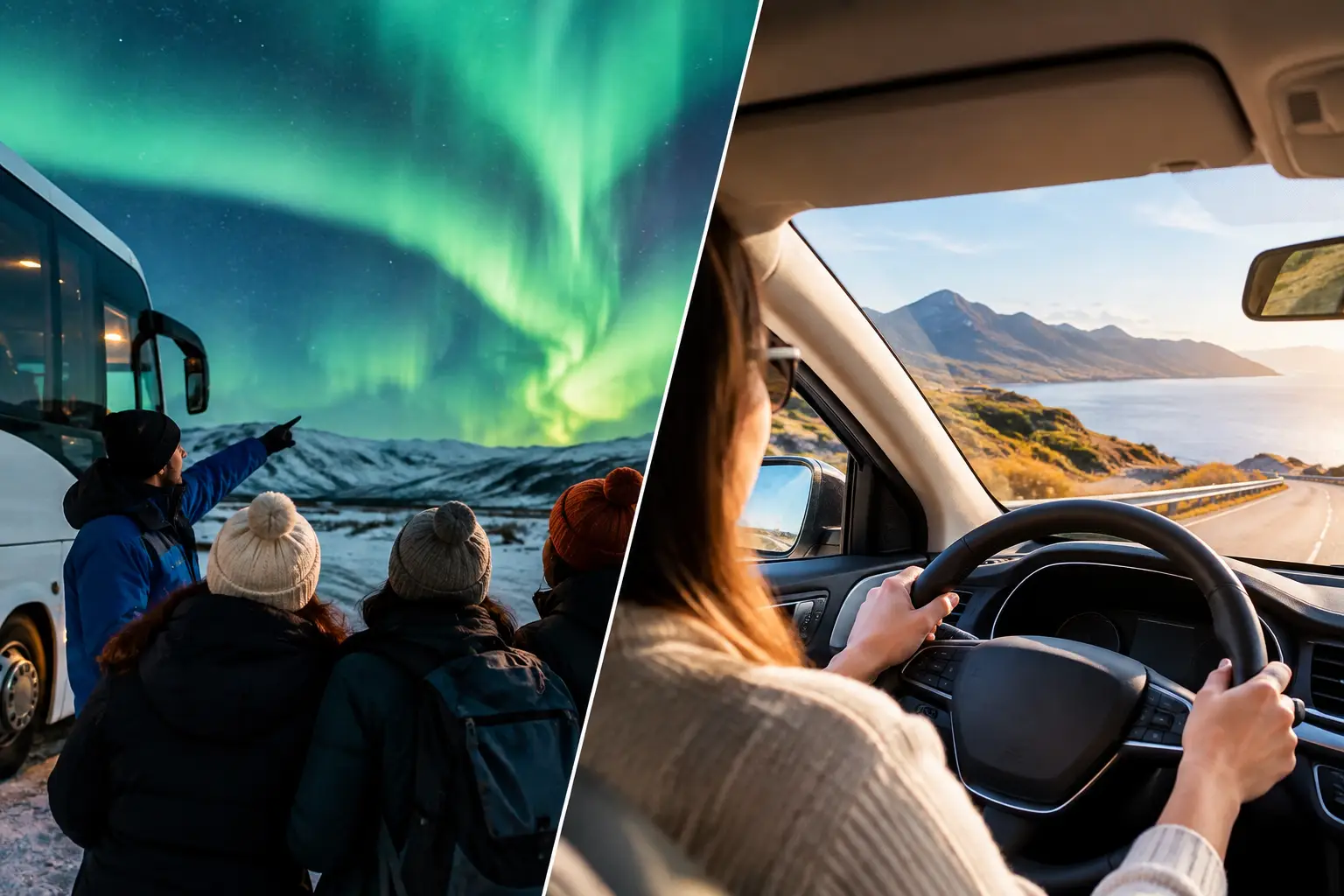
A clear sky can turn an ordinary Arctic night into the best memory of your trip. It can also expose the weak point in every Northern Lights plan: you may have excellent aurora activity overhead, but clouds, wind, icy roads, or poor timing can still keep you from seeing it. When weighing aurora tours versus self driving, the best choice is not about who is more adventurous. It is about how much local knowledge, flexibility, comfort, and weather confidence you have on the night.
A guided tour can remove much of the pressure. A rental car can give you freedom that no fixed itinerary can match. Both can be excellent options in Iceland, Norway, Finnish Lapland, Alaska, and other northern destinations. The right answer depends on the conditions and on what you want your night to feel like.
Aurora tours versus self driving: the real difference
The main difference is who carries the operational work. On an aurora tour, a local guide monitors conditions, chooses a route, drives, assesses road safety, and decides when to move or wait. You are still responsible for warm clothing, patience, and realistic expectations, but you can focus on the sky.
When self driving, you become the planner, forecaster, driver, navigator, and often the person deciding whether the road is safe enough to continue. That can be deeply rewarding. It also means that the evening is affected by your comfort with winter driving, your ability to interpret changing conditions, and your willingness to abandon a promising location when a better opening appears elsewhere.
A common mistake is treating the KP Index as the deciding number. KP describes global geomagnetic activity over a three-hour period. It does not tell you whether a specific valley is clouded over, whether the aurora is strengthening right now, or whether a nearby mountain blocks your horizon. A lower KP night under clear skies can be more successful than a high KP night under solid cloud.
When an aurora tour is the smarter choice
A tour is often the best first-night option, especially if you have just arrived, are traveling without winter-driving experience, or have only one or two chances to see the lights. Good guides do more than take guests to a dark parking area. They read local cloud patterns, know which roads remain practical in high wind, understand where light pollution fades, and recognize when a faint arc is likely to develop.
This local mobility matters most in places with fast-changing weather. Iceland is the classic example. Clouds can break along one coast while snow and wind close in on another, and the best choice may be a two-hour drive from where you started. A guide who works the same region all season may know which direction offers the most realistic opportunity, rather than simply following a generic forecast map.
Tours are also useful if you want help with photography. Many operators can suggest exposure settings, focus techniques, and composition choices. They may provide tripods or warm drinks, though you should confirm what is included before booking. Do not assume a photography tour means individual camera instruction throughout the night. Group size makes a real difference.
The trade-off is control. You share the itinerary with other guests and may spend a long time in a location that is only moderately promising because the group needs a practical place to stop. Departure times are fixed, stops can feel rushed, and the experience can be less private than standing alone beside a quiet fjord or frozen lake.
Before reserving, check four details: whether the operator cancels in unsafe weather, whether a second attempt is offered after a clouded-out night, the maximum group size, and the pickup area. A “guaranteed sighting” usually means a rebooking policy, not a guarantee that nature will perform on schedule.
When self driving is worth it
Self driving is ideal for travelers who already have a vehicle, are staying several nights, and can be flexible. It works particularly well if you are based outside a city, have access to dark roads nearby, and can choose your viewing window rather than commit to a single departure time.
The biggest advantage is that you can act on short-lived conditions. Perhaps clouds clear from 10:30 p.m. to midnight, then return. Perhaps the aurora becomes visible after a tour would have returned to town. Perhaps the strongest activity occurs before dinner. Your car lets you respond to the actual night rather than a preset schedule.
It also changes the rhythm of the experience. You can bring your own snacks, wait comfortably in the car between checks, leave when you are cold, or return to a favorite viewpoint on another night. For photographers, that freedom can be valuable. You can stay with a composition, test foreground ideas, and avoid the headlights and conversation that come with a larger group.
But freedom does not make winter roads forgiving. Darkness reduces depth perception. Wind can push snow across the road faster than you expect. Black ice may be invisible, and rural fuel stations, restrooms, and cell coverage can be limited. In northern Norway, Iceland, Greenland, Alaska, and Northern Canada, a route that looks short on a map can become inappropriate after a weather change.
Choose a vehicle suited to the season and destination. In snowy regions, confirm winter tires and learn how the vehicle handles before heading out after dark. Keep fuel well above empty, charge your phone, carry water and extra warm layers, and tell someone your route. Park only in legal pullouts or established areas. Stopping in a travel lane for a photo is dangerous, even when the sky is extraordinary.
Self driving is not a challenge to prove you can handle. If wind, visibility, or road alerts make the drive questionable, stay put or book a tour on a different night. The aurora will not reward unnecessary risk.
Forecasting for the night you actually have
Whether you book a guide or drive yourself, use live information shortly before you leave. Solar activity can change, but local visibility is just as decisive. Start with the expected cloud cover at your specific location and along the roads you might use. Then look at weather, wind, moon phase, and the likely best time window.
For the aurora itself, solar wind and IMF Bz provide more immediate context than KP alone. Solar wind carries energy from the Sun toward Earth. A southward IMF Bz can help that energy couple with Earth’s magnetic field, increasing the chance of stronger auroral activity. Neither metric promises a show by itself, but together they are more useful than waiting for one index to rise.
The free AuroraVision app brings these moving pieces together through a Live Aurora Score, real-time solar wind, IMF Bz, KP Index, cloud cover, moon phase, weather, and alerts. Check it before departure, then check again if you are waiting under clouds. A changing score may tell you to stay patient, while improving cloud data may justify moving to a clearer area.
Moonlight deserves a practical perspective. A bright moon can reduce contrast and make faint aurora harder to see, especially for the naked eye. It does not prevent strong displays, and it can make snowy landscapes easier to navigate and photograph. The better choice is usually clear skies with some moonlight rather than thick cloud on a moonless night.
Cost, comfort, and the value of a second chance
A tour has a clear per-person cost. Self driving can appear cheaper, but calculate the full picture: vehicle rental, fuel, insurance, parking, extra accommodation outside town, and the time spent planning. For two or more travelers who already need a car for daytime sightseeing, independent aurora hunting may offer strong value. For a solo visitor in a city, a tour can be simpler and sometimes less expensive.
Your number of available nights matters even more than budget. With one night, a skilled guide can improve your odds by handling route decisions quickly. With four or five nights, self driving becomes more appealing because you can wait for the clearest forecast and try more than one location. Travelers with several nights often get the best result from combining approaches: take a guided tour early, learn what local conditions feel like, then make an independent attempt when the forecast supports it.
Comfort is not trivial. An aurora chase may involve hours outside in temperatures far below freezing. If you are traveling with young children, have limited mobility, or simply do not enjoy standing in wind after midnight, choose an operator with suitable transport and manageable group logistics. If you are self driving, pick locations where you can warm up safely in the vehicle without blocking access or trespassing on private land.
Make the decision before sunset
Book a tour if road conditions are uncertain, you are new to winter driving, or your trip offers only a narrow viewing chance. Choose self driving if you have a suitable vehicle, multiple clear-weather opportunities, and the confidence to change plans when conditions change. If your budget allows, use both strategically rather than treating them as competing identities.
The Northern Lights are not a performance that starts at a fixed time for a ticketed audience. They are a live event shaped by space weather, clouds, darkness, and where you are standing. Build a plan that keeps you safe, check the conditions that matter, and be ready when the sky finally opens.