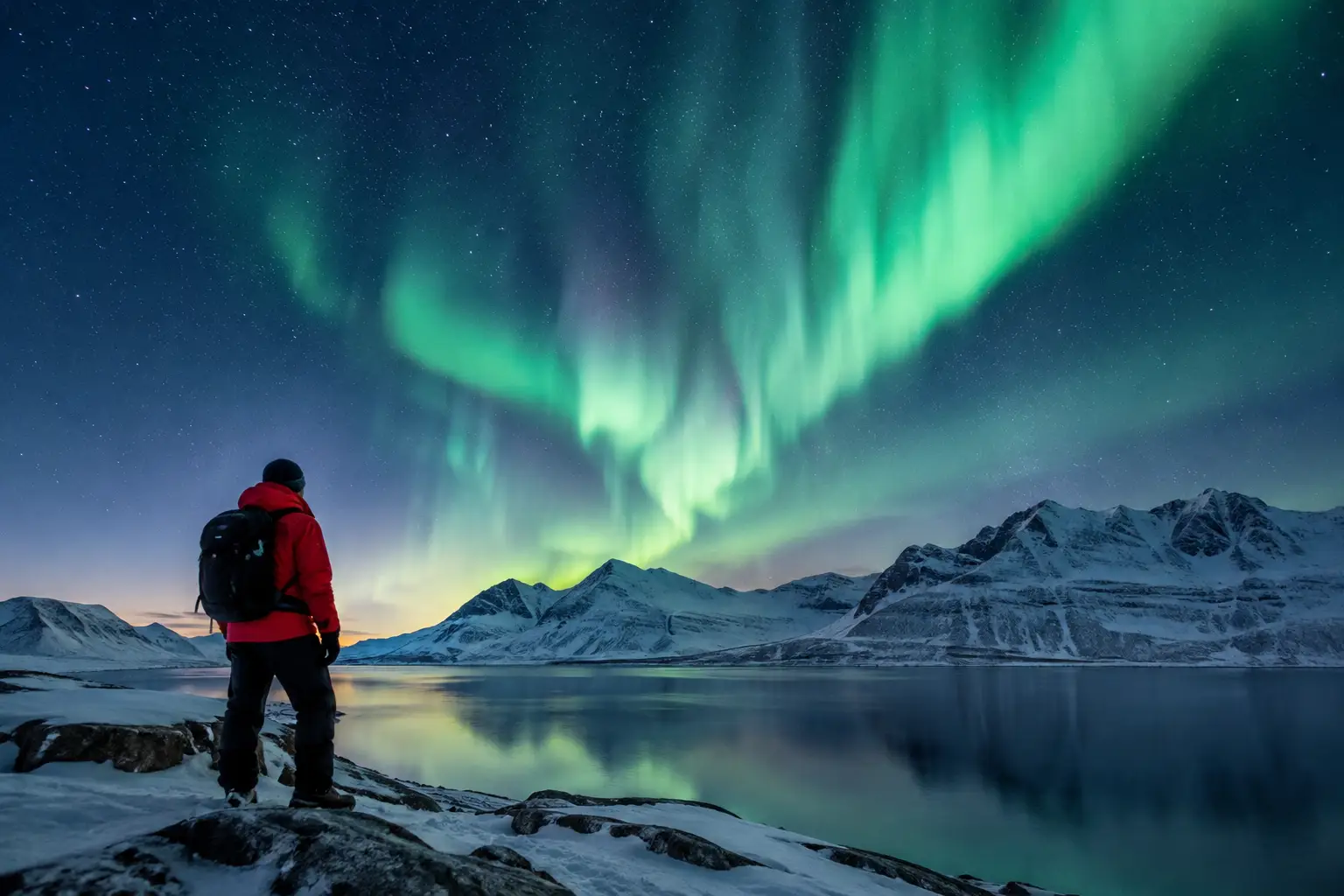
Svalbard does not reward travelers who simply look up at 10 p.m. and hope. The best Svalbard aurora experiences happen when you combine a clear sky, the right season, realistic expectations, and a safe way to leave Longyearbyen’s lights without entering polar bear country unprepared. When it works, the payoff is remarkable: ribbons of green arching over snow-covered mountains, frozen valleys, or the dark water of an Arctic fjord.
This is one of the world’s most unusual aurora destinations. Longyearbyen sits far north, well inside the Arctic, where darkness can last around the clock in midwinter. But darkness alone is not a forecast. Cloud cover, incoming solar activity, moonlight, local terrain, and transportation safety all shape whether your night becomes a memory or a long wait in the cold.
Why Svalbard Feels Different From Other Aurora Destinations
Svalbard’s location gives it a genuine advantage during modest geomagnetic activity. It lies beneath a region where aurora can often be visible even when the global KP Index does not look dramatic. That is useful, but it also explains why KP should not be treated as a simple yes-or-no answer for Svalbard.
The auroral oval shifts and changes shape as solar activity changes. At very high latitudes, a lower KP reading can still produce active displays overhead or toward the south. During stronger activity, the brightest structure may also move farther south of Longyearbyen. The result is that local visibility depends on more than a single number.
For a better decision, watch solar wind speed, density, and IMF Bz alongside the local cloud forecast. A southward IMF Bz can help energy from the solar wind couple with Earth’s magnetic field, increasing the chance of activity. Yet even favorable space weather means little beneath thick cloud. In Svalbard, where weather can change quickly between valleys and coastlines, cloud cover is often the immediate deciding factor.
Polar Night Is an Advantage, Not a Guarantee
The core dark period, commonly called polar night, runs from late autumn into late winter. Around the deepest winter weeks, the sun remains below the horizon, creating exceptionally long viewing windows. You do not need to stay awake until midnight to have a chance. Aurora can appear in the afternoon twilight, early evening, or the middle of the night.
That said, the broader aurora season is longer than polar night. From roughly late August through early April, there can be enough darkness for viewing at some point overnight. Early and late season visits offer more daylight for sightseeing, but the available aurora window is shorter. A January trip maximizes darkness; a March trip gives you a more balanced mix of daylight activities and nighttime chasing. Neither choice is universally better. It depends on whether aurora is your only priority.
Best Svalbard Aurora Experiences by Travel Style
Guided evening aurora tours from Longyearbyen
For most first-time visitors, a guided evening tour is the strongest starting point. Guides understand local road conditions, wind exposure, cloud patterns, and the strict safety realities beyond settlement limits. Outside Longyearbyen, travelers must be prepared for polar bear risk. This is not a place to walk alone toward a darker horizon because it looks promising on a map.
A vehicle-based tour also offers flexibility. If clouds settle over town but a clearer break opens in another accessible area, a guide can adjust the route. Ask how the operator handles weather decisions, group size, warm shelter, photography support, and whether the itinerary prioritizes active chasing or a fixed outdoor camp. A heated base can be comfortable, especially in extreme cold, while a mobile tour generally offers better odds of finding a clear gap.
Dog sledding beneath the northern lights
A dog sledding trip can be the most atmospheric way to see the aurora, especially for travelers who value silence as much as spectacle. Away from town, the soundscape changes completely: runners on snow, dogs breathing, wind moving across open ground. If the sky clears and aurora arrives, it is an experience that feels distinctly Svalbard.
There is a trade-off. These outings are usually planned around animal welfare, trail conditions, and safety rather than a minute-by-minute aurora chase. You may see the lights, or you may have a beautiful Arctic night under stars and cloud. Dress for inactive cold. Sitting on a sled can feel far colder than walking around a viewing site, even with temperatures that do not look extreme on paper.
Snowmobile expeditions for experienced winter travelers
Snowmobiling can open access to wider valleys and remote scenery, making it compelling for travelers who want an expedition rather than an evening transfer. It can pair aurora viewing with dramatic terrain, but it is also the least casual option. Conditions, visibility, wind, avalanche assessments, route permissions, and wildlife safety matter every time you leave town.
Choose a professionally guided trip if you do not already have Arctic winter riding experience. The best trip is not necessarily the longest or fastest. Look for a route designed with meaningful stops, insulated clothing, clear driving instruction, and a responsible weather threshold. Whiteout conditions can erase contrast between snow and sky, making even a familiar landscape difficult to read.
Overnight stays away from town lights
A wilderness lodge or remote cabin stay can make the aurora feel less like an excursion and more like part of the night. The practical attraction is simple: fewer lights, no drive back after a late display, and more time outdoors when conditions improve.
Remote accommodation is best for visitors staying several nights and accepting that logistics may be weather-dependent. It may require a transfer by snowmobile, boat, or specialized vehicle depending on season. Confirm the safety arrangements, meal plan, outdoor access rules, and what happens if travel is delayed. In Svalbard, remoteness is valuable, but it should never come at the expense of a well-run operation.
How to Choose the Best Viewing Night
Treat every night as a short operational decision rather than a promise made weeks in advance. Start with cloud cover over Longyearbyen and the areas your tour can realistically reach. Then look at aurora activity trends, including solar wind and IMF Bz, rather than relying only on KP. Finally, consider the moon. A bright moon can wash out faint aurora and reduce visible stars, but it can also illuminate mountains, snow, and foregrounds for photographs.
The free AuroraVision app helps bring those moving parts into one view with its Live Aurora Score, solar wind, IMF Bz, cloud cover, moon phase, weather, and alerts. Check conditions before committing to a self-guided evening plan, and use alerts to avoid missing a late improvement after a quiet start.
Patience matters in Svalbard because aurora rarely follows a tidy schedule. A weak glow can brighten quickly, develop moving bands, then fade just as fast. Give a promising night at least an hour outdoors if conditions are safe and the sky remains open. Keep your camera, batteries, and warm layers ready before activity begins.
Practical Gear That Makes the Difference
Svalbard cold is not the place to test a lightweight city coat. Build warm layers around a moisture-wicking base, insulating mid-layer, windproof outer shell, insulated boots, thick socks, a warm hat, and mittens that fit over thin liner gloves. Hand warmers are useful, but they do not replace good insulation.
For photography, cold drains batteries quickly. Keep spares inside an inner pocket and use a tripod sturdy enough for wind. A wide-angle lens and manual controls help, but do not spend the entire display staring at a screen. Set up during a quiet period so you can watch the sky when structure and color begin to build.
Most importantly, let your itinerary include several possible aurora nights. One-night stopovers leave too much to cloud and solar variability. Three or four nights provide a far better chance to respond to changing conditions, whether that means joining a tour, waiting through a cloudy evening, or stepping outside when the sky suddenly opens.
Svalbard’s aurora is not a guaranteed performance, and that uncertainty is part of its power. Plan safely, follow the live conditions, and leave room in the evening for the moment the Arctic sky decides to move.