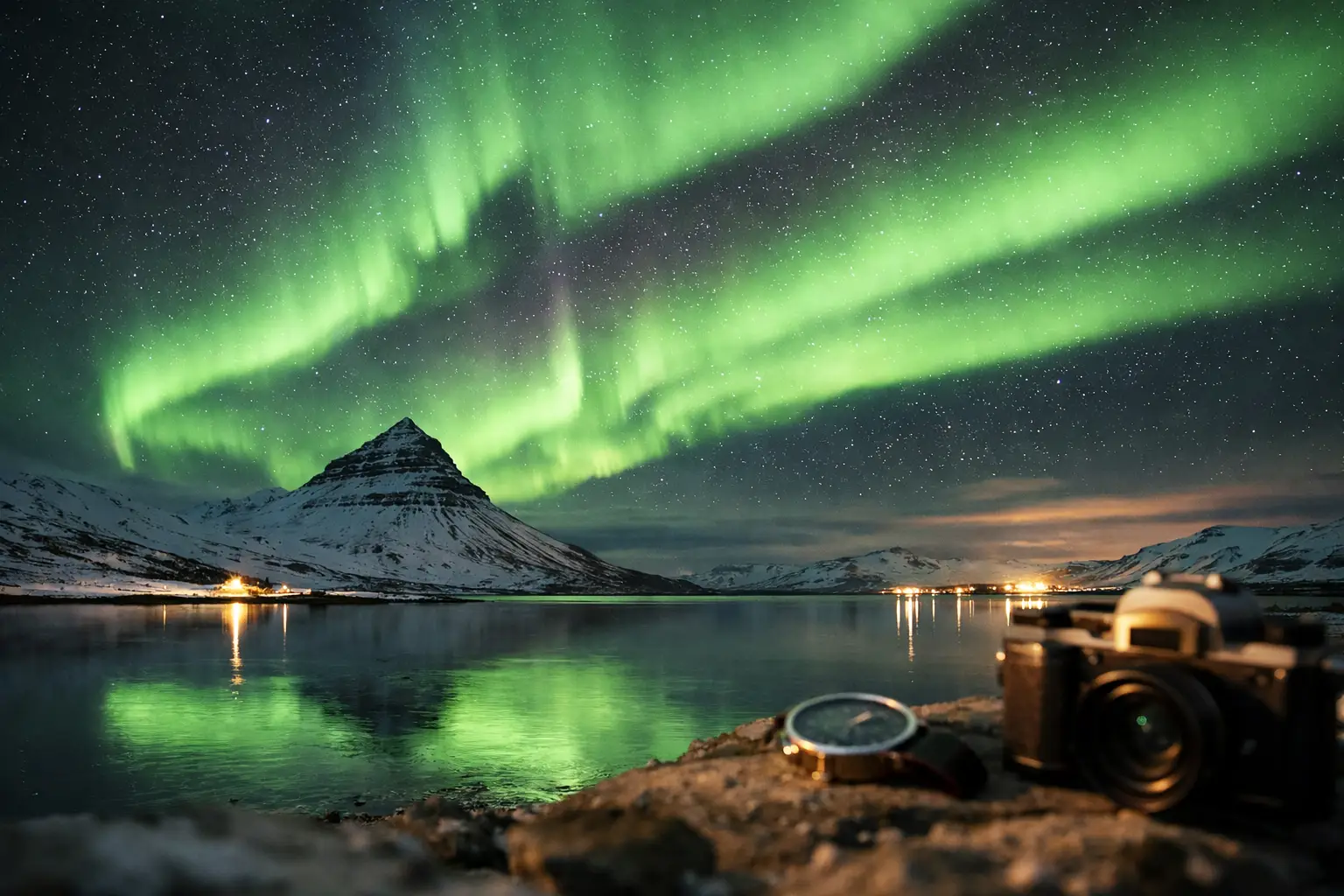
A clear night in Iceland can turn an ordinary road trip into the moment you remember most. But searching for the best time northern lights Iceland is not really about finding one perfect date. It is about matching your trip to dark skies, workable weather, solar activity, and the flexibility to act when conditions line up.
For most travelers, the strongest strategy is simple: visit during the dark season, stay several nights, and make your aurora plans flexible. Iceland is far enough north that you do not need an extreme geomagnetic storm to see the lights. You do need darkness and a break in the clouds.
Best Time for Northern Lights in Iceland: The Season
The Northern Lights season in Iceland usually runs from late August through late April. Outside that window, the aurora can still occur in the upper atmosphere, but Iceland's nights are too bright for it to be visible. Around the summer solstice, the country has near-continuous twilight, so even strong activity is hidden by daylight.
September through March is the practical core of the season. Nights are properly dark, tour operators are active, and travelers can build evenings around aurora viewing. Late August and April can work well too, especially for visitors who prefer slightly milder temperatures and longer daytime hours for sightseeing.
The best month depends on what you are willing to trade. September and October offer easier driving conditions, autumn color, and less severe cold. November through February bring the longest nights, but also more challenging roads, stronger winds, and a higher chance that a snowstorm changes your plans. March and early April are a favorite compromise: there is still enough darkness, days are noticeably longer, and winter landscapes remain in place.
There is no scientifically reliable “best month” for solar activity. The sun does not schedule its strongest aurora displays around vacation calendars. Choosing a month is therefore mostly a decision about darkness, weather tolerance, driving confidence, and the kind of Iceland trip you want.
The Best Time Tonight Is Usually Later Than You Think
Aurora activity can happen at any dark hour, but many Iceland sightings occur between about 9 p.m. and 2 a.m. Local time. That is a useful planning window, not a guarantee. A display may appear at 7 p.m., fade before 10 p.m., or strengthen near midnight.
In September and April, darkness arrives later or leaves earlier, shrinking the useful window. In midwinter, you have more hours to work with, though a long night does not automatically mean a clear one. If the sky is overcast from evening until morning, no amount of geomagnetic activity can make the lights visible from the ground.
Give yourself time outdoors. A weak arc can develop slowly, then brighten in a few minutes when solar-wind conditions improve. Arrive at a viewing location before the forecast peak, let your eyes adjust, and keep looking north as well as overhead. Aurora can begin as a faint gray-green band that cameras often reveal more clearly than the naked eye.
Why Iceland Weather Often Matters More Than KP
The KP Index is useful as a broad measure of global geomagnetic disturbance, but it is not a visibility forecast for your exact location. A modest KP level can produce a memorable display in Iceland when skies are clear and solar-wind conditions are favorable. A high KP level is irrelevant beneath thick cloud.
Iceland's Atlantic weather is fast-moving and highly local. Reykjavik may be cloudy while the South Coast opens up, or a clear patch may pass over the Reykjanes Peninsula for only an hour. That is why successful aurora travelers watch cloud maps, road conditions, and short-term weather updates instead of deciding at breakfast whether the night is lost.
Solar wind and the interplanetary magnetic field, often called IMF Bz, add important context. Faster, denser solar wind can transfer more energy into Earth's magnetic environment. When Bz points south for sustained periods, the connection is often more favorable for aurora activity. These signals help explain why the KP number alone can feel incomplete.
AuroraVision brings those factors together in its Live Aurora Score, including solar wind, IMF Bz, cloud cover, moon phase, weather, and the KP Index. Check the free app before heading out, then check again if the weather shifts. A live forecast is most valuable when it helps you decide whether to wait, drive to a clearer area, or get some sleep and try again tomorrow.
Moonlight: Helpful for Landscapes, Harder for Faint Aurora
A dark moonless sky makes faint aurora easier to see. Near a full moon, weak displays can look washed out, particularly when there is haze, snow cover, or light pollution. That does not mean you should avoid full-moon dates. Bright moonlight can make Icelandic mountains, glaciers, and foregrounds far more visible for photography.
For a first-time aurora hunter, a new moon or thinner crescent gives the best chance of noticing subtle activity. For photographers who want a detailed landscape beneath a brighter aurora, some moonlight can be an advantage. The moon is one factor, not a reason to cancel an otherwise promising night.
How Many Nights Should You Plan?
If seeing the lights is a priority, book at least three nights in Iceland. Four to six nights is safer, especially in winter. This is not because aurora requires six nights to happen. It is because you are working around cloud cover, wind, storms, travel days, and changing space weather.
Base yourself where you can respond to conditions without turning every evening into a risky drive. Reykjavik is convenient and can produce sightings from darker edges of the city or nearby coastal areas, but light pollution limits the experience. A countryside hotel or cabin often gives better darkness and the freedom to step outside when an alert arrives.
Independent travelers should be honest about winter driving. Roads can close quickly, and high winds can make a route unsuitable even when the sky looks clear farther away. Renting a vehicle adds flexibility, but it also adds responsibility. If you are unfamiliar with icy roads or traveling during a stormy forecast, a guided Northern Lights tour can be the smarter choice. Local guides monitor conditions, know sheltered viewing areas, and make the drive while you focus on the sky.
A Practical Plan for Each Aurora Night
Start by checking whether darkness, cloud breaks, and aurora conditions overlap. If they do, choose a viewing spot with an open northern horizon, low artificial light, and a safe place to park. Dress for standing still, not for walking: insulated layers, warm socks, gloves, and wind protection matter more than most travelers expect.
Bring a tripod if photography is part of the plan. Use manual focus set on a distant light or star, then test a few exposures before the aurora becomes active. Modern phones can capture brighter displays with night modes, but do not spend the entire event looking at a screen. The color and movement are better experienced directly.
Avoid chasing every tiny clearing across the country. A two-hour drive through difficult weather can cost you the clear period you already had nearby. Favor safe, realistic moves based on live cloud forecasts and road conditions. Patience at a good location is often the better call.
When Should You Book Your Iceland Trip?
Choose September or October if you want a balanced road trip with dark nights and relatively manageable conditions. Choose November through February if long nights and winter scenery matter most, while accepting that weather can be disruptive. Choose March or early April if you want a blend of aurora potential, winter landscapes, and more daylight for waterfalls, glaciers, and day tours.
If the lights are your main reason for visiting, avoid a one-night stopover and do not build your entire plan around a single KP forecast seen weeks in advance. Space weather cannot be predicted that precisely. Build room into your itinerary, keep one or two evenings uncommitted, and be ready to adjust.
The best aurora night in Iceland is rarely the one with the most dramatic forecast headline. It is the night when you are warm, safe, under a clear patch of sky, and ready when the lights begin to move.