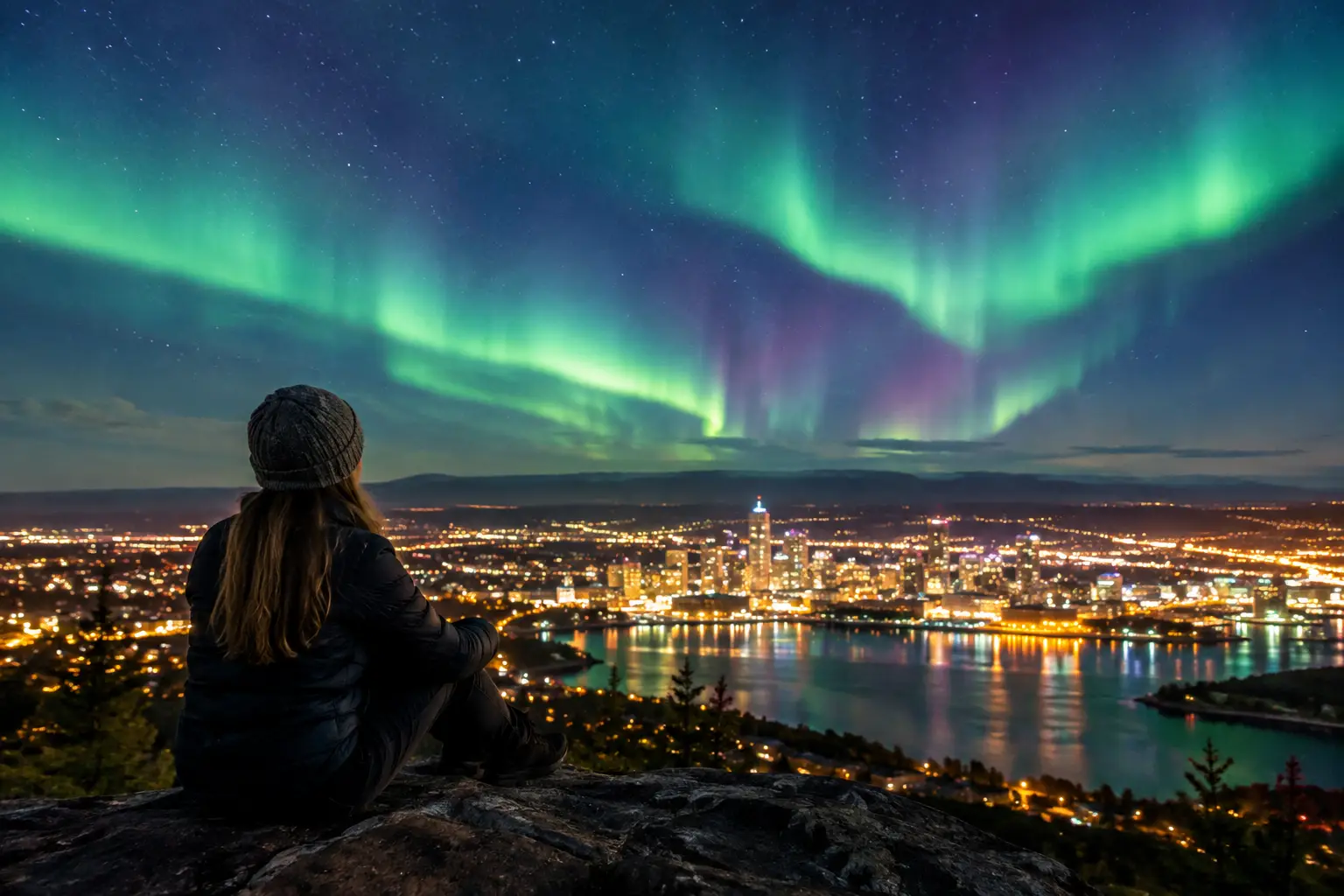
A faint aurora can be directly overhead and still look like nothing more than a pale gray haze from a brightly lit parking lot. Move ten minutes beyond the town glow, however, and that same haze may reveal structure, motion, and a green tint. This is why travelers often ask: can city lights hide aurora? Yes - but they do not affect every display in the same way.
City light pollution reduces contrast. It does not switch the Northern Lights off, block them physically, or change what is happening in the upper atmosphere. A powerful aurora can shine above a city. The challenge is whether your eyes and camera can separate its relatively dim light from the brighter glow of streetlights, homes, traffic, and illuminated signs.
Can City Lights Hide Aurora Completely?
They can hide a weak aurora almost completely, especially near the horizon. Under a bright urban sky, the background is already light gray, orange, or white. A subtle green arc has little contrast against it, so your eyes may not recognize it as aurora at all.
Strong activity is different. During a bright, active display, you may see a green band, rays, or moving curtains from cities such as Reykjavik, Tromso, Fairbanks, or Yellowknife. If the aurora is high overhead, it also has less city glow between you and the sky than an arc sitting low in the northern horizon.
That does not mean city viewing is equally good. Colors appear less vivid, fine structure disappears first, and photography becomes harder. Your camera can often record more color than your eyes, but a bright sky still limits how much detail the sensor can capture without overexposure.
What Light Pollution Actually Does
Light pollution is scattered artificial light in the atmosphere. Streetlights point upward directly or reflect off roads, snow, buildings, and low clouds. That light scatters through air, moisture, and particles, creating a skyglow that reaches far beyond city limits.
For aurora viewing, the key issue is contrast. The brighter the background sky, the brighter the aurora must be before it becomes obvious. It is similar to trying to see a faint projection with the room lights on: the image is still there, but the dark areas are no longer dark enough.
Cloud makes the problem worse. In a city, low cloud can reflect artificial light back toward you and turn the entire sky a bright yellow, orange, or gray. In a darker rural area, that same cloud is more likely to look dark, making it easier to identify breaks in the cloud cover and wait for clear sky.
Moonlight is another source of natural sky brightness. A full moon can soften the contrast of a modest aurora, though it is usually less disruptive than urban light pollution. The moon can also illuminate mountains, snow, and foregrounds beautifully for photography. The best choice depends on whether you want the strongest possible aurora contrast or a balanced landscape image.
Brightness, Direction, and Height Matter
There is no single city-light cutoff where the aurora becomes visible or invisible. Three factors matter most: how strong the aurora is, where it appears in the sky, and how dark your immediate surroundings are.
A low northern arc is the first thing city lights erase. In Iceland or northern Scandinavia, that arc may be visible from a dark coast or open field but lost entirely behind a distant glow from town. When solar activity strengthens, the aurora can expand higher overhead or farther south. That gives viewers in brighter places a better chance, because the display is no longer sitting in the most polluted part of the sky.
Local shielding matters, too. A hill, trees, or a building can block a direct source of glare without removing the wider skyglow. Standing on the dark side of a structure, away from streetlamps and car headlights, may improve your night vision immediately. It is not a substitute for a dark-sky location, but it can turn a frustrating wait into a usable viewing spot.
Snow creates a trade-off. It reflects nearby light and can brighten the ground around you, yet it also makes roads, paths, and landscapes easier to navigate and photograph. If you are driving to a viewing location, prioritize safety over chasing a marginally darker pullout.
How Far From a City Should You Go?
Often, you do not need to drive for hours. Leaving the densest commercial lighting and reaching an open area 15 to 30 minutes outside a city can make a major difference. The exact distance depends on the size of the city, terrain, humidity, snow cover, and whether nearby towns add their own glow.
Look for a location with an open view north if activity is expected to be modest. If conditions suggest a stronger, more overhead display, a wide view of the whole sky is better. Avoid valleys with steep walls, heavily forested areas, and roadside locations where headlights regularly hit your eyes.
In Iceland, coastal roads and rural areas can offer fast access to darker skies, but weather and wind can change quickly. In Norway, fjords and mountains can block parts of the horizon even when the sky above is clear. In Alaska and Northern Canada, distance from town helps, but cold-weather planning, fuel, and road conditions deserve equal attention. The darkest location is not the best choice if you cannot reach it safely or wait there comfortably.
A guided Northern Lights tour can be a practical option for first-time visitors who do not want to assess roads, clouds, and local viewing areas after dark. Independent travelers with a rental car should choose a legal, safe place to park, keep reflective gear available, and never stop in a traffic lane for a photo.
Do Not Use the KP Index Alone
The KP Index describes broad geomagnetic activity over a three-hour period. It can offer useful context, especially for estimating how far south the aurora may be visible, but it cannot tell you whether clouds are covering your location, whether the solar wind is favorable right now, or whether city skyglow will overpower a faint display.
For a real decision - stay in town, drive farther out, or wait for a break in the clouds - use several live signals together. Solar wind speed and density show the energy arriving from the Sun. IMF Bz helps indicate whether that energy can couple effectively with Earth's magnetic field. Cloud cover, weather, moon phase, and darkness at your specific location determine whether a display can actually be seen.
AuroraVision brings these conditions into one Live Aurora Score, alongside real-time solar wind, IMF Bz, KP Index, cloud cover, moon phase, weather, and alerts. Check the app before leaving your hotel, then check it again if clouds shift or activity changes. The best time tonight can be very different from the forecast you saw at breakfast.
A Better Plan for City-Based Aurora Viewing
Start by accepting that the goal is not always a perfect dark-sky experience. If you are staying in a city for a short trip, you can still catch a bright display by choosing the darkest accessible edge of town, avoiding direct glare, and watching the clearer part of the sky.
Give your eyes time to adapt. Put away bright phone screens for several minutes, use a red screen mode if available, and do not judge the sky immediately after stepping out of a brightly lit lobby or car. Look for a pale, smooth arc or a cloud-like band that holds its shape. Aurora often appears gray or white to the eye before it appears distinctly green.
For photos, move away from lamps, shield the lens from side glare, and avoid pointing directly toward a brightly lit skyline. A tripod helps, but camera settings cannot restore contrast that city lights have already washed out. If the foreground is lit by headlights or a nearby lamp, reposition rather than simply increasing exposure.
When Staying in the City Is Worth It
Do not abandon a promising night just because you are in an urban area. Stay local when the aurora is forecast to be strong, the sky is clear, travel conditions are poor, or you have a rooftop, waterfront, park, or outskirts viewpoint with limited direct lighting. A memorable overhead display can be visible even with a city nearby.
Go darker when activity is uncertain, clouds are patchy, or photography is a priority. On those nights, every bit of contrast matters. The Northern Lights reward patience, but they also reward smart positioning: get away from glare, watch the live conditions, and give the sky a chance to show what is already there.