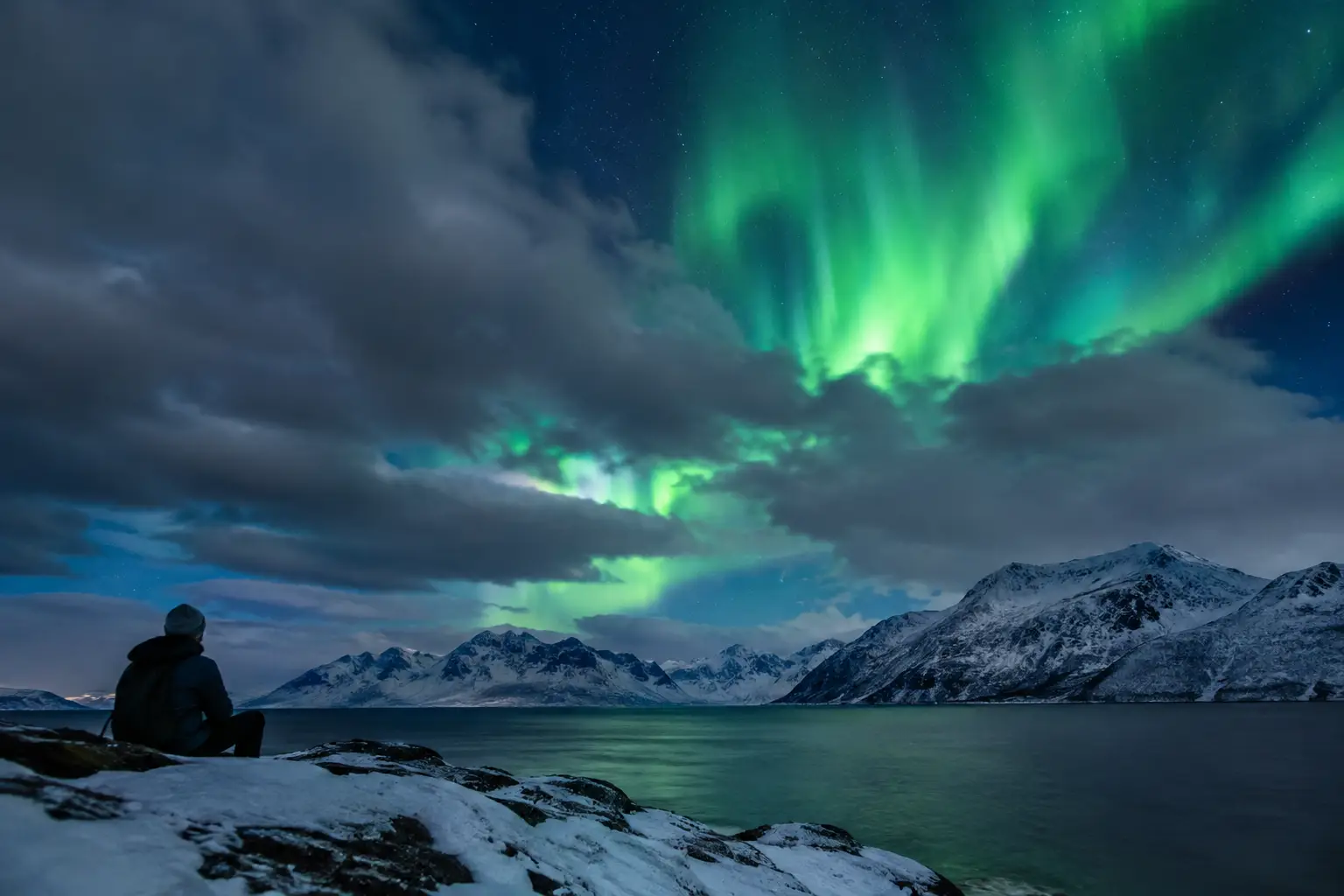
A strong aurora display can be happening directly above you and still be completely invisible from the ground. So, can clouds block northern lights? Yes. Thick cloud cover blocks your view of the aurora as effectively as a closed curtain blocks a window. The lights are still active high in the atmosphere, but no camera setting, high KP reading, or patient waiting can make them visible through an overcast sky.
That is why a good Northern Lights plan always combines space weather with local weather. Solar activity tells you whether aurora is possible. Clouds tell you whether you can actually see it.
Can Clouds Block Northern Lights Completely?
The Northern Lights usually form roughly 60 to 300 miles above Earth. Most clouds sit far lower, generally within the first 8 miles of the atmosphere. From the ground, however, that distance does not help. A dense sheet of low cloud between you and the sky will hide the aurora entirely.
This is the frustrating part of aurora hunting: a powerful display does not guarantee a successful viewing night. You may see an excellent forecast, a favorable IMF Bz, strong solar wind, and active aurora cameras elsewhere in the region, yet see only gray or black sky at your location. That does not mean the forecast failed. It means cloud cover became the limiting factor.
Clouds matter in layers. Low clouds such as stratus and fog are often the biggest problem because they create a solid, opaque ceiling. Mid-level clouds can soften or obscure the lights, while high, thin clouds may allow a bright aurora, moon, or stars to show faintly through. In practice, though, thin cloud is still a compromise. A weak green arc may disappear, and the structure that makes an aurora memorable can look washed out in photos.
Not All Cloud Cover Means the Same Thing
A weather forecast that says “partly cloudy” can be excellent or useless depending on when and where those clouds move. A 50% cloud-cover number does not mean half the sky will be clear above you all night. It may mean clear gaps pass through every 20 minutes, or it may mean one half of the region is clear while the other is fully overcast.
For aurora viewing, the details that matter are cloud type, timing, wind direction, and geography. Coastal Iceland, for example, can change quickly as weather systems move across the island. A cloudy evening in Reykjavík may become clear farther inland or on another coast. In northern Norway or Finnish Lapland, conditions can be more stable on some nights, but valleys, fjords, and local fog can still create major differences over short distances.
Look for moving breaks rather than treating a cloudy forecast as an automatic cancellation. If the cloud map shows scattered coverage and a clearing window around midnight, that may be your best opportunity. If it shows unbroken low cloud across your entire driving range for six hours, waiting outside is unlikely to pay off.
Why Stars Are Your Fastest Cloud Check
Before you start a long drive, look up. If you can see several stars, you have at least some usable transparency. If you see only a bright haze around streetlights or the moon, clouds may be too thick for all but the strongest aurora.
Stars are a practical field test because they reveal more than a simple cloud percentage. A few visible stars through thin cloud can mean the sky is improving. Fast-moving cloud edges may signal a break worth waiting for. On the other hand, a sky that looks clear near the horizon but has a milky layer overhead can make faint aurora difficult to spot.
Your camera can help, but do not rely on it alone. A long exposure may reveal green through thin clouds before your eyes can detect it. That is useful for checking conditions, especially for photographers. Still, a camera showing a faint glow does not necessarily mean the display will be satisfying to watch. Clear sky remains the goal.
Cloud Cover Versus Aurora Strength
A brighter aurora can sometimes show through lighter cloud, but strength does not cancel out weather. During a major geomagnetic storm, bright curtains may be visible through broken or thin cloud, especially if the display reaches high overhead. Yet even an intense aurora cannot penetrate thick low cloud.
The opposite is also true: clear skies do not create aurora. A beautiful, cloudless night with weak solar conditions may produce little more than a faint arc near the northern horizon. This is why the KP Index alone is not enough for travel decisions. KP is a broad measure of geomagnetic activity, not a guarantee of visibility at your exact location.
A better decision comes from combining the sky conditions with real-time space-weather signals. Solar wind speed and density show how much energy is arriving. IMF Bz indicates whether that energy can couple efficiently with Earth’s magnetic field. Local cloud cover, weather, darkness, and moonlight determine whether you can see the resulting aurora.
AuroraVision brings those factors together in one Live Aurora Score, alongside solar wind, IMF Bz, KP Index, cloud cover, moon phase, weather, and alerts. Check it before you leave your accommodation, then check again if weather is moving quickly. The best plan at 8 p.m. may not be the best plan at 11 p.m.
How to Find Clearer Skies Tonight
If clouds are blocking the Northern Lights, your best move is often geographic rather than technical. Do not spend an hour changing camera settings beneath an opaque sky. Look for a nearby area where the cloud map shows a genuine break, then consider road conditions, wind, visibility, and your safe driving range.
For independent travelers, a flexible rental car can make a major difference, particularly in Iceland, northern Scandinavia, Alaska, and Canada. But flexibility should never turn into risky driving. High winds, ice, blowing snow, or poor visibility can make a cloud-chasing trip unsafe. If conditions are difficult, staying put or joining an experienced local Northern Lights tour may be the smarter choice. Guides often know which nearby routes, valleys, and coastal areas tend to clear first.
Use a simple decision process:
- If skies are clear or nearly clear where you are, stay outside and watch the full sky, not only the northern horizon.
- If clouds are broken and moving, wait through several cloud cycles and keep checking the forecast timeline.
- If a clear area is nearby and roads are safe, relocate early enough to arrive before the best viewing window.
- If thick cloud covers the region, protect your energy and plan for another night if your itinerary allows.
This approach is especially valuable on multi-night trips. Many visitors treat their first cloudy night as a lost chance, then discover the forecast improves dramatically the next evening. Building two or three possible aurora nights into a trip gives weather room to change.
When Cloud Breaks Are Worth Waiting For
A cloud break is most valuable when aurora conditions are already favorable. If the Bz is southward, solar wind is elevated, and your location is dark, even a short opening can reveal a sudden display. The aurora can intensify in minutes, so being ready matters.
Dress for waiting rather than for a quick look outside. Bring insulated layers, gloves that let you operate a phone or camera, and a warm drink if you are far from services. Stand somewhere with an open view away from bright lights, but avoid exposed shorelines, unstable ground, and roadsides where you could be at risk.
Photographers should set up before the gap arrives. Use a tripod, focus manually on a distant light or bright star, and keep a lens cloth handy for moisture. Do not assume that a large gap near the horizon is enough. The most active aurora may appear overhead or toward the northeast, northwest, or south during strong activity.
Moonlight, Fog, and Other Visibility Traps
Clouds are the main barrier, but they are not the only one. Fog can hide the entire sky even when a general weather map suggests low cloud cover. Snow showers can produce the same problem. Haze, sea spray, and moisture on your lens can reduce contrast enough to make a modest display hard to detect.
Moonlight does not block the aurora, but a bright moon can make faint aurora less obvious to the eye and reduce contrast in photographs. A strong aurora can still look spectacular under moonlight, while the illuminated landscape can be beautiful for wide-angle images. Treat the moon as a condition to manage, not a reason to give up.
Light pollution is similar. City lights do not prevent aurora activity, but they can wash out weak displays. If clouds are thin and the aurora is faint, moving away from town can be the difference between seeing a green band and seeing nothing at all.
The Best Mindset for a Cloudy Aurora Forecast
The most successful aurora travelers do not ask only, “How high is the KP?” They ask, “Will I have a clear sky during active conditions, and can I reach it safely?” That question leads to better decisions than any single number.
Clouds can block the Northern Lights completely, but they also move, split, and disappear. Watch the real-time conditions, keep your plan flexible, and treat every clearing as a possible window rather than a promise. The moment the sky opens may last five minutes or two hours - be warm, be ready, and look up.