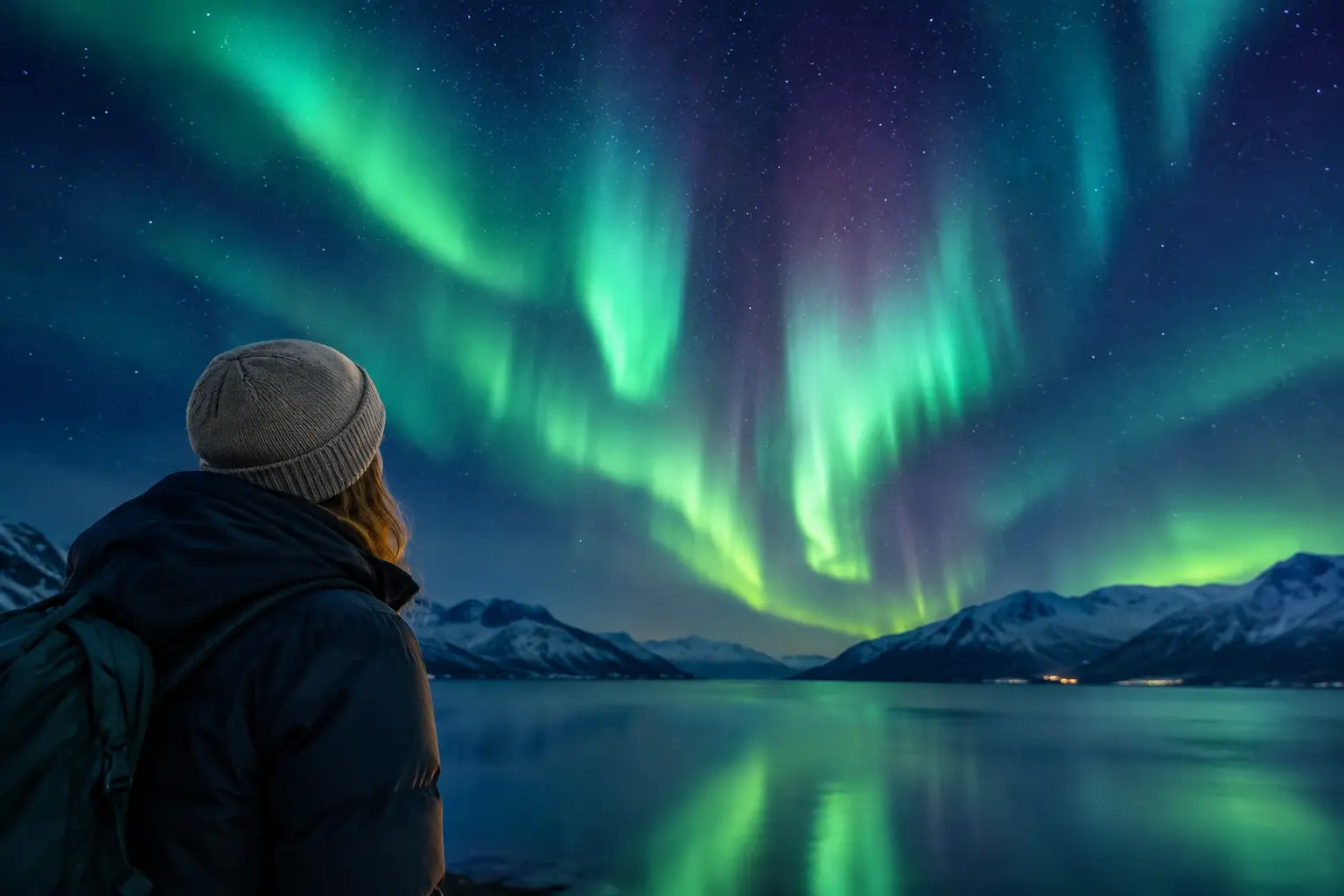
A clear sky at 11:30 p.m. can be worth far more than a promising forecast at 8:00 p.m. The key is to choose an aurora viewing window when darkness, cloud breaks, and geomagnetic activity overlap in the same place. That overlap may last hours on a quiet, clear Arctic night, or only 20 minutes between snow showers and changing solar wind.
For travelers, this is the difference between waiting outside all evening and being ready when the sky actually has a chance to perform. A viewing window is not simply the time between sunset and sunrise. It is a practical period when the Northern Lights can be visible from your location.
What an Aurora Viewing Window Really Means
An aurora viewing window has four parts: enough darkness, a usable sky, active aurora conditions, and a view away from local light pollution. Miss any one of them and your chance drops, even during a strong geomagnetic event.
Darkness is the basic requirement. In Iceland, northern Norway, Alaska, and other high-latitude destinations, the sky may stay too bright during summer for ordinary aurora viewing. During the main season, twilight still matters. A faint aurora can be washed out before full darkness, while a brighter display may be visible earlier.
The next factor is cloud cover. A high Aurora Score cannot put lights behind thick clouds into view. This is why local weather forecasts matter as much as space weather, especially in coastal Iceland, the Faroe Islands, and northern Norway, where conditions can shift quickly over short distances.
Finally, there must be a reason for the aurora to appear. That comes from solar activity interacting with Earth’s magnetic field. The best window is where this space-weather opportunity meets your local darkness and cloud conditions.
Choose an Aurora Viewing Window by Starting With Darkness
First, find your true dark period, not just sunset. Civil twilight is often still too bright for weaker displays. In autumn and spring, allow time for the western horizon to lose its glow. In midwinter, darkness may arrive early and last for many hours, giving you flexibility when clouds move through.
Your latitude changes the schedule. In southern Iceland, a practical viewing period may begin earlier than it does in Tromsø or Svalbard during certain parts of the season. Farther north, long twilight can narrow the useful period in early fall and late spring.
You do not need to stay out for every dark hour. Instead, mark the dark period as your possible range, then narrow it using live conditions. This protects your energy on a road trip and helps you avoid driving tired through unfamiliar winter conditions.
The Best Time Is Not Always Midnight
Many people assume the aurora peaks at midnight. It often appears during the late evening or around local magnetic midnight, but there is no fixed nightly appointment. Displays can begin soon after darkness, fade for an hour, then return with a stronger burst after midnight.
Treat the whole dark period as an opportunity, with special attention to active changes in the data. If the solar wind strengthens, the magnetic field turns favorable, or clouds begin clearing, your best time tonight may shift quickly.
Check the Sky Before You Chase the Forecast
Cloud cover should be read at the scale of your actual travel plans. A regional forecast that says “mostly cloudy” may still contain a usable gap over a peninsula, valley, or inland road. On the other hand, a forecast showing 30% cloud cover does not guarantee that your chosen viewpoint will be clear.
Look for timing and movement. Are clouds arriving from the west? Is a break expected to cross your area around 10 p.m.? Are low clouds blocking the horizon while higher layers are thin enough to reveal stars? These details help you decide whether to wait, drive a short distance, or change plans.
In Iceland, it can make sense to choose between nearby weather zones if roads are safe and the difference is meaningful. In Finnish Lapland, where weather can be more stable inland, the better decision may be to stay near your accommodation and wait for the cloud layer to pass. Conditions depend on terrain, road access, and the forecast trend - not just the percentage on a map.
Moonlight is the other sky condition travelers often overlook. A bright full moon does not prevent an aurora display, especially a strong one. It does make faint green arcs harder to see and can reduce contrast in photographs. If the moon is bright, choose a darker location, avoid looking directly toward it, and set expectations accordingly.
Read Space Weather Beyond the KP Index
The KP Index is useful as a broad measure of geomagnetic activity, but it is not a local visibility forecast. It does not show whether clouds are above you, whether twilight is still too bright, or whether activity is rising right now.
For a more useful viewing decision, watch the solar wind and the interplanetary magnetic field, often called IMF Bz. Solar wind carries energy from the Sun toward Earth. When speeds and density support activity, the aurora has more potential. A southward, or negative, IMF Bz can help that energy couple with Earth’s magnetic field and increase the chance of brighter or more active displays.
These signals are not guarantees. They can change rapidly, and aurora response is not perfectly immediate. But they are far more informative than treating one KP number as the whole story.
AuroraVision brings Live Aurora Score, solar wind, IMF Bz, KP Index, cloud cover, moon phase, and local weather into one real-time view. Use the free app before leaving your hotel, then keep alerts active while conditions are changing. It is designed to answer the practical question travelers actually have: is this the moment to go outside, wait, or relocate?
Build a Window Around Your Location
Once you know darkness, clouds, and space weather, choose a viewing spot that gives the sky room to work. You do not always need to drive far from town, but you do need a safe place with an open northern view when possible and minimal direct lighting.
A beach, lakeshore, open field, or elevated turnout can work well if it is legally accessible and safe. In mountainous areas, a northern horizon may be blocked by ridges, while a valley can trap cloud or fog. Do not park on narrow roads, stop in active traffic lanes, or walk onto ice, cliffs, or unmarked terrain in the dark.
If you are booking a Northern Lights tour, ask how the operator responds to clouds. Some guides stay close to one scenic area; others follow weather breaks within a defined region. Neither approach is automatically better. A mobile tour can be valuable on mixed-cloud nights, while a local guide with a reliable base may be ideal when the sky is already clear.
Independent travelers should also account for the return journey. The perfect cloud break is not worth a long, hazardous drive on icy roads. Choose a window that leaves enough time to reach your location, watch without rushing, and return safely.
Give Each Window Enough Time
A common mistake is checking the sky for five minutes, seeing nothing, and heading back inside. Auroras are dynamic. A pale arc may sit low on the horizon before suddenly brightening, or a quiet sky may develop visible movement after a change in solar wind.
For a promising window, plan to observe for at least 30 to 60 minutes. Keep your eyes adjusted to the dark and avoid repeatedly looking at a bright phone screen. If you are photographing, set up before activity begins so you are not changing lenses and settings during the best moment.
When conditions are marginal, use shorter, targeted checks. Step outside when clouds thin, when an alert signals improving activity, or when the forecast shows a break passing overhead. This approach is especially useful for guests staying at aurora hotels, cabins, or RV sites where warm shelter is close by.
When the Forecast and the Sky Disagree
If the forecast looks excellent but the sky is empty, check whether clouds, moonlight, or lingering twilight are reducing visibility. If the forecast looks average but stars are sharp overhead, stay alert. A modest level of geomagnetic activity can still create a memorable display at high latitudes under dark, clear skies.
The most rewarding aurora nights are rarely about chasing one number. They come from making good decisions repeatedly: watch the clouds, track real-time activity, choose a safe dark location, and be ready when those signals align. Keep your gear warm, your route simple, and your eyes on the sky - the next clear interval may be the one you remember.