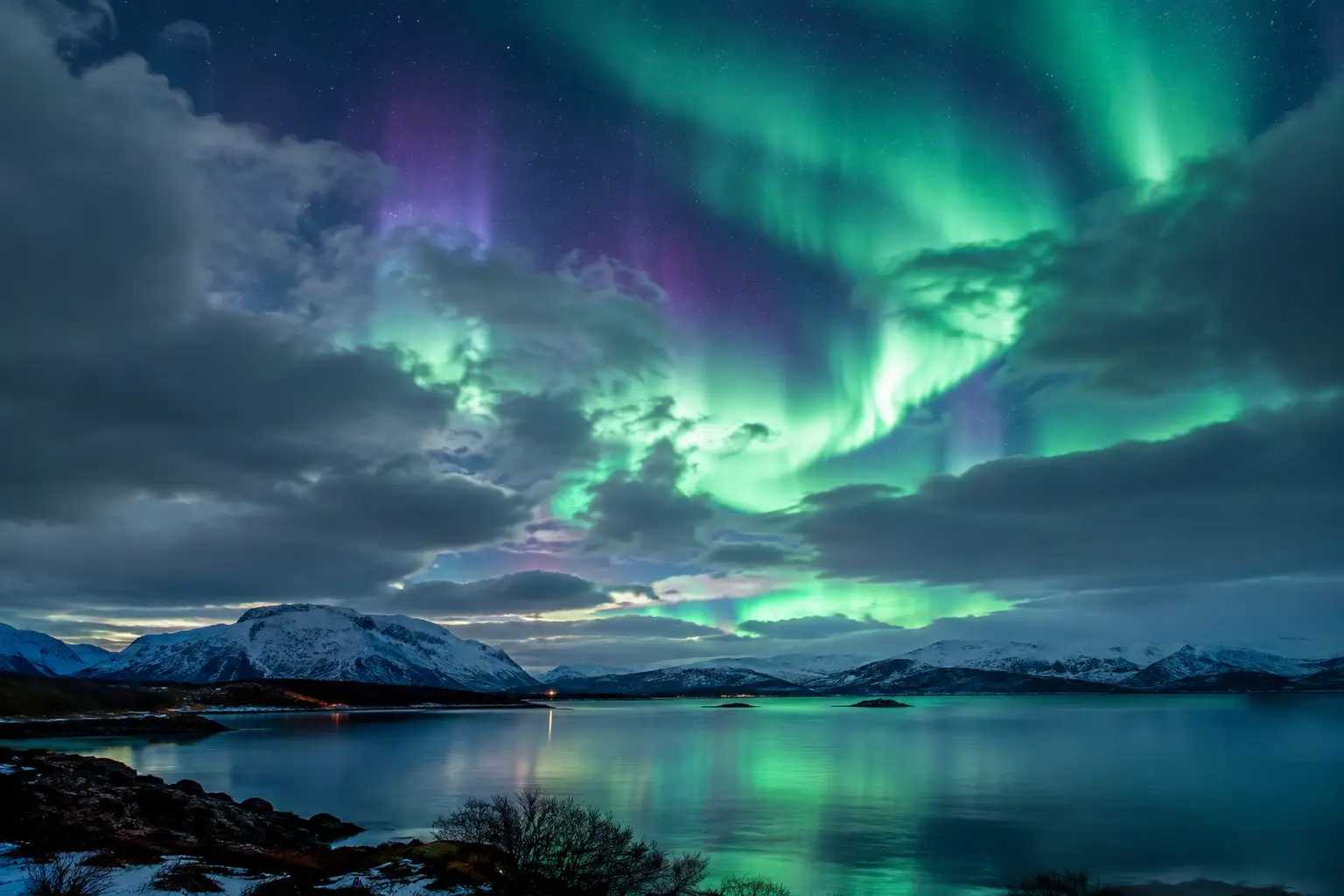
A bright aurora can be active overhead while the sky above your hotel looks completely black. So, do clouds block aurora? Yes - clouds block your view of the Northern Lights in much the same way they block stars, the Moon, and airplanes. The aurora is still happening high above them, but its visible light cannot reliably reach you through a solid cloud layer.
That does not always mean the night is lost. Cloud cover is rarely identical across an entire region, and a short drive, a patient wait, or a break in the clouds can turn an apparently poor forecast into a successful viewing window. The key is knowing what kind of cloud you are dealing with and checking it alongside live aurora activity.
Do Clouds Block Aurora Completely?
Most clouds do. Northern Lights usually form roughly 60 to 300 miles above Earth, while weather clouds sit far lower, generally below 8 miles. Yet altitude does not help if a thick layer of water droplets or ice crystals is between your eyes and the sky. The cloud layer scatters and absorbs the relatively faint light from the aurora before it reaches the ground.
Thick low clouds, rain clouds, fog, and snow showers are the toughest conditions. They can erase even a strong display from view. If you cannot see stars or the Moon through the cloud, you should assume you will not see meaningful aurora detail either.
A powerful aurora may occasionally create a vague pale glow behind thinner cloud, particularly near a city or when the Moon lights the clouds. That glow is not the same as seeing the Northern Lights. You will usually miss the structure that makes a display memorable: arcs, rays, moving bands, and the shifting green or red colors that cameras and dark-adapted eyes can reveal.
Thin Clouds, Broken Clouds, and the Open-Sky Advantage
Cloud cover is not a simple yes-or-no measurement. A forecast showing 60% cloud cover can mean many different things. It could be an unbroken sheet covering most of the sky, or fast-moving patches with large openings between them. For aurora chasing, those situations are completely different.
High, thin clouds may leave stars faintly visible. You might still see a bright aurora through them, although contrast will be reduced and photographs can look soft or hazy. Broken mid-level clouds can be frustrating, but they also create opportunities. A clear gap to the north may be enough for a low auroral arc, while a gap overhead can reveal a corona during stronger activity.
Low coastal cloud and valley fog deserve special attention in Iceland, Norway, and Alaska. These layers can sit below a clearer sky on nearby higher ground. Moving uphill may help, but only if roads are safe and local conditions support it. Never treat a mountain road or an unfamiliar winter route as a shortcut to a clear sky.
The practical goal is not necessarily a perfectly cloudless forecast. It is enough open sky, in the right direction, during an active period. That is why experienced guides often relocate instead of waiting under a cloud deck.
Why a Cloud Map Can Be Wrong at Your Exact Location
Weather models are remarkably useful, but they are not a view out the windshield. Cloud forecasts estimate conditions over grid areas and time intervals. A map can miss a narrow clear strip along a coast, a local fog bank, or clouds forming against a mountain range.
This matters most in terrain with sharp weather changes. One side of a fjord may be clear while the other is cloudy. Wind can push a cloud gap across your location in 20 minutes. In winter, darkness makes these changes harder to judge from the ground.
Use cloud forecasts to choose a starting area, then keep checking the real sky. Look for stars, identify the direction of moving cloud, and give passing showers time to clear. If you are on a guided Northern Lights tour, ask whether the operator is tracking conditions beyond the pickup location. A good tour can use local knowledge and mobility to improve the odds, though no guide can guarantee a clear sky.
Aurora Strength Still Matters - But It Cannot Beat Solid Cloud
Clear skies do not create an aurora, and active space weather does not remove clouds. You need both ingredients at the same time.
The KP Index is often treated as the whole forecast, but it only describes broad geomagnetic disturbance. It does not tell you whether the solar wind is arriving favorably right now, whether the interplanetary magnetic field is pointed south, or whether clouds have covered your viewing location. A moderate KP night with clear skies and strong real-time solar wind conditions can be more rewarding than a high-KP forecast under rain and overcast.
Watch the bigger picture: solar wind speed and density show the energy arriving from the Sun, while IMF Bz helps indicate whether that energy can couple efficiently with Earth’s magnetic field. A sustained southward Bz is generally favorable. Local cloud cover, precipitation, visibility, and moonlight then determine how much of that activity you can actually see.
AuroraVision brings these moving pieces together with a Live Aurora Score, real-time solar wind, IMF Bz, cloud cover, moon phase, weather, and alerts. It is designed for the question travelers actually need answered: is there a realistic viewing opportunity where I am, right now?
What to Do When Clouds Are Forecast Tonight
Start by separating an overcast forecast from a partly cloudy one. If the sky is expected to be fully overcast for several hours, use the evening for a relaxed plan, but keep alerts on in case the forecast changes. If clouds are scattered or broken, prepare to go out. Those are the nights when persistence can matter most.
Choose a location with a broad horizon and as little artificial light as possible, but do not sacrifice safety for a darker viewpoint. In Iceland, that can mean checking road and wind conditions before leaving town. In northern Norway or Finnish Lapland, it may mean using a nearby lakeside or open field rather than driving deep into unfamiliar back roads.
Once outside, give your eyes at least 15 to 20 minutes to adjust away from bright screens and vehicle lights. Scan more than one part of the sky. The aurora may begin as a gray-green band low on the northern horizon, but during stronger displays it can spread overhead or appear across large areas of the sky. Clouds often move quickly, so keep watching the openings rather than staring at one covered patch.
If you are photographing, do not assume your camera will solve a cloudy sky. A longer exposure may brighten thin cloud and reveal some color behind it, but it cannot produce detail that thick cloud has hidden. Check your lens regularly for moisture, and avoid exposing it to snow or rain without protection.
Can You See the Aurora Above Clouds From a Plane?
Sometimes, yes. From an airplane above a lower cloud deck, passengers may see aurora activity that is invisible on the ground. A window seat on the darker side of the aircraft offers the best chance, although cabin lights, window reflections, flight direction, and the aircraft’s altitude all matter.
It is an enjoyable bonus, not a dependable viewing plan. You cannot choose the cloud layer, route, or timing with the same freedom you have on the ground. Also, do not use flash photography near an aircraft window. If a display appears, enjoy it with your eyes first.
The Best Mindset for Cloudy Aurora Nights
Cloud is the final gatekeeper for every aurora forecast. Treat it as a live, local condition rather than a reason to give up at noon. A cloudy city can sit a short distance from a clear coast. An overcast hour can become a 15-minute opening just as activity strengthens. The reverse can happen too, which is why honest planning means accepting uncertainty.
Pack warm layers, keep your route flexible, and make decisions based on the combination of sky clarity and real-time aurora conditions. On the right night, you do not need a perfect forecast. You need to be ready when the clouds finally make room.