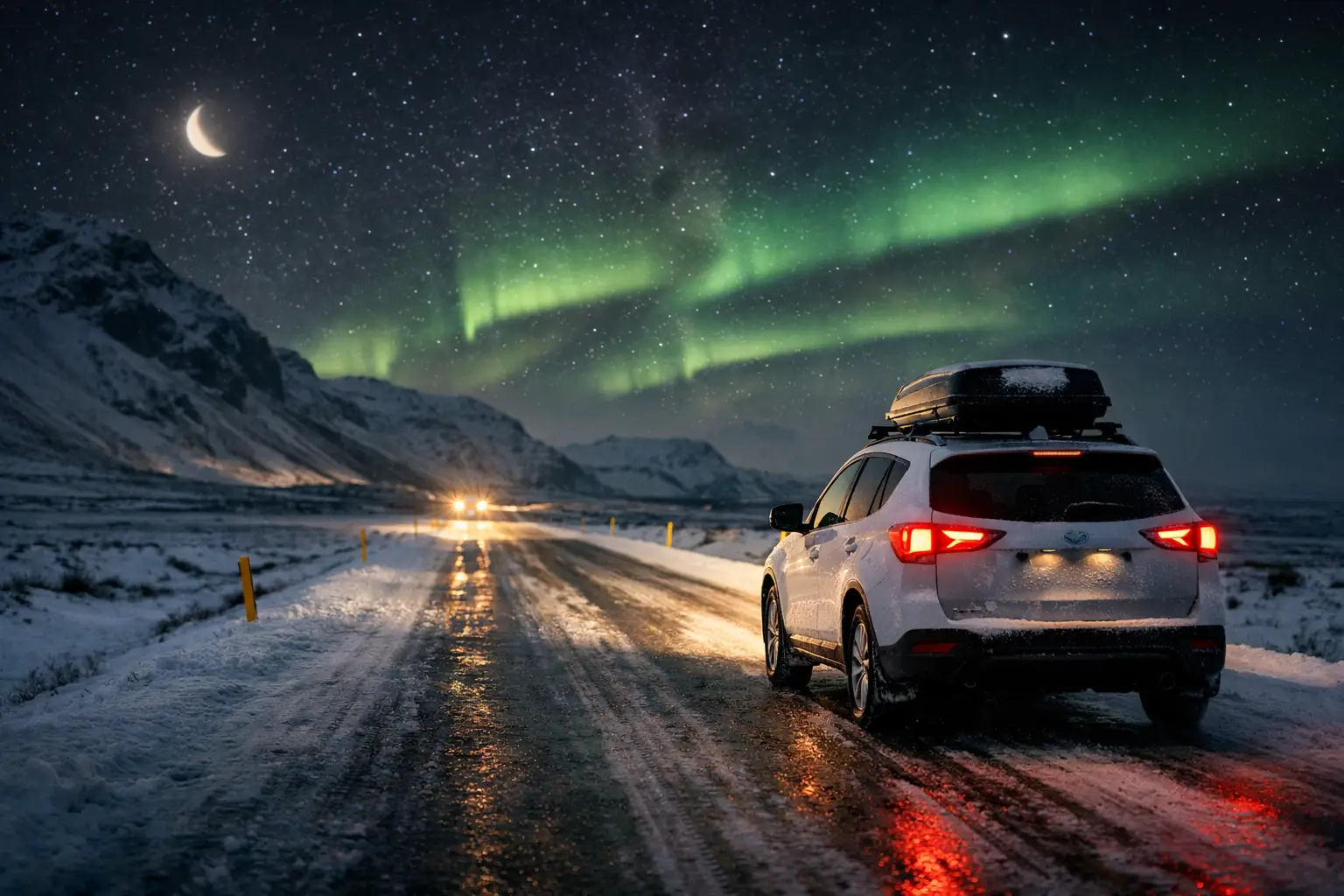
A winter road in Iceland can look manageable at 4:00 p.m., then become a black, windblown corridor before dinner. That is why driving Iceland at night in winter calls for a different mindset than a summer road trip. You are not simply following a route. You are continuously deciding whether the road, weather, visibility, and your own energy still make the trip worthwhile.
For Northern Lights travelers, the temptation is obvious: the clearest sky may be outside town, and aurora activity can improve after dark. But a promising forecast never makes an unsafe drive a good idea. The best plan is one that gives you a realistic viewing opportunity while preserving enough time, fuel, and confidence to turn back.
What makes Icelandic winter nights difficult
Darkness is only one part of the equation. In midwinter, daylight can be limited to a few hours, and twilight fades quickly. Outside populated areas, there may be no streetlights, few reflective markers, and long stretches with no services. A road that looks wide in daylight can feel much narrower when snow covers its edges and headlights reveal only a short section ahead.
Wind is often the deciding factor. Strong crosswinds can push a vehicle across the lane, while drifting snow can erase tire tracks and reduce contrast between road, shoulder, and open fields. A sudden snow shower may reduce visibility much faster than visitors expect. Rain can be equally problematic when temperatures hover near freezing, creating slick surfaces or invisible black ice.
Then there is the human factor. Many visitors spend the day sightseeing, wait for a late aurora window, and begin the return journey tired. The road conditions may be unchanged, but fatigue slows the decisions that matter most: reducing speed early, noticing an icy bridge deck, or choosing to stop somewhere safe rather than pushing on.
Before driving Iceland at night in winter
Make the go-or-no-go call before you leave, not from a dark roadside turnout. Check the official road-condition and weather warnings for your exact route, including mountain passes and exposed coastal stretches. Look beyond the general forecast for your hotel town. Conditions can differ dramatically over a short distance, especially where elevation, wind exposure, or precipitation changes.
Your rental vehicle matters. A suitable winter rental should have proper winter tires, a working heater and defroster, functional lights, a windshield scraper, and enough fuel for detours or delays. Four-wheel drive can improve traction and control in some conditions, but it does not shorten braking distances or make high winds harmless. A larger vehicle may also be more affected by gusts.
Set a conservative turnaround time before departure. This is particularly useful for aurora chasers because the lights can encourage people to stay out longer than planned. If the weather worsens, the road becomes uncertain, or you are simply more tired than expected, turning around is a successful decision. There will be another night.
Bring warm outer layers, gloves, water, snacks, a charged phone, and a power bank. Keep these accessible rather than buried under luggage. If you stop to watch the sky, cold hands and a fogged windshield are more than an inconvenience - they make it harder to operate the vehicle safely.
Use aurora forecasts as a travel tool, not a reason to take risks
The aurora forecast should help you decide where to wait and when to be ready. It should not override a weather warning or poor road conditions. A high KP Index alone is not enough to plan a night drive in Iceland. The KP Index describes broad geomagnetic activity, but it does not tell you whether your local sky is clouded over, whether the solar wind is currently favorable, or whether moonlight will reduce the visibility of a faint display.
For a better decision, look at the full picture: aurora activity, solar wind, IMF Bz, cloud cover, moon phase, local weather, and the best time window. AuroraVision brings those live conditions together in a single Live Aurora Score, so you can judge whether it is worth leaving your accommodation, waiting nearby, or staying put. Smart alerts are especially useful when you want to rest instead of checking forecasts every few minutes.
The practical question is not, “Could the aurora appear somewhere in Iceland tonight?” It is, “Is there a reasonable chance of seeing it safely from where I can get to and return from?” A moderate display under clear skies near your hotel can be a far better experience than chasing a stronger event across hazardous roads.
Choose a viewing location before dark
The safest aurora viewing locations are usually planned in daylight. Look for a legal pull-off, designated parking area, or accommodation with an open view of the northern sky. Avoid stopping on the shoulder of a narrow road, at the crest of a hill, beside blind curves, or anywhere drifting snow could make your parked vehicle difficult for other drivers to see.
If you are staying in Reykjavík or another town, darkness does not require a remote expedition. A short drive to a familiar, safe location may be enough when cloud cover and light pollution allow. If conditions require a long drive on unfamiliar roads, consider whether a Northern Lights tour is the better option. A local driver knows common viewing areas, road behavior, and when conditions are no longer suitable for continuing.
Photographers should resist setting up directly beside the car lane. Headlights from passing traffic can ruin an exposure, but the larger issue is visibility. Wear reflective details when moving around after dark, keep your tripod well clear of the roadway, and use a red headlamp mode where practical so your eyes stay adjusted to the dark.
On the road: slow down before you feel you need to
Drive at a speed that matches the surface and sightlines, not the posted maximum. On icy or snow-packed pavement, gentle steering, gradual acceleration, and long following distances are essential. Brake earlier than feels necessary. Bridges, shaded sections, and roads near water can freeze first, even when other pavement appears wet.
Keep your headlights on and windshield clear. Use low beams in falling snow or fog, because high beams can reflect light back toward you and reduce what you can see. If gusts increase, grip the wheel firmly, reduce speed gradually, and expect the vehicle to move. Do not make abrupt corrections.
If visibility falls sharply, do not stop in the travel lane. Continue cautiously to the nearest safe place where you can pull fully off the road. In severe conditions, waiting for a short period may be safer than trying to force progress through a squall. Keep the exhaust area clear of snow if the vehicle is running while parked, and never assume another driver can see you from far away.
Watch for animals too. Sheep are less common on roads in winter than during warmer months, but they are not impossible, and reindeer can be present in eastern Iceland. More often, the surprise is a patch of ice, a snowdrift, or a parked car without enough visible lighting.
Know when to stay put
Staying at your hotel is not giving up on the Northern Lights. It can be the smartest way to experience them. If cloud cover is breaking overhead, conditions may change without a drive. Step outside periodically, choose a dark side of the property, and give your eyes time to adjust. Even a faint arc can strengthen quickly when the solar wind and magnetic conditions improve.
Cancel the drive when warnings are active along your route, wind makes the vehicle difficult to control, snow reduces visibility, or you no longer feel confident. That last reason is enough. Iceland rewards patient travelers, and a safer night indoors can leave you rested for clearer roads and a better aurora window tomorrow.
A good winter aurora plan leaves room for the unexpected: a clear gap in the clouds, a road closure, a burst of green above your hotel, or a simple decision to stop chasing and look up. Keep the car ready, watch live conditions, and let safety determine how far you go.