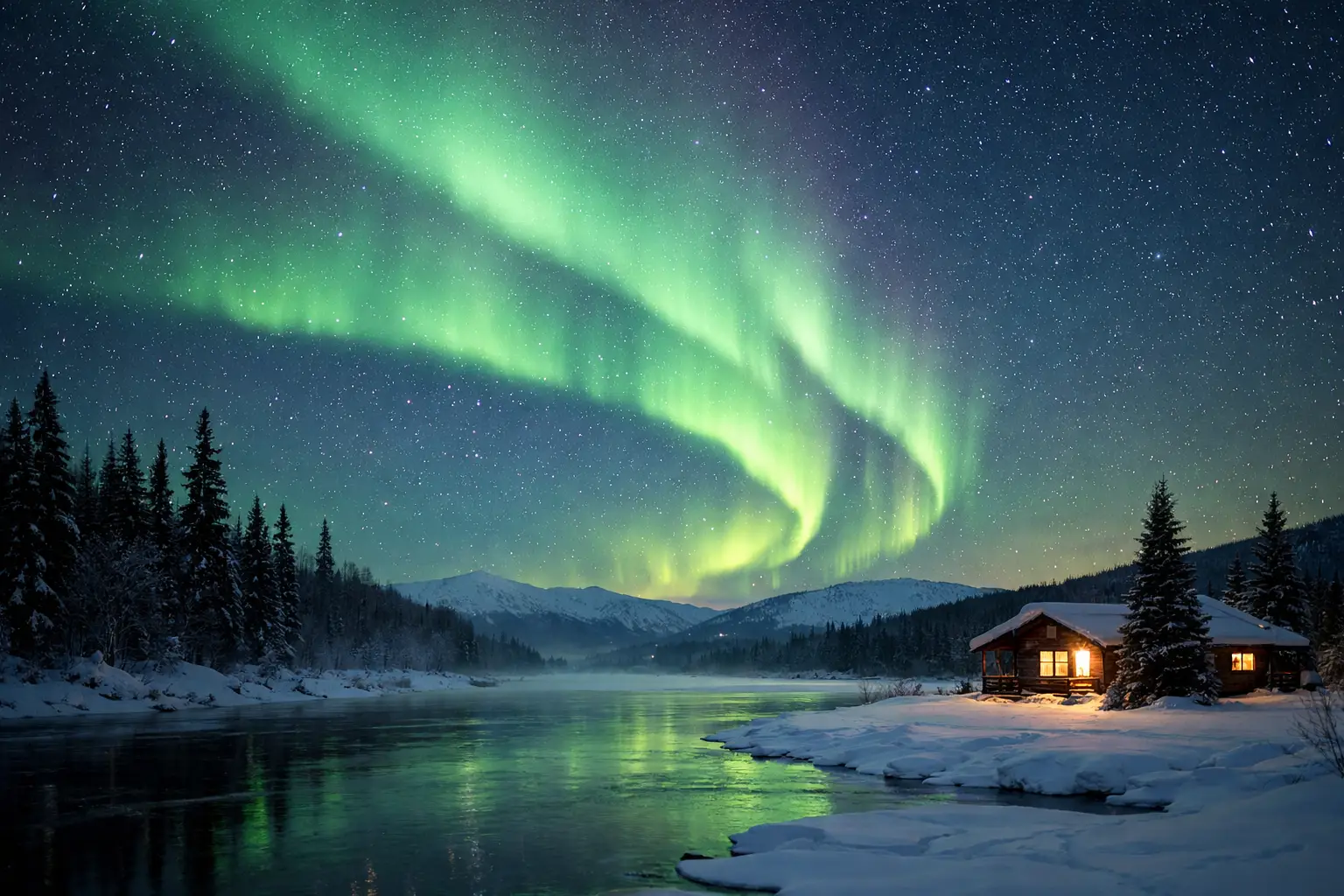
Fairbanks rewards travelers who plan for darkness, flexibility, and cold rather than a single “perfect” forecast. The Fairbanks northern lights season is long by global standards, but the best trip dates depend on what matters most to you: comfortable temperatures, autumn color, deep winter snow, photography conditions, or the broadest possible window for clear skies.
At roughly 65 degrees north, Fairbanks sits beneath the auroral oval often enough that displays can appear during modest geomagnetic activity. That is a major advantage over destinations farther south. But latitude is only one part of the equation. A visible aurora still needs darkness, a sufficiently active solar wind, and a gap in the clouds above you.
Fairbanks northern lights season: late August through April
The viewing season generally runs from late August to mid-April. The summer sun keeps the sky too bright for aurora viewing, even when space weather is active. By late August, nights become dark enough again, and the season continues until spring twilight takes over in April.
For most visitors, September through March offers the most practical combination of dark nights and travel services. You can see the Northern Lights at any point within that span, but each period has a different personality.
Late August and September: milder nights, changing conditions
Early season is appealing for travelers who do not want to face Alaska’s most severe cold. September can bring fall color, unfrozen rivers, and easier driving than midwinter. The darkness is returning quickly, so the usable viewing period grows as the month progresses.
The trade-off is that snow cover may be limited, temperatures can vary widely, and some nights feel more like autumn than an Arctic winter. For photographers, dark ground and open water can complicate foreground compositions, while lakes may offer reflections when conditions are calm. September is an excellent choice if you value daytime hiking and a less demanding cold-weather experience as much as aurora chasing.
October and November: dark nights arrive before the deepest cold
October brings longer darkness and, often, the first reliable winter landscapes. November is very dark, which gives you a generous nightly viewing window. These months can be a smart middle ground for travelers who want snow and night without targeting the coldest part of the year.
Weather remains the deciding factor. Fairbanks has a continental interior climate, not a coastal one, so it can experience periods of clearer, drier weather than many maritime northern destinations. Still, cloud cover changes hour by hour. A forecast calling for “mostly cloudy” does not automatically end the night if there are moving breaks in the cloud deck.
December through February: maximum darkness and true winter
Midwinter is what many people picture when they imagine Fairbanks: snow-covered spruce, frozen landscapes, long nights, and temperatures that can fall well below zero Fahrenheit. December has the least daylight, while January and February combine deep darkness with a more established winter travel rhythm.
These are strong months for travelers building a full Alaska winter trip around dog sledding, hot springs, ice art, or snow activities. They are also demanding months. You need serious layers, insulated boots, warm gloves that still let you operate a camera, and a transportation plan that respects icy roads and limited visibility.
Cold itself does not create aurora. It can, however, coincide with clear high-pressure periods that make viewing more comfortable from a sky perspective, even when it is uncomfortable for your fingers. Dress for standing outside for an hour or more, not for a quick walk from the hotel.
March and early April: a favorite for balance
March is often one of the most attractive months for a Fairbanks aurora trip. Nights remain dark enough for viewing, snow usually covers the landscape, and daylight returns for easier sightseeing. Temperatures may still be very cold, but the sun is higher and the trip can feel less relentlessly wintry than December.
Early April can work well too, especially for travelers who want brighter days and spring snow. The key is to understand that the nightly darkness window is shrinking. Plan to be ready during the darkest hours rather than assuming the aurora can be seen at any time of night.
Do equinoxes make the lights better?
You will often hear that September and March are the “best” months because of the equinoxes. There is a scientific basis for paying attention to the weeks around the March and September equinoxes: seasonal geometry can favor geomagnetic activity. But it is not a guarantee of a show on your travel dates.
A quiet solar wind can produce a quiet sky in March, while a strong solar event can create an excellent display in January. Treat equinox season as a possible advantage, not a booking promise. A longer stay is usually more valuable than trying to predict the single best calendar night months in advance.
What actually determines whether you see aurora tonight
In Fairbanks, you do not need an extreme KP Index for the Northern Lights to be visible. The city’s latitude places it close enough to the auroral oval that a KP of 2 or 3 can be worthwhile under clear skies. A higher KP can mean a stronger or more widespread event, but it does not override thick cloud cover, moonlight, or local weather.
The useful question is not “What is the KP?” It is “Will the aurora be visible where I am during a clear, dark window?” That answer comes from several moving pieces:
- Solar wind speed and density indicate how much energy is arriving from the Sun.
- IMF Bz describes the direction of the interplanetary magnetic field. A sustained southward Bz generally helps energy couple into Earth’s magnetic field.
- Geomagnetic activity shows how the system is responding, including KP as one broad indicator.
- Cloud cover and local weather determine whether you can see the sky at all.
- Moon phase and moon position affect how much contrast faint aurora will have against the sky.
The free AuroraVision app brings those signals together in a Live Aurora Score, along with real-time solar wind, IMF Bz, cloud cover, moon phase, weather, and alerts. Use it on the afternoon of each viewing night, then check again after dark. Conditions can improve quickly when a cloud break arrives or Bz turns southward.
Best time of night in Fairbanks
Aurora can appear anytime it is dark, but the most productive period is often from about 10 p.m. to 2 a.m., with activity commonly strengthening around local midnight. That is a planning window, not a rule. Some displays begin in the evening; others wait until the early morning hours.
Avoid the mistake of looking outside once and giving up. If the forecast shows clear or partly clear conditions with favorable aurora activity, give yourself time. Watch the northern sky, but scan overhead too. In Fairbanks, a stronger display may stretch high across the sky rather than staying low on the horizon.
Your eyes also need time to adjust. Step away from vehicle interiors, phone screens, and bright lodge lighting for several minutes. A faint gray-green arc may be visible before the camera records much color, and it can suddenly brighten or begin moving.
Choose the right Fairbanks base and transport plan
Fairbanks offers a practical split between convenience and darkness. Staying in town puts restaurants, supplies, and organized tours within easy reach. Staying outside the city can reduce local light pollution and make it easier to respond quickly when conditions improve. Neither option guarantees clearer skies, since cloud patterns can cover a wide area, but a mobile plan gives you more choices.
A guided Northern Lights tour is a strong option for first-time winter visitors, anyone uneasy about icy roads, and photographers who would rather focus on the sky than navigation. Experienced winter drivers may prefer a rental car, but only if they are comfortable with cold-weather driving, understand fuel and battery precautions, and have a conservative turnaround plan. Do not drive farther simply because an app shows better conditions somewhere else if roads or visibility are deteriorating.
For independent viewing, look for a safe, legal pull-off or designated viewing area with an open horizon. Keep the vehicle fueled, carry extra warm layers, and never stop in an unsafe roadside location. If you are shooting photos, bring spare batteries inside your coat, since cold drains them quickly.
Plan for several nights, not one perfect forecast
The most reliable Fairbanks strategy is to book enough nights to let weather and solar activity vary. Three nights can work; four or five nights gives you more room for clouds, quiet periods, fatigue, and changing travel plans. Put your most flexible activities on the first days, then keep the clearest or most promising nights open for aurora viewing.
Fairbanks can deliver a quiet green band, a fast-moving overhead corona, or no visible aurora at all on a cloudy night. That uncertainty is part of the experience, not a failure of planning. Arrive ready, watch the real conditions, stay warm, and give the sky more than one chance to surprise you.