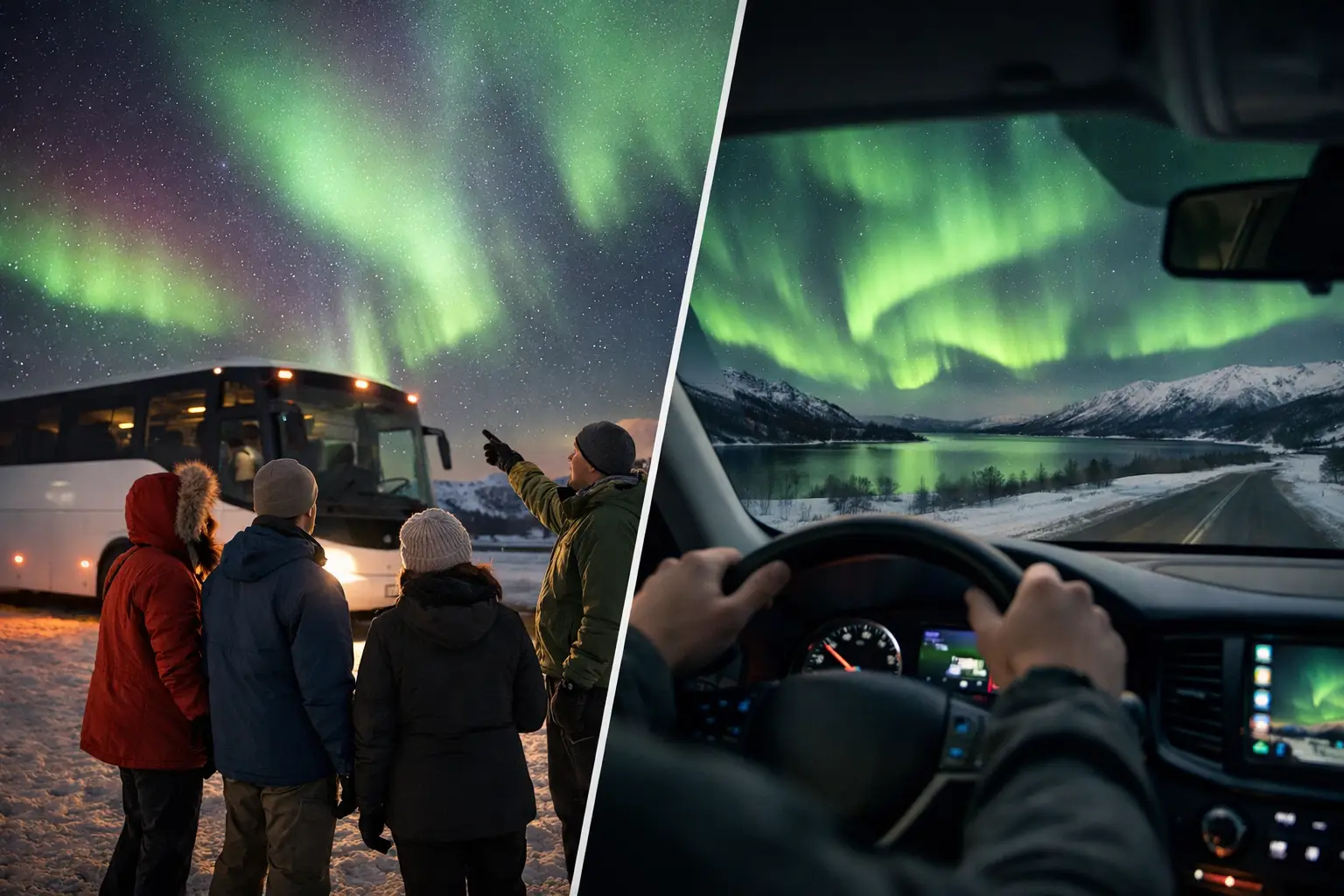
A clear forecast can change your whole evening, but it cannot remove a snow-covered road, an unfamiliar turnout, or a cloud bank moving over the mountains. When weighing guided tours versus self driving for the Northern Lights, the best choice is rarely about comfort alone. It is about how confidently you can respond when the sky, weather, and solar activity change by the hour.
A guided tour gives you local judgment and someone else at the wheel. Driving yourself gives you control over your timing, route, and photography setup. Both can lead to an unforgettable display. The better option depends on your winter-driving experience, trip style, group size, and willingness to make decisions in real time.
Guided tours versus self driving: the real trade-off
The key difference is not simply “organized” versus “independent.” A good Northern Lights tour is an operational service. Guides monitor road conditions, local cloud patterns, and aurora activity, then decide whether to wait, change locations, or call off a night that is unlikely to deliver. They also know which dark areas are accessible without blocking roads, crossing private land, or walking into an unsafe shoreline or snowfield.
Self-driving replaces that expertise with flexibility. You can leave earlier, stay out later, return to a promising location on a second night, and avoid sharing a viewing spot with a larger group. For photographers, this can be the deciding factor. You can set up a tripod, refine your composition, and wait without worrying about a departure time.
Neither approach guarantees the aurora. A tour cannot create clear skies, and a rental car cannot turn a weak geomagnetic response into a major show. Your goal is to maximize useful time under a dark, clear sky while remaining safe and ready when activity improves.
When a guided tour is the smarter choice
Guided tours are especially valuable on a first winter visit to Iceland, northern Norway, or other Arctic destinations where road conditions can be more demanding than travelers expect. Darkness arrives early, wind can be strong, and weather may vary dramatically over a short distance. A route that looked simple in daylight can feel entirely different after midnight in blowing snow.
A guide also reduces the mental workload. Instead of checking road closures, judging icy pull-offs, and watching for sheep or reindeer, you can look at the sky. This is useful for couples, solo travelers, families, and anyone who would rather experience the night than manage it.
Tour operators may also have access to private viewing areas, warm shelters, camera assistance, insulated clothing, or a second attempt if conditions are poor. Policies vary widely, so read the details before booking. A “free retry” is helpful only if you have enough nights left in your itinerary to use it.
Choose a guided tour if you are new to winter driving, have only one realistic aurora night, do not want to drive after dark, or are staying in a city without a vehicle. It is often the better value when the alternative is renting a car for one evening, paying for insurance, and still feeling uncertain about where to go.
What to ask before booking
Look beyond the tour’s headline promise. Ask whether the operator changes locations based on cloud cover, how long the tour normally lasts, whether pickup is included, and what happens if weather closes roads. Small-group tours can offer more flexibility, while larger coach tours may be less expensive and more social.
Also ask how the company defines a cancellation or retry. Some operators will run when the aurora forecast is modest because breaks in the clouds are still possible. That is not automatically a bad practice, but expectations should be clear.
When self-driving gives you the edge
Self-driving is strongest when you have multiple nights, are comfortable driving in winter conditions, and can adjust your plan around the forecast. It is particularly appealing for road trips, RV travelers with an appropriate winter setup, and photographers who want quieter foregrounds than a standard tour stop can provide.
The biggest advantage is mobility over several days. If one region is cloudy, you may be able to sleep elsewhere or use the evening for another activity. If conditions are good near your accommodation, you can step outside rather than spend hours traveling. In Finnish Lapland or rural Alaska, a dark lodge away from town lights can make this approach wonderfully simple.
But independence works only if you set limits. Do not chase a marginal opening across long distances on roads you do not know. Do not stop in a traffic lane because green light appears in the sky. And do not assume a four-wheel-drive rental makes every road safe. It helps with traction in some situations, but it does not improve braking on ice or replace sensible speed and route choices.
For a self-drive aurora night, identify two or three legal, dark viewing locations before sunset. Check parking access, restroom availability if needed, cell coverage, and the route back to your accommodation. Bring warm layers, a charged phone, a headlamp with a red-light setting, water, and extra time. If you are photographing, prepare your camera before the activity begins. Cold fingers and a dark car are a poor place to learn unfamiliar settings.
Forecasting should shape either choice
The most common planning mistake is treating the KP Index as a complete Northern Lights forecast. KP describes global geomagnetic activity, but it does not tell you whether clouds will cover your exact location, whether the solar wind is favorable, or whether the aurora is likely to strengthen in the next hour.
For practical decisions, watch the complete picture: solar wind speed and density, the IMF Bz direction, local cloud cover, weather, moon phase, darkness, and your distance from light pollution. A negative IMF Bz can help energy enter Earth’s magnetic system, while a southward turn alone is not a promise of visible aurora. Local clouds can still be the final deciding factor.
AuroraVision brings these live datasets together in a single Live Aurora Score, including solar wind, IMF Bz, cloud cover, moon phase, weather, and the KP Index. That is useful whether you book a tour or drive yourself. Check the Best Time Tonight before you leave, activate alerts, and make a decision based on conditions where you will actually be standing.
For tour guests, this information helps set expectations. You will understand why a guide may drive away from a clear hotel sky toward a better cloud gap, or why a night with moderate KP can still be worth trying. For self-drivers, it helps avoid the opposite problem: committing to a distant route when a nearby break in the clouds offers the better opportunity.
Cost, comfort, and group dynamics
A guided tour has a clear upfront cost, but it can be economical for one or two people who only need transportation for a single aurora outing. Self-driving can become better value for a family or group already renting a vehicle for a broader trip. Factor in fuel, parking, insurance, possible overnight stays, and the cost of changing plans when weather disrupts your route.
Comfort matters as well. Tours usually provide a predictable return plan and a driver who stays focused on the road. Self-driving offers privacy, freedom to play your own music, and the option to leave when the cold becomes unpleasant. If one person in your group is anxious about winter roads, the flexibility may not feel worth the pressure.
There is also a middle ground. Many travelers rent a car for daytime sightseeing but reserve one guided aurora tour early in the trip. The tour offers a local introduction to the conditions and viewing etiquette. Later, if the forecast and roads cooperate, they can use their own vehicle for a second attempt.
Make the call for tonight
If the weather is difficult, roads are questionable, or you have only one chance, let a qualified guide handle the logistics. If you have time, winter-driving confidence, and a flexible itinerary, self-driving can deliver a more personal and patient experience.
Whatever you choose, give yourself more than one night if possible. The Northern Lights reward preparation, but they also reward travelers who stay warm, stay safe, watch the changing data, and are ready when the sky finally opens.