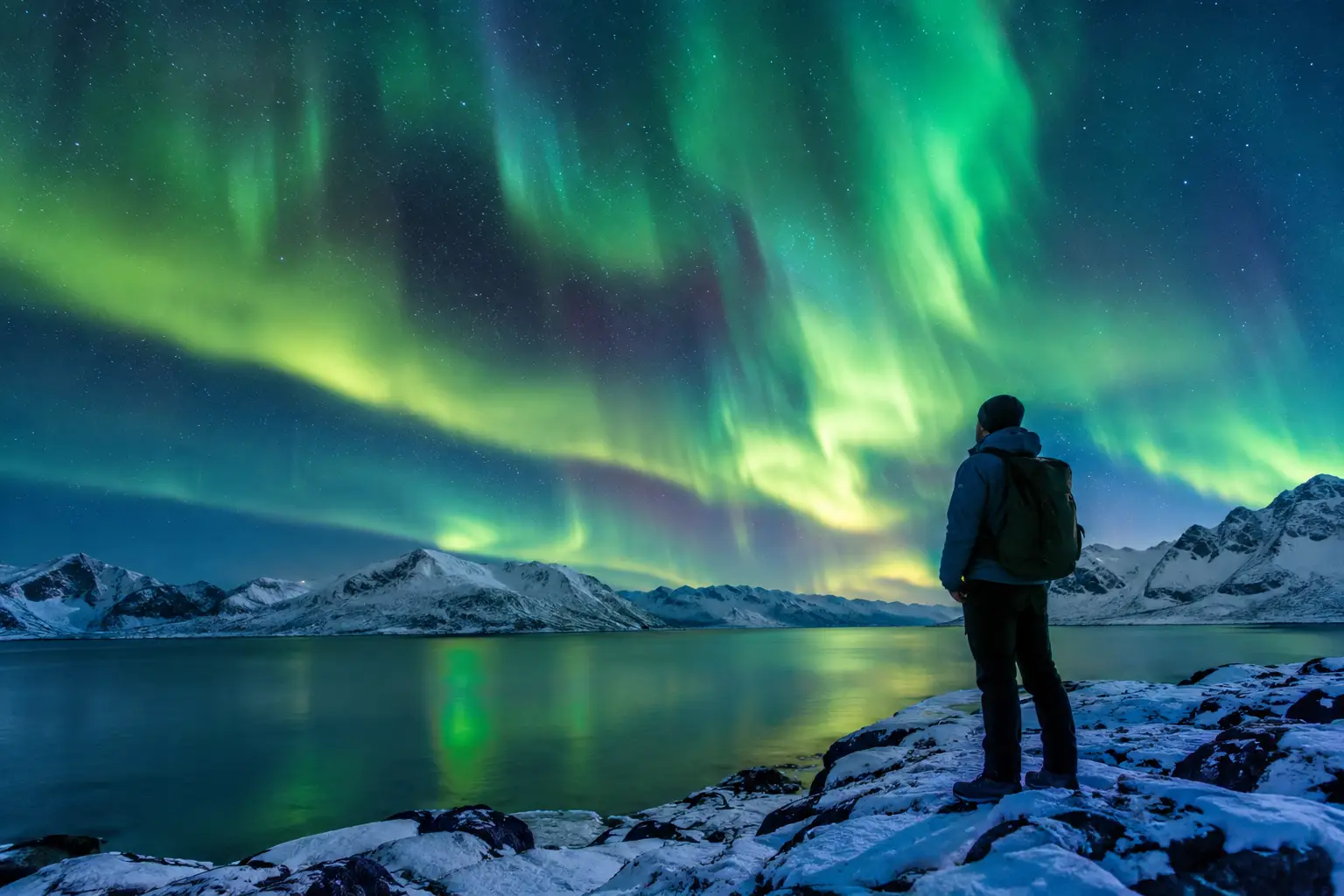
A bright aurora can appear on a relatively modest night, while a headline-making space-weather event can leave travelers staring at a cloudy sky. That is the practical truth about solar storms: they create the potential for stronger Northern Lights, but they do not guarantee what you will see from the ground.
For aurora travelers, the goal is not to chase dramatic terminology. It is to understand what is happening between the Sun, Earth, and your exact viewing location - then make a good decision before you drive an hour into the dark, book a tour, or set up a camera in subfreezing temperatures.
What are solar storms?
Solar storms are disturbances caused by activity on the Sun. The Sun constantly releases charged particles into space as the solar wind. Sometimes that flow becomes faster, denser, or more magnetically complex. In larger events, the Sun can release an enormous cloud of magnetized plasma called a coronal mass ejection, or CME.
When these particles and magnetic fields reach Earth, they interact with our planet's magnetic field. Some energy enters the upper atmosphere near the poles, where it excites oxygen and nitrogen. As those gases release energy, they produce the light we call the aurora.
The phrase “solar storm” covers several different events. A solar flare is a burst of radiation from the Sun. A CME is a traveling cloud of solar material. A high-speed solar wind stream often comes from a coronal hole, a region where the Sun's magnetic field allows solar wind to escape more easily. All can matter, but they affect aurora conditions in different ways and on different timelines.
A flare can reach Earth quickly in the form of radiation, while a CME may take roughly one to several days to arrive. A coronal-hole stream can produce recurring periods of unsettled geomagnetic activity as the Sun rotates. That is why a forecast saying “solar activity is possible” is not the same as a prediction that the lights will be visible at 10:00 p.m. from your hotel.
Why solar storms can strengthen the Northern Lights
Earth's magnetic field usually shields us from much of the solar wind. The key word is “usually.” When incoming solar wind conditions are favorable, energy transfers more efficiently into the magnetosphere, Earth’s magnetic environment. The resulting geomagnetic disturbance can push aurora activity farther south and make the auroral oval brighter or more active.
For viewers in Iceland, northern Norway, Finnish Lapland, Sweden, Greenland, Alaska, Svalbard, and Northern Canada, stronger activity can mean a more dramatic display overhead: faster-moving arcs, brighter curtains, visible rays, or a broader sky filled with green. During exceptional events, aurora can be seen much farther from the poles.
But strength is only part of the story. An aurora overhead may still look faint to the eye if the activity is diffuse, moonlight is strong, or the sky is not fully dark. Conversely, a compact active arc can deliver a memorable display even when broad regional indexes do not look extraordinary.
Solar wind speed: more energy can arrive faster
Solar wind speed is measured in kilometers per second. Higher values often increase the available energy in the Earth-Sun system, especially when paired with favorable magnetic conditions. A speed increase by itself is not a promise of aurora, but it is a useful signal that conditions may become more dynamic.
Density also matters. Denser solar wind can briefly compress Earth’s magnetic field and add energy to the system. Short-lived density pulses sometimes coincide with sudden aurora intensifications, though the timing and local effect can be difficult to predict precisely.
IMF Bz: the direction that travelers should watch
The interplanetary magnetic field, or IMF, is the magnetic field carried by the solar wind. Its north-south component is called Bz. When Bz turns southward, it is generally easier for solar energy to connect with Earth’s magnetic field. That often improves the chance of active aurora.
A sustained negative Bz is usually more encouraging than a brief dip. If Bz is positive, even fast solar wind may produce less impressive activity than expected. This is one reason a single KP number cannot explain the whole night.
Why KP Index is useful, but incomplete
The KP Index is a global measure of geomagnetic disturbance on a scale from 0 to 9. It is valuable for understanding the overall size and position of the auroral oval. A higher KP can indicate that aurora may reach lower latitudes, which is especially useful for travelers outside the main aurora zone.
In Iceland or Tromsø, however, a high KP is not required for a good experience. These destinations are already near the auroral oval. On a clear dark night, a lower KP can still produce visible Northern Lights. A high KP with cloud cover can produce nothing you can see.
There is also a timing issue. KP is reported in three-hour intervals and represents broad geomagnetic conditions. Aurora can change sharply in minutes. For a traveler deciding whether to leave dinner now or wait another hour, real-time solar wind and Bz can offer more immediate context than KP alone.
This is why AuroraVision combines a Live Aurora Score with solar wind, IMF Bz, KP, cloud cover, moon phase, and local weather rather than treating any one metric as the answer. The free app is most useful when conditions are changing and you need to decide whether tonight is worth the drive.
What a solar storm forecast means on the ground
Space-weather headlines should change your attention level, not replace your travel plan. A predicted CME arrival may raise the odds of a strong display, but arrivals can be early, late, weak, or less favorably oriented than expected. The magnetic field inside the CME matters as much as its arrival.
Think in layers. First, ask whether the sky will be dark enough. Next, check whether your location has a clear view, especially toward the northern horizon if activity is weak. Then look at cloud cover and local weather. Finally, use real-time space-weather conditions to judge whether the aurora is likely to be active right now.
This layered approach matters most in places with fast-changing weather. Icelandic cloud can divide the island into clear and overcast zones on the same evening. In coastal Norway, mountain terrain and local cloud patterns can make a nearby fjord very different from a city forecast. A solar storm may be occurring above both locations, but only one may offer an open sky.
How to plan an aurora night during elevated activity
If a solar storm is forecast, keep your plans flexible. Choose accommodation or a route that gives you options rather than committing to a single viewpoint. Travelers on a self-drive trip should identify several safe legal pull-offs before dark, check road conditions, and avoid stopping where they could block traffic or create a hazard.
Guided tours can be especially useful when you do not know the terrain or regional microclimates. A good local guide can move toward clearer skies, choose a safe viewing area, and help you read a display that may begin as a faint gray-green band before it becomes camera-visible or brightens to the eye.
For photographers, do not wait for a perfect forecast to prepare. Charge batteries, clear memory cards, bring a tripod, and set up a starting exposure before the activity peaks. Bright, fast aurora often requires shorter exposures than a faint arc, so review images as conditions change instead of relying on one fixed setting.
Moon phase deserves a realistic interpretation. A bright moon can wash out faint detail and reduce contrast, but it also lights the landscape beautifully for photographs. Strong aurora can remain impressive under moonlight. Cloud is usually the more decisive obstacle.
Don’t miss a good ordinary night
The most common planning mistake is waiting for a “major” solar storm. Many travelers only have a few nights in an aurora destination, and some of their best chances occur under moderate geomagnetic activity with clear skies. The Northern Lights reward patience, preparation, and fast decisions more reliably than dramatic predictions.
Check conditions after dark, give your eyes time to adapt, and stay out long enough for the sky to change. The best moment may arrive during a quiet-looking forecast window - and it may last only a few minutes.