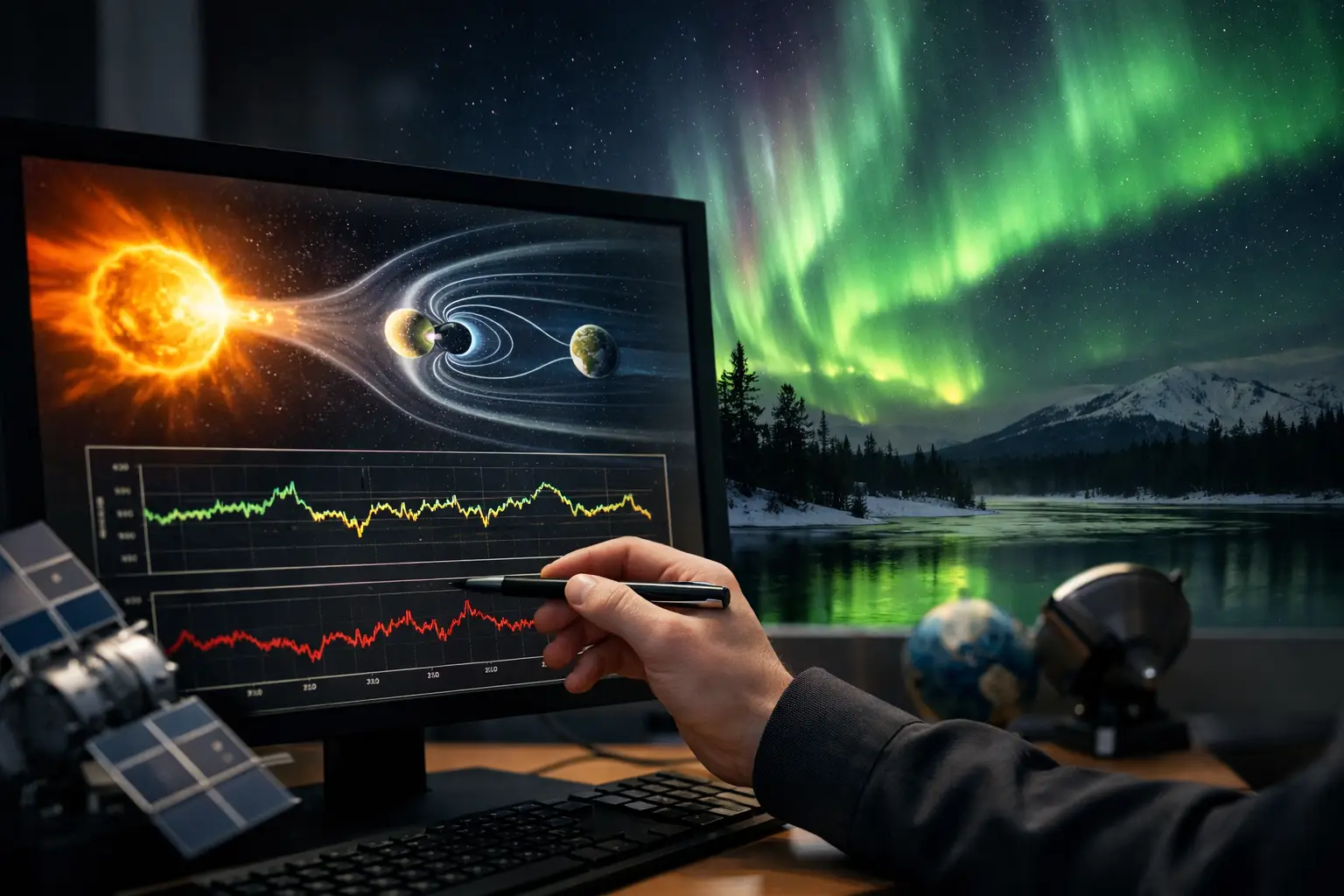
A negative Bz can be the difference between a quiet sky and a sudden burst of Northern Lights. But travelers who try to interpret IMF Bz readings as a simple green-light or red-light signal often leave too early, drive too far, or miss the best window entirely. Bz matters greatly, but it only tells part of the story.
For an aurora forecast you can actually use, read Bz alongside solar wind, local weather, darkness, and your location. That turns a technical space-weather number into a better decision: wait at your hotel, head for a clear-sky area, join a tour, or set an alarm for later tonight.
What IMF Bz means
IMF stands for Interplanetary Magnetic Field. It is the magnetic field carried outward from the Sun by the solar wind. Bz is the north-south component of that field, measured in nanoteslas, or nT.
Earth has its own magnetic field. When the IMF points southward, shown as a negative Bz value, it is better aligned to connect with Earth's field on the sun-facing side. This process transfers energy from the solar wind into Earth's magnetosphere. That added energy can feed geomagnetic activity and, under the right conditions, produce brighter and more active aurora.
When Bz points northward, shown as a positive value, that connection is usually less efficient. Aurora can still be visible, especially at high latitudes such as northern Iceland, Tromso, Finnish Lapland, or interior Alaska, but the solar wind has a harder time delivering fresh energy into the system.
The key point is simple: south is generally favorable. More negative is generally more favorable. But neither rule is a guarantee.
How to interpret IMF Bz readings in real time
Start by looking at the sign. A Bz of -5 nT is southward and supportive of aurora activity. A Bz of +5 nT is northward and less supportive. Values close to zero, such as -1 nT or +1 nT, are usually neutral enough that other conditions deserve more attention.
The magnitude and duration matter more than a single reading. A quick dip to -12 nT may look exciting, but if it lasts only a few minutes, it may not lead to a meaningful response. A Bz holding near -5 nT for 30 to 60 minutes is often more useful because it gives Earth's magnetosphere time to absorb energy.
As a practical travel reference, these ranges can help:
- Between 0 and -3 nT: Slightly favorable, but usually not a major driver on its own.
- Between -3 and -6 nT: A worthwhile supporting signal, particularly with good solar wind speed.
- Between -6 and -10 nT: Strongly favorable if it persists.
- Below -10 nT: Potentially very favorable, especially during elevated solar wind conditions, though a short-lived spike still needs caution.
These are not fixed thresholds. A sustained Bz of -4 nT with fast solar wind can create an excellent night in Iceland. Meanwhile, Bz at -12 nT with slow solar wind, thin cloud, and a poor viewing location may still produce a disappointing experience.
Why solar wind changes the meaning of Bz
Think of Bz as the direction of the door and solar wind as the force pushing against it. Southward Bz helps open the door for energy to enter Earth's magnetic environment. Solar wind speed, density, and pressure influence how much energy is available and how strongly Earth responds.
Solar wind speed is especially useful for aurora travelers. Speeds around 300 to 400 kilometers per second are common background conditions. When speed climbs above roughly 500 km/s and Bz remains southward, the chance of noticeable aurora activity improves. At 600 km/s or more, a sustained negative Bz can support a much more dynamic display.
Density can add short-term impact. A dense solar-wind stream may compress Earth's magnetic field and trigger activity, even if the speed is only moderate. This is why a forecast dashboard should not be reduced to one metric. A strong Bz reading can lose its advantage if wind conditions are weak, while a modest negative Bz can become meaningful during fast, dense solar wind.
There is also a timing delay. Most solar-wind monitors sit far upstream from Earth, near the L1 point between Earth and the Sun. Their measurements may reach Earth roughly 15 to 60 minutes later, depending on solar wind speed and data processing. Treat Bz as an approaching condition, not an instant report from directly overhead.
Bz does not tell you whether you can see the sky
This is the most common forecasting mistake. Bz measures space weather. It does not measure clouds, precipitation, road conditions, moonlight, city lights, or whether the aurora oval reaches your exact location.
A cloud-free sky with a modest aurora is more valuable than excellent solar-wind data behind solid cloud cover. In Iceland, for example, conditions can change dramatically across a short drive. A traveler near Reykjavik may see overcast skies while a clearer area opens along the south coast or toward Borgarfjordur. Safe road conditions, wind, and daylight must always shape that decision.
Moon phase also affects the experience, particularly for photographers. A bright moon can wash out faint detail, but it can illuminate snowy landscapes and add foreground interest. Strong aurora remains visible under moonlight. The best choice depends on whether you are chasing a faint green arc, photographing a landscape, or simply hoping to see a memorable display.
KP Index adds useful context, but it is not a live local viewing guarantee. KP describes global geomagnetic disturbance over a time period, while Bz and solar-wind readings show conditions arriving now or soon. Neither replaces a local cloud forecast.
A practical decision routine for tonight
Before committing to a drive or tour, check whether you have the three things that matter most: darkness, clear or clearing skies, and space weather that is at least supportive.
First, look for a negative Bz trend rather than one isolated low number. Next, check whether solar wind speed is elevated or rising. Then compare that opportunity with cloud cover at your intended viewing area. If skies are clear and Bz is moderately negative, it is often worth getting outside even when the KP Index looks unremarkable.
If Bz is strongly negative but your local sky is cloudy, do not assume the night is lost. Check nearby areas, but only travel if the forecast suggests a real clearing and conditions are safe. Travelers on guided tours should ask whether the operator can move toward clearer skies. Independent road-trippers should avoid turning an aurora chase into a hazardous drive.
If Bz turns northward after a productive southward period, stay patient. Aurora activity can continue as energy already stored in Earth's magnetosphere is released. This can happen in pulses, often called substorms, where a quiet arc suddenly brightens, expands, or develops visible movement. A positive Bz is a reason to manage expectations, not necessarily pack up immediately.
Read the trend, not the headline number
A graph tells a better story than a single number. Look for a Bz line that stays below zero, repeated southward dips, or a transition from positive to sustained negative values. Pair that graph with the solar-wind speed trend. Rising speed and persistent negative Bz are generally more encouraging than either metric alone.
AuroraVision brings these signals together in its Live Aurora Score, alongside real-time solar wind, IMF Bz, cloud cover, moon phase, weather, and Best Time Tonight guidance. That combined view is more useful than chasing KP alone because it answers the travel question behind every forecast: will you have a realistic opportunity to see aurora from where you are?
When a modest Bz reading is enough
At high aurora latitudes, you do not need dramatic numbers every night. In northern Norway, Swedish Lapland, Finnish Lapland, Greenland, and parts of Alaska and Northern Canada, a faint arc can appear during relatively calm conditions if the sky is dark and clear. Cameras may record green color before your eyes detect more than a pale gray-green band.
Farther south, stronger geomagnetic activity is usually needed for aurora to reach lower latitudes or become obvious. That is where sustained negative Bz, faster solar wind, and broader geomagnetic disturbance become more significant.
Your goal is not to wait for a perfect dashboard. It is to recognize a reasonable window, get under clear skies, let your eyes adjust for at least 15 to 20 minutes, and keep watching. The best Bz reading is only useful if you are outside when the sky responds.