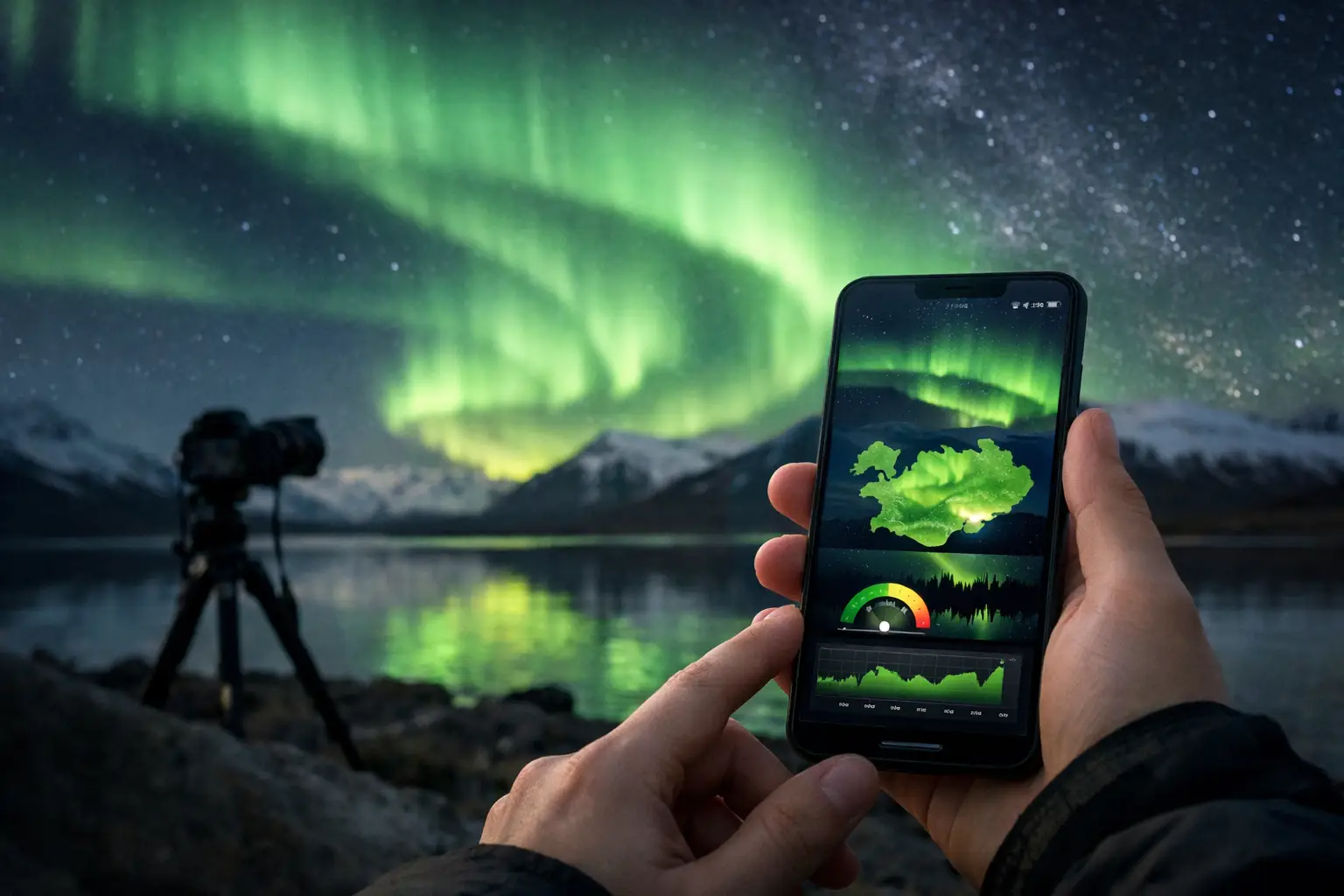
A clear sky over Reykjavík can make an Iceland aurora alert app feel unnecessary - until the lights appear for 20 minutes while you are indoors checking only the KP Index. Aurora viewing is a moving target. The best alert is not simply a notice that geomagnetic activity is high; it is a timely signal that space weather and your local sky may finally line up.
For travelers with only a few nights in Iceland, that distinction matters. You need to know whether it is worth putting on warm layers, leaving your hotel, joining a tour, or waiting for the next cloud break. Good alerts turn a forecast into a practical decision.
What an Aurora Alert Should Actually Tell You
An aurora alert should answer a simple question: Will you see aurora tonight, where you are? It cannot guarantee a display, but it should give you the most useful evidence available at that moment.
The aurora begins far above Iceland, when energy from the solar wind interacts with Earth’s magnetic field. Conditions can strengthen or weaken quickly. Meanwhile, a favorable aurora overhead is irrelevant if low cloud, rain, or snow blocks the view. Moonlight does not stop the aurora, but it can make faint displays harder to notice and affects how dramatic the sky appears in photographs.
That is why KP alone is an incomplete alert trigger. KP is a broad, three-hour index that describes recent global geomagnetic activity. It is useful for context, especially when planning expectations before a trip, but it does not describe every short-lived surge or tell you whether clouds are covering your precise viewing area.
A useful Iceland alert combines several live signals: current solar wind conditions, the IMF Bz direction, geomagnetic activity, local cloud cover, weather, and moon phase. It should then translate those inputs into a clear, location-aware viewing recommendation.
Why Solar Wind and IMF Bz Matter Tonight
Solar wind is a stream of charged particles flowing from the Sun. Faster, denser solar wind can increase the energy available to drive aurora activity. But speed is not a standalone answer. The magnetic field carried within that solar wind is also critical.
IMF Bz is the north-south component of that magnetic field. When Bz turns southward, it can connect more efficiently with Earth’s magnetic field and allow more energy into the magnetosphere. A sustained negative Bz is often a favorable sign for aurora watchers in Iceland. A positive Bz can reduce the chance of activity even when other numbers look exciting.
Neither metric should be read as a promise. Conditions measured upstream in space take time to reach Earth, and auroral activity can be uneven. Think of solar wind and Bz as the engine behind the forecast, while cloud cover determines whether you have a windshield view.
AuroraVision brings these live inputs together through its Live Aurora Score, alongside solar wind, IMF Bz, KP, cloud cover, moon phase, and weather. Rather than asking travelers to interpret every chart at midnight, the free app is designed to show the practical opportunity and send smart alerts when conditions deserve attention.
Choose Alerts That Respect Iceland’s Microclimates
Iceland’s weather can vary sharply over a short drive. Reykjavík may be cloudy while a clearer pocket opens on the Reykjanes Peninsula, near Þingvellir, or farther along the south coast. Conversely, an apparently clear aurora map does not make a late-night drive sensible if wind, ice, visibility, or road conditions are poor.
For that reason, an alert should not encourage automatic chasing. Use it as the prompt to check the local forecast, the sky outside, and your route before you go. If you are staying in the capital, a guided Northern Lights tour can be a practical choice: local guides can adjust their route based on clouds, know legal pull-offs, and save you from navigating unfamiliar roads in difficult conditions. If you are on a self-drive trip, choose a nearby dark location you can reach safely and return from comfortably.
Hotels also matter more than many visitors expect. A rural hotel with dark surroundings, open northern horizons, and a place to step outside can turn an alert into a viewing opportunity without a long drive. In winter, that convenience can be worth more than chasing a marginal improvement in the forecast.
Set Alerts for Decisions, Not for Every Fluctuation
An app that sends a notification for every small change quickly becomes noise. The best setup is one that matches your trip and your tolerance for late nights.
If you have a rental car and flexible plans, enable alerts for strong local opportunities and watch for improving cloud cover. If you are relying on tours, use alerts earlier in the evening to decide whether to book, confirm, or prepare. If you are staying near Reykjavík without transportation, an alert can still tell you when to check a darker waterfront area or your hotel grounds, but keep expectations realistic around city lights.
Avoid treating a low score as a reason to stop looking forever. In Iceland, aurora can arrive during a short clear interval, and solar conditions can improve after sunset. The practical approach is to check live conditions periodically, especially between roughly 9 p.m. and 1 a.m., while remembering that the best time changes with season, darkness, clouds, and solar activity.
How to Read an Alert Without Overreacting
When a notification arrives, take two minutes to assess the situation. Start with the Live Aurora Score or equivalent visibility rating. Then look at cloud cover for your location, not just Iceland as a whole. Check whether weather conditions make it safe and comfortable to be outside, and note the moon if you hope to photograph subtle color.
A high aurora score with thick cloud is a reason to look for a safe clear area or wait. A moderate score with a cloud-free sky may be the better choice, especially away from city lights. This is the central trade-off every aurora traveler faces: dramatic space-weather numbers are exciting, but visible sky is nonnegotiable.
Also give your eyes time. The first sign of aurora may look like a pale gray or greenish arc, not the bright ribbon seen in edited photos. Step away from direct lights, allow 10 to 15 minutes for your eyes to adapt, and scan low across the northern sky. A phone camera in night mode can sometimes reveal green color before it is obvious to your eyes, though it should not replace simply watching the sky.
A Simple Tonight Plan
Before dark, identify one nearby viewing spot with a clear horizon and a safe route. Pack a warm outer layer, gloves, a charged phone, and a small light with a red setting if possible. Keep your camera ready, but do not spend the entire display changing settings.
When an alert arrives, compare aurora activity with local clouds. If both are favorable, go outside promptly. If clouds are mixed, wait for a gap or choose a safe nearby area with clearer conditions. If roads are poor, stay close to your accommodation and use the darkness available rather than turning an aurora hunt into a risky drive.
The Difference Between Forecasting and Seeing
Aurora forecasts are probabilities, not reservations. Even excellent real-time data cannot guarantee that a particular traveler will see a particular shape, color, or intensity. A quiet-looking night can surprise you, and a strong geomagnetic event can remain hidden above a solid cloud deck.
That uncertainty is not a flaw in the experience. It is why the most effective travelers stay prepared, use current data rather than a single headline number, and make plans that leave room for a quick decision. In Iceland, the moment often belongs to the people already dressed, already aware of the clouds, and ready to step outside when the alert says conditions are turning in their favor.