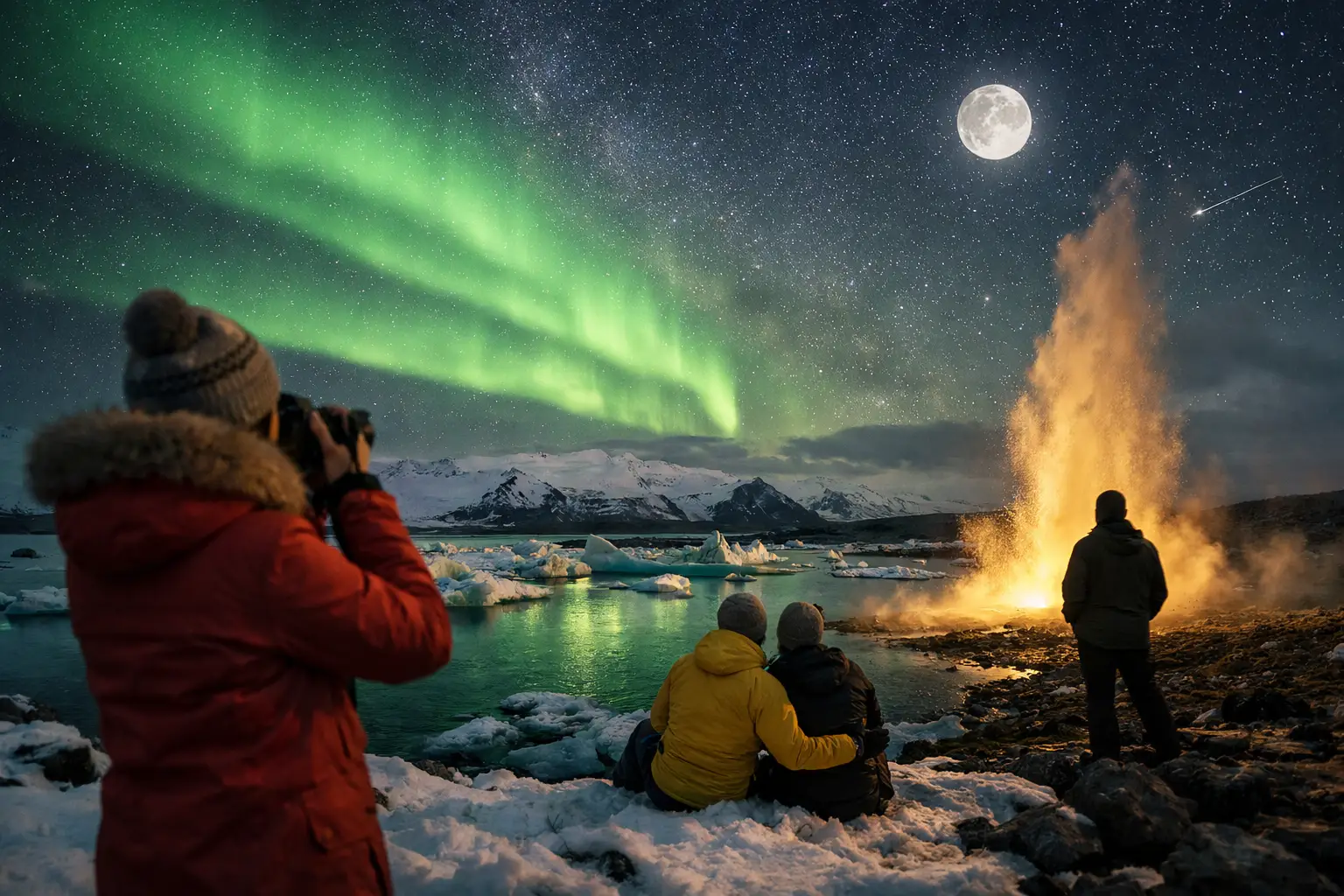
A clear winter night in Iceland can change quickly: one minute the sky is empty, and the next a pale green arc is lifting above a black lava field. Iceland night tours are built around that possibility, but the best experience depends less on a dramatic KP forecast than on cloud gaps, local weather, road conditions, moonlight, and how flexibly you can respond.
For most visitors, a night tour means a Northern Lights outing. Some also combine evening sightseeing, hot springs, snowmobiling, or photography instruction. The right choice is not automatically the longest tour or the cheapest one. It is the one that fits your travel dates, comfort level, and ability to make a second attempt if nature does not cooperate.
What Iceland Night Tours Are Really Like
Aurora tours usually leave Reykjavik between 8:00 and 10:00 p.m. from late August through mid-April, when nights are dark enough for viewing. Expect to be outside for several hours, often in open countryside rather than at a fixed attraction. Guides follow weather patterns and cloud forecasts, sometimes changing direction shortly before departure to find clearer skies.
That mobility is valuable. Iceland’s weather is famously local: Reykjavik may be cloudy while the Reykjanes Peninsula, Thingvellir area, or South Coast has a useful break in the cloud. A good operator is not promising a show. They are giving you better logistics, local driving knowledge, warm transport, and an experienced person making real-time decisions.
The aurora itself may look different from the photos. A faint display can appear gray-white to the naked eye, while a camera on a longer exposure brings out green, purple, or red. Stronger activity can be obvious and moving, but even then, clouds can end the night early. Go with realistic expectations and treat the landscape, stars, and winter atmosphere as part of the experience.
Choose the Right Iceland Night Tour Format
Large coach tours
A coach tour is usually the simplest option for first-time visitors staying in central Reykjavik. Pickup is easy, prices are often lower, and you do not need to drive icy roads after dark. The trade-off is flexibility. A large group moves more slowly, and the guide must choose locations that work for a bus rather than a small vehicle.
This option suits travelers with one or two nights in the city, especially if they prefer a straightforward evening without navigation or parking concerns.
Small-group and photography tours
Small-group tours typically use minibuses or modified vans. They can sometimes reach quieter viewing areas and adjust their route more easily. The atmosphere is more personal, and photography-focused trips may include help with focus, exposure, tripods, and composition.
They cost more, and no photography tour can create clear skies or high solar activity. Still, they are a strong choice if getting a well-composed image matters as much as seeing the lights. Ask whether equipment is provided, whether the tour includes basic camera instruction, and how much time is spent at each stop.
Private tours
Private tours work well for families, couples, serious photographers, and travelers who want control over pickup time and pace. You may be able to request a quieter location, stop when children need a warm-up break, or build the evening around a special occasion.
The higher price only makes sense if the flexibility matters to you. For a solo traveler or a short, budget-conscious visit, a small group often offers the better balance.
Self-drive aurora chasing
Renting a car gives you the greatest freedom, especially if you are already on an Iceland road trip. You can wait for a cloud break, leave after dinner, and return to the same promising spot on another night. You also avoid a rigid departure schedule.
But winter driving changes the calculation. Wind, ice, blowing snow, darkness, and changing road closures can make an otherwise simple route difficult. Never pull off onto an unsafe shoulder or walk onto private land for a better foreground. If conditions are poor, stay near your accommodation or book a guide instead. No aurora photo is worth a roadside emergency.
Read the Forecast Beyond KP
KP is a broad measure of geomagnetic activity, not a local visibility guarantee. A high KP value can coincide with a completely clouded-out Icelandic sky. A modest KP night can produce a memorable display if the sky is clear, the solar wind is favorable, and you are in the right place at the right time.
For a practical decision, look at several signals together. Solar wind speed and density describe incoming energy from the Sun. IMF Bz describes the direction of the magnetic field carried by that solar wind; a sustained southward Bz can help energy couple into Earth’s magnetic field and support aurora activity. These values change, sometimes quickly.
Then place those space-weather conditions against the factors you can actually see and feel: cloud cover at your intended viewing area, precipitation, wind, moon phase, and the hours of darkness. Bright moonlight does not prevent an aurora, but it can reduce contrast, especially when the display is weak. Clouds are usually the more decisive problem.
The free AuroraVision app brings these moving parts into one view with a Live Aurora Score, solar wind, IMF Bz, cloud cover, moon phase, weather, and smart alerts. Use it before booking a last-minute tour, before leaving your hotel, and again while you are out. The goal is not to chase one number. It is to identify the best window and the clearest reachable area tonight.
Timing Your Tour Around Your Itinerary
Give yourself at least three nights in Iceland if seeing the Northern Lights is a priority. This is not because every night needs exceptional solar activity. It is because multiple nights give you more chances to work around cloud cover and weather. Travelers who book a single tour on their final evening sometimes have no backup when conditions fail.
If you are joining a guided tour, check the operator’s cancellation and rebooking policy before paying. Many companies offer a free retry when no lights are seen, but definitions vary. Some provide another seat only if the tour runs and the guide declares conditions unsuccessful. Others do not issue a refund for a cloudy night. A flexible policy is useful, but it is not the same as a guaranteed sighting.
Avoid booking a demanding morning activity immediately after your only aurora attempt. Tours can return after midnight or much later if the guide finds a late opening. Leave room in your schedule for sleep and, if possible, another night outside.
Dress and Pack for Standing Still
Aurora watching is colder than daytime sightseeing because you are often standing in one place. Icelandic wind can cut through ordinary city clothing, even when the temperature seems manageable.
Bring these essentials:
- A warm base layer, insulating mid-layer, and windproof outer shell
- Insulated boots with grippy soles, plus thick socks
- A hat, gloves, and hand warmers, especially for photographers
- A fully charged phone and a power bank, since cold drains batteries
- A tripod and camera with manual controls if photography is a priority
For phone photography, clean the lens before you leave and use night mode only if you can keep the phone still. A small tripod or stable surface helps more than repeatedly increasing brightness. Most importantly, do not spend the entire display looking at a screen. Let your eyes adjust, watch the sky, and enjoy the movement overhead.
Make the Call Before You Go
A booked tour should not mean you stop checking conditions. Look at the forecast in the afternoon, then again close to departure. If clouds are widespread, ask whether the operator is still planning to run and where they expect to search for breaks. If you are self-driving, choose a conservative route with fuel, warm clothing, and a clear turnaround plan.
When the sky opens, be ready to leave without overthinking it. Iceland rewards travelers who stay patient, dress properly, and use real-time information instead of waiting for a perfect KP number. Keep one extra evening free if you can, turn on alerts, and be ready for the moment the forecast turns in your favor.