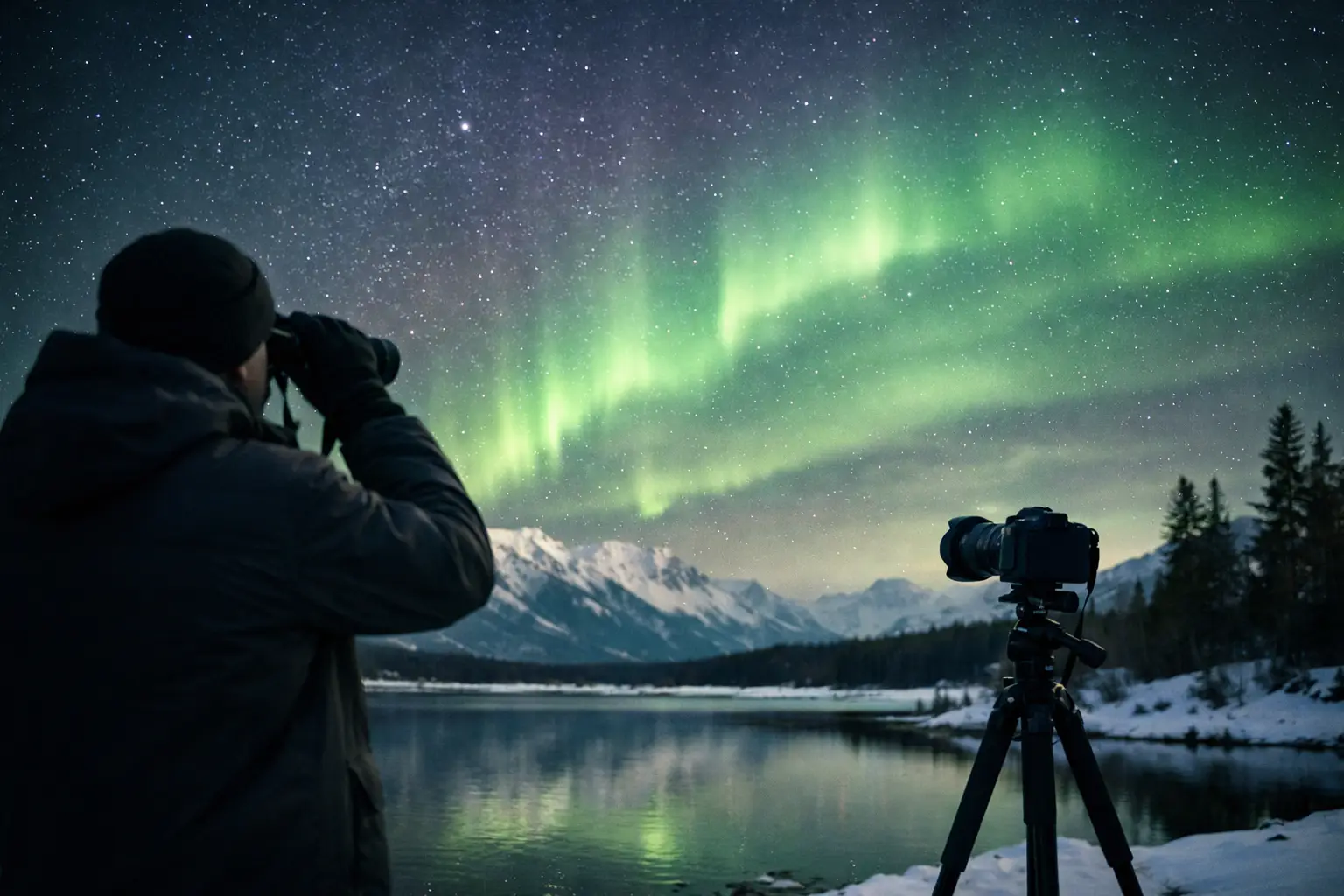
A low KP sufficient for Northern Lights? Often, yes - especially when you are already under the auroral oval. The mistake is treating the KP Index as a simple on-off switch. A quiet-looking KP value can still produce a memorable display above Iceland, northern Norway, Finnish Lapland, Sweden, Greenland, Alaska, or Northern Canada. But the sky must be dark, clear, and active at the right time.
For travelers, this is good news. You do not need to cancel an evening out simply because the forecast says KP 2. You do need to understand what that number does and does not tell you.
Is a Low KP Sufficient for Aurora Viewing?
KP measures geomagnetic activity on a scale from 0 to 9. It is useful because it describes how disturbed Earth’s magnetic field has been over a recent period. Higher KP values generally mean the aurora can become stronger, brighter, and visible farther south.
The key phrase is farther south. If you are visiting a high-latitude destination close to the normal auroral oval, a low KP can be sufficient. A KP 1 or KP 2 night may bring a soft green arc across the northern sky, a moving band overhead, or a stronger burst that lasts only a few minutes. At a location farther from the oval, that same activity may remain below the horizon or be too faint to notice.
This is why a traveler in Reykjavik, Tromso, Abisko, Fairbanks, or Yellowknife should interpret KP differently from someone hoping to see the aurora much farther south. The value is not a promise of brightness at your exact location. It is a broad measure of regional geomagnetic conditions.
A higher KP still helps, particularly for travelers in southern Iceland or those who want a wider, more dramatic display. Yet high KP with thick cloud cover is not useful from the ground. A lower KP under a clear, dark sky can be the better night.
Why KP Alone Can Mislead You
KP is calculated from observations at multiple geomagnetic stations and is reported in time blocks. That makes it a valuable planning tool, but not a minute-by-minute local visibility forecast. Northern Lights activity can change faster than the index does.
Solar wind conditions drive much of that change. The solar wind is a stream of charged particles from the Sun. When its speed increases and the interplanetary magnetic field, known as IMF Bz, turns southward, energy can enter Earth’s magnetic field more efficiently. That can strengthen the aurora quickly, even before a broad KP reading fully reflects the change.
IMF Bz is especially useful because its direction matters. A sustained negative, or southward, Bz often supports better auroral activity. A positive Bz is generally less favorable. Neither value guarantees a display, but together with solar-wind speed and density, it offers a more immediate view of what may happen next.
Then there is the factor that ends more viewing attempts than quiet space weather: clouds. You can have excellent auroral conditions above Iceland and see nothing below a solid cloud layer. Local weather, cloud movement, precipitation, wind, and safe road conditions determine whether you can actually reach and see a clear horizon.
Moonlight also changes the experience. A bright moon does not stop the aurora, especially during stronger activity, but it can wash out faint detail and reduce contrast in photos. Low KP aurora is often more subtle, so darker moon conditions can make a real difference.
What a Low KP Night Can Look Like
Do not expect every low KP display to be a full-sky green explosion. Managing that expectation helps you recognize a good night when it arrives.
At low activity levels, the aurora may begin as a pale gray or greenish band near the northern horizon. It may look more like a long cloud than the bright curtains seen in photographs. Give your eyes time to adjust. Avoid looking at a bright phone screen, and use a red screen setting if available.
A quiet aurora can also be surprisingly photogenic. Modern cameras can capture green color and structure that your eyes may see only faintly. That does not make the experience less real. It simply reflects how cameras collect light over several seconds while human vision prioritizes motion and low-light sensitivity differently.
Low KP is also not always low drama. Short-lived substorms can brighten and animate an otherwise modest night. The arc may suddenly rise, form rays, or ripple across a larger section of sky. These bursts are one reason to stay out longer than a quick ten-minute check.
How to Decide Whether to Go Out Tonight
Use KP as one layer of your decision, then check the conditions that affect your exact viewing window. A practical choice usually comes down to four questions:
- Is your location within or close to the expected auroral oval for the current activity level?
- Are solar wind and IMF Bz supportive, or improving?
- Is there a realistic break in cloud cover during the dark hours?
- Can you reach a dark viewing spot safely, with a clear view north or overhead?
If the answer is mostly yes, a low KP should not stop you. In high-latitude destinations, it may be enough for a worthwhile outing.
AuroraVision is built for this decision rather than a single-number forecast. Its Live Aurora Score combines current solar wind, IMF Bz, KP, cloud cover, moon phase, and local weather so you can compare space-weather potential with the conditions outside your door. Check the Best Time Tonight view before dinner, then use alerts if conditions improve while you are resting or driving back from a tour.
Plan Differently for Tours and Self-Drive Trips
A guided Northern Lights tour can be a smart choice on a low KP night, particularly if you are unfamiliar with the area. Experienced local guides often know which valleys, coastlines, or inland routes are more likely to have breaks in the cloud. They also remove the stress of driving on icy roads in darkness.
Self-drive travelers have more flexibility, but that flexibility needs limits. Choose a small number of safe candidate locations before sunset. Prioritize paved or well-maintained roads, legal parking, and a broad view away from streetlights. Do not chase a tiny cloud gap across difficult roads just because KP has risen by one point.
In Iceland, weather can shift rapidly between the coast and inland areas. In northern Scandinavia, a short drive can move you from cloud to clear sky, but winter roads still require preparation. Carry warm layers, a charged phone, water, and enough fuel. If you plan to photograph, set up before activity peaks so you are not adjusting a tripod while the sky changes.
Hotels can matter too. An accommodation with a dark outdoor area, easy parking, and a visible horizon can turn a low KP night into an easy opportunity. You may not need a long drive if the sky clears where you are staying.
The Better Question Than “What Is the KP?”
Ask, “Will I be able to see aurora from my location during the next few dark hours?” That question combines the science with the travel reality. KP helps answer it, but it cannot answer it alone.
If activity is low but rising, clouds are thinning, and you are near the auroral oval, get outside. Stay patient, watch the whole sky, and let your eyes adapt. The Northern Lights do not need a headline-level KP value to give you a night worth remembering.