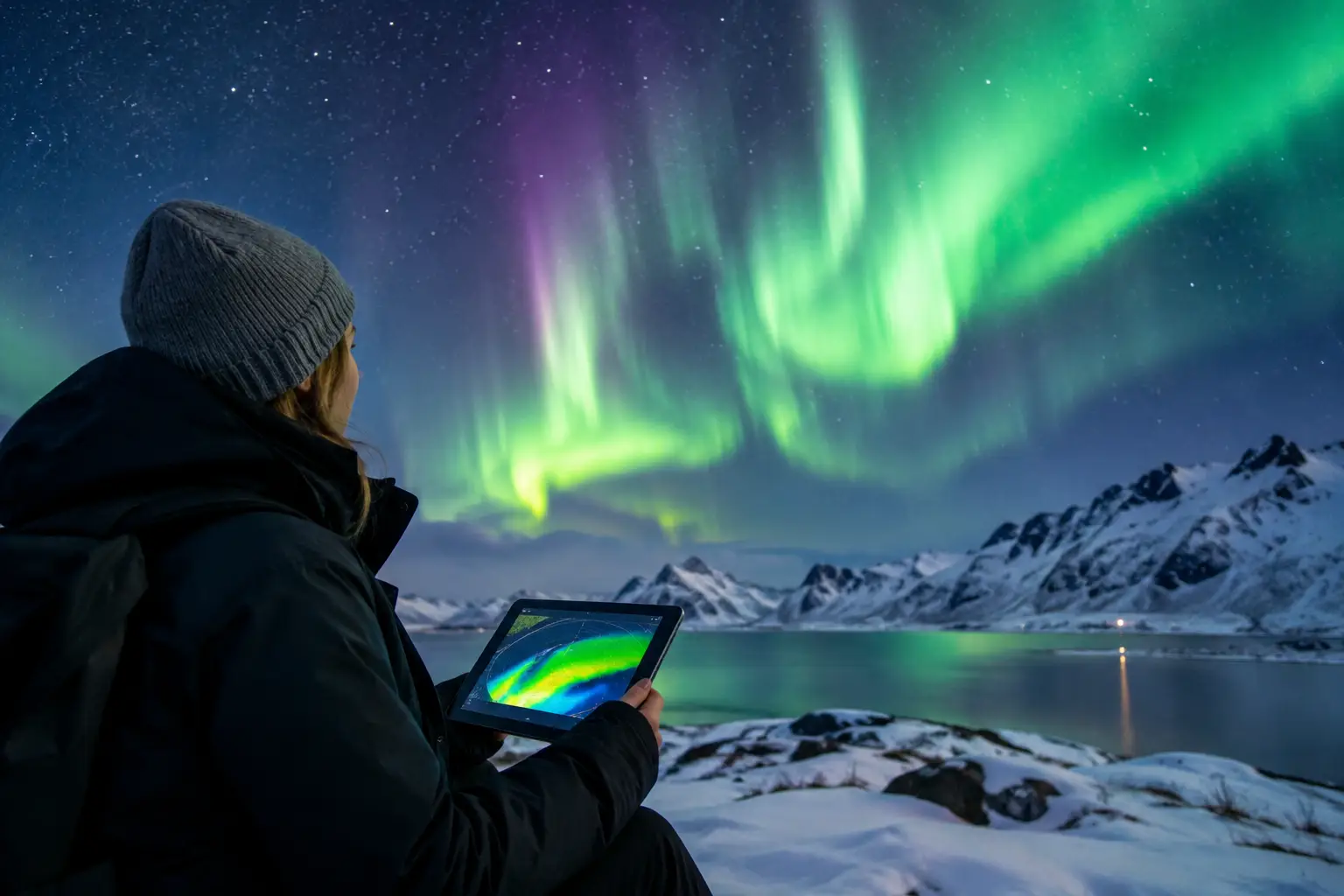
A Kp 5 forecast can produce a spectacular aurora over a clear fjord in Norway and absolutely nothing visible from a cloudy roadside 60 miles away. That is the central problem with KP Index accuracy: Kp describes global geomagnetic activity, not whether you will personally see the Northern Lights from your exact location tonight.
For travelers, Kp is useful context, but it is not a yes-or-no aurora forecast. Treat it as one reading in a larger decision: How strong is the solar wind? Is the IMF Bz pointing south? Is your sky clear? Are you far enough from city lights? Answer those questions well, and you will make much better viewing decisions than someone watching Kp alone.
What the KP Index Actually Measures
The planetary Kp index measures geomagnetic disturbance across Earth. It uses readings from magnetometer stations at mid-latitudes and reports activity on a scale from 0 to 9. A higher number generally means the auroral oval has expanded farther from the poles and may be brighter or visible from more southerly locations.
Kp is usually expressed in thirds, such as Kp 2+, Kp 4-, or Kp 5. Those small differences have scientific meaning, but they should not lead travelers to expect a precise local outcome. The index is calculated from a three-hour period, then released after the fact. Forecast versions of Kp estimate what may happen during an upcoming period, which introduces another layer of uncertainty.
That timing matters. A brief, intense aurora substorm can flare up and fade within 20 minutes. A three-hour planetary average may not capture the peak in a way that tells you when to step outside. Conversely, a high Kp can reflect activity earlier in the interval while conditions have already weakened by the time clouds break over your location.
Why KP Index Accuracy Has Limits
The Kp index is scientifically valid. Its limitation is not that it is wrong, but that travelers often ask it to answer a question it was never designed to answer.
First, Kp is a planetary average. The aurora responds differently around the oval depending on local time, magnetic latitude, and the direction of incoming solar wind. Iceland may have active skies during a moderate Kp event while a location farther south sees little, even under clear conditions.
Second, aurora activity is uneven. The lights often form arcs, bands, and active sectors rather than a uniform ring around the planet. One part of northern Finland can see visible curtains while another has a quiet northern horizon. A forecast number cannot tell you where the strongest local activity will develop.
Third, the view from the ground has nothing to do with geomagnetic activity alone. Thick cloud cover makes a Kp 7 irrelevant. Bright moonlight does not stop a strong aurora, but it can wash out faint structure and reduce contrast for both viewers and cameras. Rain, wind, road conditions, and light pollution also decide whether an otherwise promising night is practical.
Finally, Kp forecasts depend on solar events that may change in transit. A coronal mass ejection can arrive earlier, later, weaker, or stronger than predicted. Even when the timing is broadly correct, its magnetic field orientation can determine whether it couples efficiently with Earth’s magnetic field.
The Live Signals That Matter More Tonight
For a same-night decision, solar wind data and local weather usually provide more useful detail than Kp alone. The most practical signal is IMF Bz, the north-south component of the interplanetary magnetic field. When Bz turns negative, or southward, it can connect more effectively with Earth’s magnetic field and allow energy into the magnetosphere. Sustained negative Bz is often favorable for aurora activity, especially when solar wind speed is elevated.
Solar wind speed provides the energy flow. Speeds above roughly 500 kilometers per second can support stronger displays, although there is no single threshold that guarantees visible lights. Density and pressure can also create sudden responses, particularly when they rise alongside a southward Bz.
These measurements are still not promises. Solar wind monitors observe conditions upstream from Earth, so there is a short delay before the effects reach the auroral zone. Local aurora behavior can also remain variable after the solar wind changes. The value of live data is that it shows the direction of conditions, not that it eliminates uncertainty.
Cloud cover is the next filter. A moderate aurora under clear skies is worth pursuing. A major geomagnetic storm under solid cloud usually is not, unless you can safely drive to a clear-weather zone. Check forecasts at the scale that matters to your route, especially in Iceland, coastal Norway, and the Faroe Islands, where local terrain and fast-moving systems can create sharp differences over a short distance.
What Kp Level Do You Need?
The answer depends on where you are standing. Near and within the auroral oval, including much of Iceland, northern Norway, northern Sweden, northern Finland, Greenland, Alaska, Svalbard, and Northern Canada, a low to moderate Kp can be enough. Kp 1 to 3 may still produce a visible arc, soft green glow, or an active display if skies are dark and clear.
At lower latitudes, a higher Kp matters more because the auroral oval must expand southward. Even then, visibility is not guaranteed. A Kp 6 or 7 may improve your geographic chances, but clouds and light pollution can still end the night before it starts.
This is why “Kp 4 is bad” is a poor rule for Arctic travelers. If you are already under the oval, waiting only for high Kp can cause you to miss many good nights. A clear Kp 2 night with a southward Bz and a dark viewing site can be much more rewarding than a cloudy Kp 6 night.
A Better Decision Process for Aurora Chasing
Start by checking whether darkness is available. During the bright summer season, geomagnetic activity can be present but the sky may not be dark enough to see it. Then look at cloud cover along your possible driving route, not just at your hotel.
Next, review live aurora conditions. Look for a favorable trend in solar wind and Bz rather than fixating on one Kp value. If activity is rising and your sky is clearing, be ready to move. If Bz is strongly northward and the solar wind is quiet, it may be reasonable to rest rather than spend hours waiting outside.
Choose a site with an open northern view, minimal artificial light, and a safe place to park. In strong displays, the lights can appear overhead or across much of the sky, but an open horizon remains useful for weaker activity. Give your eyes 15 to 20 minutes to adjust, and do not judge the sky only through a phone screen.
AuroraVision brings these factors together through its Live Aurora Score, live solar wind and IMF Bz readings, cloud cover, moon phase, weather, and timing tools. That combination is more practical for a traveler deciding whether to leave now, wait an hour, or drive toward clearer skies than a Kp forecast in isolation.
When a High Kp Forecast Is Still Worth Acting On
A high Kp forecast should get your attention, particularly if you are traveling near the southern edge of usual aurora visibility. It may create a rare opportunity for stronger colors, faster movement, and a wider display. Keep expectations realistic, though: the forecast is a reason to monitor conditions closely, not a guarantee of an overhead show.
If a strong event is predicted during your trip, prepare before dark. Charge camera batteries, fuel the vehicle, identify safe viewing areas, and check whether roads are suitable for night driving. Guided Northern Lights tours can be especially useful when weather is difficult, since experienced local guides can interpret clouds, select safer routes, and adjust plans quickly.
The best aurora nights often do not arrive with a dramatic Kp headline. They arrive when clear skies, darkness, a good viewing location, and a timely burst of solar activity line up. Watch the full picture, stay flexible, and be ready to go when the sky gives you a real opening.