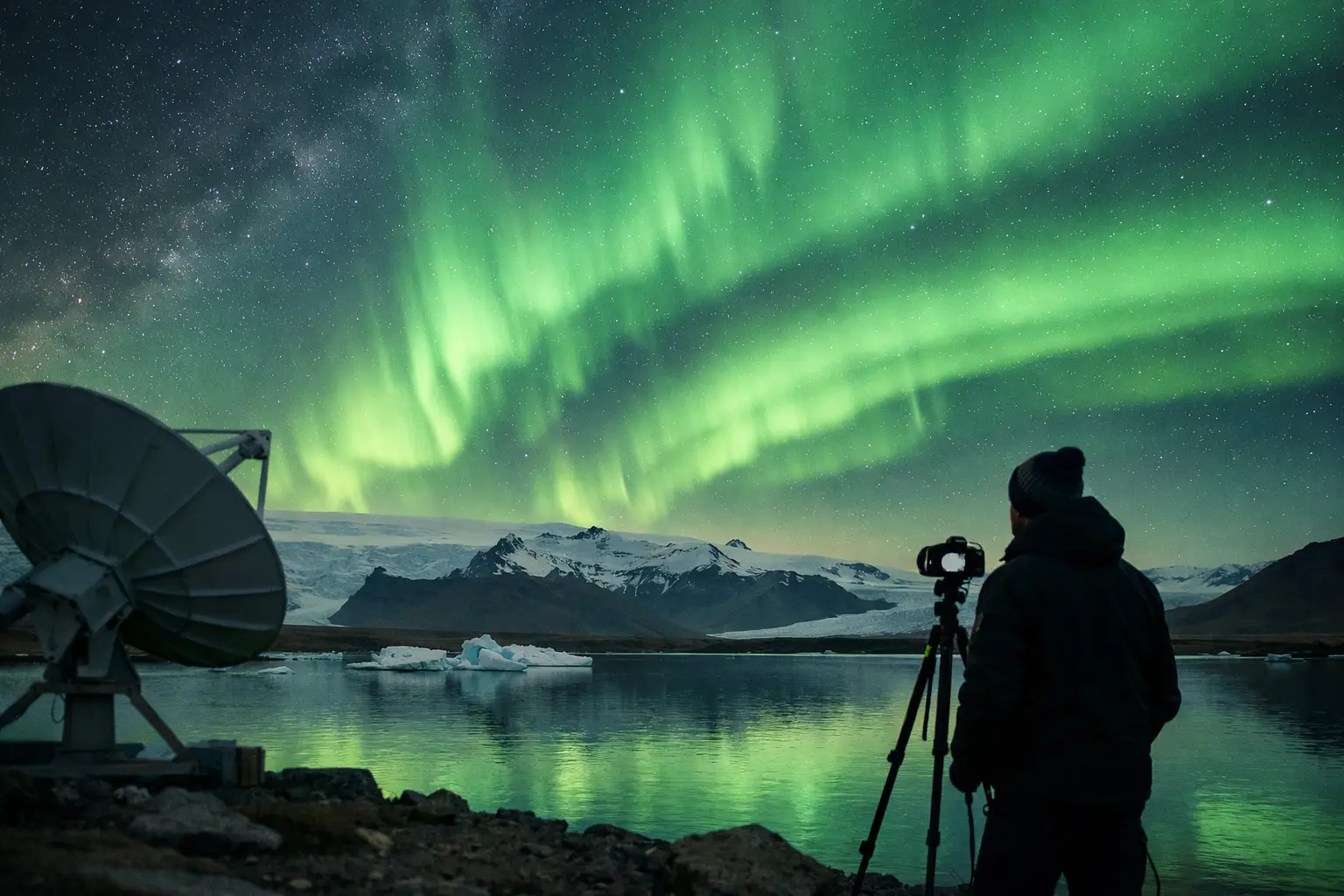
A KP index Iceland forecast can look disappointing on paper and still produce a memorable Northern Lights display. That is the first rule travelers should know before canceling a night drive, skipping a tour, or going to bed early. Iceland sits far enough north that aurora can be visible during modest geomagnetic activity, provided the sky is dark and clear.
The KP Index is useful, but it is not a yes-or-no aurora forecast. It describes global geomagnetic activity over a three-hour period. Your actual chance of seeing lights from a specific Icelandic beach, mountain pass, or hotel depends just as much on cloud cover, local weather, darkness, and the solar wind conditions reaching Earth right now.
What Is the KP Index?
KP is a scale from 0 to 9 that measures disturbances in Earth’s magnetic field. A higher number generally means the auroral oval expands farther south and may become more active. The scale is calculated from magnetic observations at stations around the world, so it is a broad planetary measurement rather than a precise prediction for one Icelandic location.
For Iceland travelers, the practical question is not simply, “Is KP high?” It is, “Is the auroral oval active enough for my latitude, and do I have a clear, dark view of the northern sky?” A KP 2 night with clear skies can beat a KP 5 night hidden beneath thick cloud.
KP values are often presented as whole numbers, but forecasts may show fractional values such as KP 2.33 or KP 4.67. Treat those decimals as a sign of changing activity, not as a promise of a particular brightness or color. The index is best used to set expectations and choose how far you are willing to travel for clearer skies.
KP Index Iceland Levels: What Travelers Can Expect
Because Iceland is close to the usual auroral zone, lower KP activity is more useful here than it would be in locations farther south. That is good news for travelers visiting during a normal, quiet solar period.
KP 0 to 1: Quiet, but not impossible
At KP 0 or 1, the aurora is usually concentrated well north of Iceland or close to the northern horizon. A faint green band may still appear from northern areas of the country, especially under excellent dark-sky conditions. It is not the night to drive several hours solely for aurora, but it can be worth looking outside if the forecast shows clear skies.
KP 2 to 3: A realistic Iceland aurora night
KP 2 and KP 3 often provide worthwhile viewing opportunities across Iceland. The lights may begin as a pale arc, a low green glow, or a subtle band that brightens in short bursts. Cameras can reveal more color and structure than your eyes initially see, but a visible display is entirely possible.
For many visitors, this is the range where good planning matters most. Leave the city lights behind, find a safe viewing location with an open northern horizon, and stay patient. Aurora can strengthen dramatically for 10 minutes, then fade again.
KP 4 to 5: Stronger potential, greater competition from weather
At KP 4 or KP 5, the auroral oval is more likely to expand over Iceland and displays can become brighter, taller, and more widespread. This is the level that gets attention on social media, but it also creates a common mistake: travelers focus on the number and ignore clouds.
If most of the country is overcast, a high KP forecast does not help much. On these nights, a flexible road trip plan or a guided tour that can relocate toward breaks in the cloud may be more valuable than waiting at one fixed hotel.
KP 6 to 9: Rare, powerful, and still not guaranteed
High KP events can bring striking aurora to Iceland and visibility much farther south than usual. During a geomagnetic storm, curtains may stretch overhead, colors can become more obvious, and activity may be visible for longer periods. But even a major storm cannot shine through dense clouds, and strong winds, icy roads, or poor visibility can make travel unsafe.
Do not chase a high number at the expense of sensible travel decisions. Check road and weather conditions, dress for long periods outside, and choose a legal, safe place to stop. The best aurora experience is never worth creating a roadside hazard.
Why KP Alone Does Not Tell You if You Will See Aurora Tonight
The KP Index is calculated over a multi-hour window and reflects global magnetic activity. Aurora responds to conditions in space much faster than that. A sudden change in the solar wind can make the display strengthen or weaken within minutes.
Solar wind speed matters because faster particles carry more energy toward Earth. Density and pressure can also trigger short-lived bursts of activity. Another key measurement is IMF Bz, the north-south direction of the interplanetary magnetic field. When Bz turns southward, it can connect more effectively with Earth’s magnetic field and increase the chance of stronger aurora.
That is why a low or moderate KP value can occasionally produce an exciting display when solar wind and Bz are favorable. The reverse is also true: a respectable KP forecast may underperform if the real-time solar wind weakens or Bz remains northward.
Then there is the condition that matters most from the ground: cloud cover. Iceland weather changes quickly, and a forecast for “partly cloudy” can mean a clear northern horizon in one valley and complete overcast 30 miles away. Wind, rain, snow showers, fog, and mountain clouds all affect whether you can actually see the sky.
Moon phase adds another trade-off. A bright moon can wash out faint aurora, particularly in photographs, yet it also lights up Iceland’s landscapes and makes travel easier. Strong aurora remains visible under moonlight. If the display is weak, choose a darker location and avoid looking at phone screens or car interior lights before your eyes adjust.
How to Use KP for Better Iceland Travel Decisions
Start by using KP as a planning filter. If the forecast is KP 2 or higher during the dark season, keep your evening open and check conditions after dinner. At KP 4 or above, be prepared to travel for a clearer sky if weather and roads allow. At KP 0 or 1, prioritize other evening plans but remain alert if you are already in a dark, clear location.
Next, choose your base carefully. Reykjavík offers convenience, restaurants, and easy access to services, but city light pollution reduces contrast. Even a short drive beyond the brightest areas can improve the view. In rural regions, you may have darker skies, though you should confirm parking, road access, wind exposure, and weather before heading out.
Timing also matters. There is no fixed nightly aurora hour, but the period from late evening through the early morning is often productive. A weak arc can appear early, disappear, and return much stronger after midnight. Give yourself at least an hour outside when conditions are promising, rather than making a five-minute check from a hotel doorway.
For live decisions, use a forecast that puts the measurements together. The free AuroraVision app combines Live Aurora Score, real-time solar wind, IMF Bz, KP Index, cloud cover, moon phase, and weather so you can judge the whole situation instead of chasing one headline number. Smart alerts are especially helpful when you are warming up indoors or traveling with a group that needs time to get ready.
A Simple Tonight Checklist
Before leaving, confirm that the sky is likely to be clear where you plan to stand, not just somewhere else in Iceland. Check the current aurora activity alongside solar wind and Bz, then compare it with the hourly weather forecast. Bring insulated layers, gloves, a hat, and warm footwear because waiting comfortably is often the difference between seeing the best burst and leaving too soon.
If you are driving, fill the fuel tank, keep a charged phone, and avoid stopping on narrow roads or in unsafe pullouts. Iceland’s scenery can make any dark roadside look inviting, but wind, ice, and limited visibility demand caution. Travelers without a rental car may prefer a reputable Northern Lights tour on nights when conditions are favorable, especially if local guides can move toward clearer skies.
The KP Index gives you a useful starting point, not a verdict. Watch the sky, stay flexible with your location, and let real-time conditions guide your evening - because the best Iceland aurora nights are often the ones that improve after the forecast first looked ordinary.