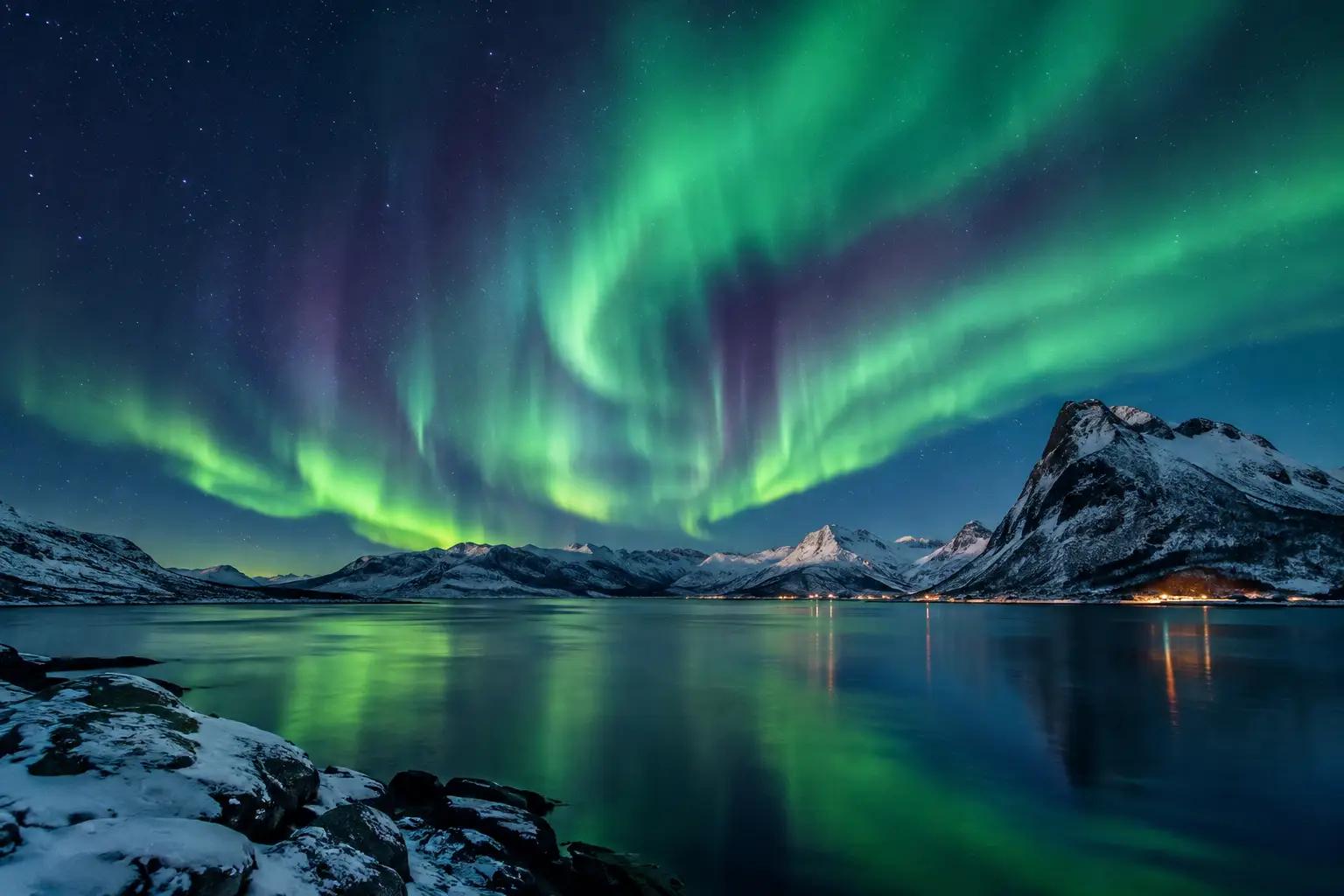
A KP index of 5 can sound like a guaranteed Northern Lights show. It is not. You may still find a clear, active aurora overhead in Iceland at KP 2, or see nothing at KP 6 because thick cloud has moved in. The useful question is not simply, “What is the KP?” It is, “Will I see aurora tonight from where I am?”
The KP index remains one of the most recognized space-weather measurements for aurora travelers. It gives valuable context, especially when you are deciding whether the lights may reach farther south than usual. But it is only one part of the forecast. Understanding what it measures, what it misses, and when to act on it will save you from both unnecessary late-night drives and missed displays.
What is the KP index?
The KP index is a planetary measure of geomagnetic activity. Earth’s magnetic field shifts when energy from the solar wind interacts with the magnetosphere. Ground magnetometers detect those changes, and scientists combine readings from stations around the world into a scale running from 0 to 9.
A higher number generally means a stronger global geomagnetic disturbance. Stronger disturbances can push the auroral oval - the ring of aurora around each magnetic pole - farther toward lower latitudes. That is why KP attracts attention from travelers in places such as southern Norway, Scotland, the northern United States, and Canada.
The scale is usually reported in three-hour blocks. A value near 0 or 1 indicates very quiet conditions. KP 3 is moderate activity, while KP 5 or higher is commonly associated with a geomagnetic storm. Values above KP 6 are more unusual and can create opportunities well south of the Arctic.
That description is useful, but it also reveals the index’s first limitation: it is planetary and averaged. It was not designed to tell you whether a specific beach outside Reykjavik, fjord in Norway, or cabin in Finnish Lapland has visible aurora at 10:45 p.m.
Why a high KP index does not guarantee aurora
KP describes magnetic disturbance, not the complete viewing experience. Northern Lights visibility requires several conditions to line up at the same time: solar energy must be reaching Earth, your location must be under or close enough to the auroral oval, the sky must be dark, and clouds cannot be blocking the view.
A high KP reading can arrive after the most dramatic solar-wind conditions have already passed. It can also reflect activity detected across a broad region while your local section of the oval is quiet. Conversely, a modest KP level can produce vivid overhead curtains in Iceland, northern Norway, Sweden, Finland, Alaska, Greenland, Svalbard, and Northern Canada because these destinations already sit close to the typical auroral zone.
Cloud cover is the most practical reason a promising KP forecast fails. No matter how active the sky is above the clouds, you cannot photograph or see it through an overcast layer. Weather also affects access. Wind, icy roads, blowing snow, and poor visibility may make the best-looking map location a poor choice for an independent drive.
Moonlight deserves a more careful interpretation. A bright moon does not stop the aurora. Strong displays can look spectacular under a full moon, and moonlight can brighten snowy landscapes for photographers. However, a weak aurora is easier to see and capture under a darker sky. The trade-off depends on the strength of the display, the camera setup, and whether your priority is faint detail or a brighter foreground.
KP index levels for Arctic travel
For most visitors traveling within the main Arctic aurora zone, chasing a huge KP number is a mistake. A low or moderate reading can be enough when the solar wind is favorable and the sky is clear.
KP 0 to 2: Quiet does not mean impossible
At KP 0 to 2, aurora is usually concentrated farther north and can be less widespread. In northern Iceland or Lapland, it may still appear as a faint arc on the northern horizon, then brighten during short active intervals. This is a good time to choose a dark location with a broad northern view and remain patient rather than assuming the night is over.
KP 3 to 4: A useful range in the aurora zone
KP 3 or 4 often supports worthwhile viewing in Arctic destinations. If local cloud cover is low and solar-wind conditions are active, this range can produce moving bands, green arcs, and occasional overhead activity. Travelers in Reykjavik may need to leave city lights, while guests in darker rural areas can have much better odds.
KP 5 and above: More reach, more expectations
KP 5 marks minor storm-level activity. It can expand viewing opportunities farther south and increase the chance of stronger displays in places already near the auroral oval. It does not mean every location will have a sky-filling show. Treat it as a reason to check conditions more closely, not as a promise.
At KP 6 to 9, the auroral oval may expand substantially, but cloud and timing still decide the experience. These events also bring crowds, especially near popular pullouts and tour meeting points. If you are self-driving, plan your route before dark, keep fuel topped up, and do not stop in unsafe roadside locations simply because an alert arrives.
The real-time data that matter with KP
A better aurora decision combines KP with measurements that show what is happening now. The most useful are solar-wind speed, density, and the interplanetary magnetic field, usually shortened to IMF.
Solar wind is the stream of charged particles flowing outward from the Sun. Faster wind can deliver energy more effectively, but speed alone is not enough. Density can add pressure and trigger changes in Earth’s magnetic field, particularly when it rises sharply.
IMF Bz is especially important because it describes the north-south direction of the magnetic field carried by the solar wind. When Bz turns southward, shown as a negative value, it can connect more efficiently with Earth’s northward field. That connection allows more energy into the magnetosphere and can support stronger aurora. A sustained negative Bz is often more useful for near-term viewing decisions than a broad KP forecast.
None of these readings works as a single magic number. Solar wind can look excellent while Bz remains northward. Bz can turn strongly negative for only a few minutes, creating a brief response rather than an all-night display. This is why live monitoring matters: aurora activity changes in pulses, and forecasts are probabilities rather than appointments.
AuroraVision brings these signals together in its Live Aurora Score alongside real-time solar wind, IMF Bz, cloud cover, moon phase, weather, and best-time guidance. Use the free app before leaving your accommodation, then check again if conditions change. A strong live score under clearing skies is often a better reason to move than a high KP number on its own.
How to use the KP index tonight
Start with your location. If you are in an Arctic destination during aurora season, do not wait solely for KP 5. A KP 2 or 3 can be enough, particularly away from city light pollution. If you are farther south, a rising KP becomes more significant because the auroral oval has farther to expand.
Next, check whether the sky is clear where you can safely reach it. In Iceland and coastal Norway, cloud patterns can vary dramatically over short distances. A modest drive toward a break in the clouds may improve your odds far more than chasing a slightly higher KP forecast. On a guided tour, ask whether the operator is actively selecting locations based on cloud movement and road conditions rather than following a fixed itinerary.
Then watch for live solar-wind changes. A negative Bz, elevated solar-wind speed, and a rising local aurora score can signal that it is time to get outside. Give yourself a full viewing window rather than checking the sky once. Aurora may brighten for ten minutes, fade, and return an hour later.
Finally, prepare for the conditions you actually have. Dress for standing still in cold wind, not for walking from a warm car to a viewpoint. Keep your camera batteries warm, bring a tripod if photography matters, and preserve your night vision by dimming screens and avoiding white lights. If roads are difficult, a guided tour can be a safer choice than an improvised night drive.
Common KP index mistakes
The most expensive mistake is booking an entire trip around a single high-KP forecast. Solar activity cannot be scheduled weeks in advance with that level of precision. Plan several nights in an aurora-friendly location, choose accommodation with an open view or easy road access, and treat any individual forecast as a chance to improve your timing.
Another mistake is confusing the forecast KP with observed KP. Forecast values estimate potential activity. Observed values describe geomagnetic activity that has already occurred during a reporting period. Both are useful, but neither replaces current sky conditions.
Photographers sometimes make a third mistake: assuming an invisible aurora will look dramatic in a long exposure. Cameras can reveal faint color and structure that the eye barely notices, but a technically detectable glow is not always the memorable display most travelers hope for. Set realistic expectations, and enjoy the stars, landscape, and quiet between bursts of activity.
Tonight, let the KP index tell you how broad the opportunity may be. Let live solar conditions, clouds, darkness, and safe access tell you whether it is time to go. The best Northern Lights nights usually belong to travelers who are ready when several small signals line up.