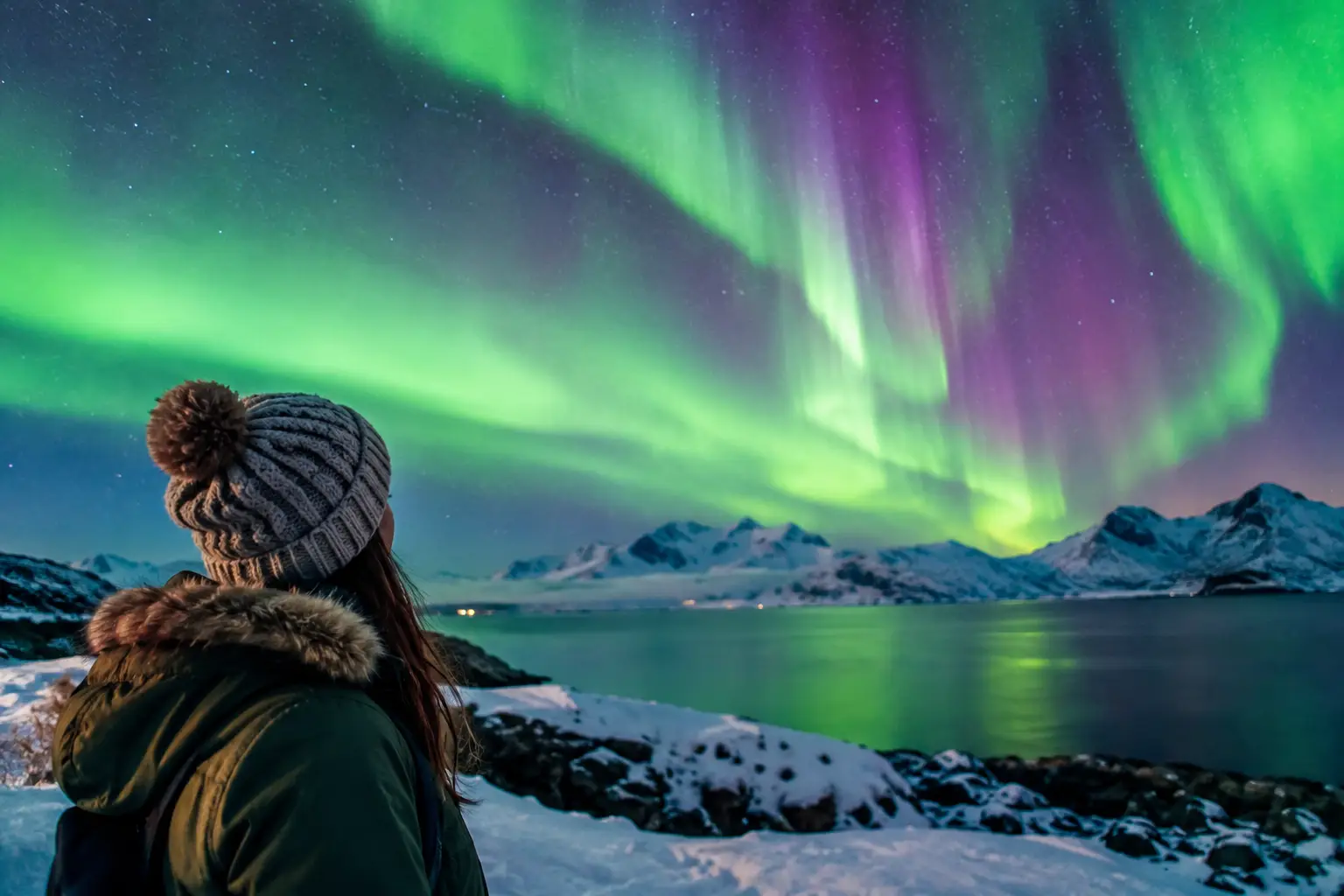
A KP 5 forecast can look exciting on paper, yet still produce a disappointing night beneath thick cloud or weak solar wind. That is the practical problem behind live aurora score versus KP: travelers need to know what is happening where they are, right now, not simply how disturbed Earth’s magnetic field was predicted to be.
KP remains useful. It is one of the fastest ways to understand the broad scale of geomagnetic activity. But it was never designed to answer every question that matters when you are deciding whether to leave a warm hotel room, drive into the dark, or set up a camera on an Icelandic beach. For that decision, a live aurora score offers a more complete operational view.
Live Aurora Score versus KP: the key difference
KP is a planetary geomagnetic index. It summarizes magnetic activity measured at stations around the world on a scale from 0 to 9. Higher KP values generally mean the auroral oval expands farther from the poles, giving people at lower latitudes a better chance of seeing the lights.
That makes KP particularly valuable for planning a trip. A visitor in northern Scotland may need a notably stronger disturbance than someone in northern Norway. In Fairbanks, Alaska, or northern Finland, even modest activity can be enough when the sky is dark and clear. KP helps put that geographic difference into context.
Its limitation is timing. The index is commonly presented in three-hour blocks, and forecasts are estimates based on expected geomagnetic conditions. Aurora activity can brighten, fade, and shift within minutes. A KP number also does not tell you whether the key ingredients are favorable at your exact viewing location.
A live aurora score is designed for that moment-of-decision problem. Rather than treating geomagnetic activity as the whole forecast, it brings together current space-weather signals and local observing conditions. The goal is not to replace KP. It is to translate several moving datasets into a clearer answer to a traveler’s real question: Will you see aurora tonight?
Why a high KP can still lead to a quiet night
A high KP improves the potential reach of the aurora, but visible Northern Lights require more than a large-scale magnetic disturbance. The solar wind has to deliver energy effectively into Earth’s magnetic environment, the aurora has to be active during your darkness window, and the sky over you needs to be usable.
Solar wind speed matters because faster solar wind can transfer more energy into the magnetosphere. Density and pressure can also matter, especially when they change quickly. These values are dynamic, so a forecast issued earlier in the day may no longer reflect what is arriving near Earth.
The interplanetary magnetic field, or IMF, is another critical signal. Its north-south component is called Bz. When Bz turns southward, it is generally more favorable for coupling solar-wind energy into Earth’s magnetic field. A sustained negative Bz can support stronger auroral activity. When Bz turns strongly northward, activity can weaken even if the KP outlook had looked promising.
Then there is the part no space-weather index can solve: cloud cover. A powerful display behind solid overcast is not a visible display. In Iceland and coastal Norway, localized cloud breaks can make a greater difference to your night than a one-point change in KP. Check a cloud map close to departure and be willing to move, if roads and conditions are safe.
Moonlight adds another trade-off. A bright moon does not stop the aurora. Strong displays remain visible, and moonlight can make snowy landscapes easier to photograph. But faint green arcs and subtle structure are harder to see against a bright sky. For photographers chasing detail, moon phase and moon position deserve attention alongside the aurora forecast.
What a live score should help you do
The best forecast is not the one with the most technical numbers. It is the one that helps you make a better choice before the opportunity passes. A useful live score should tell you whether conditions are improving or weakening, when the best time tonight is likely to be, and whether local weather gives you a realistic viewing chance.
AuroraVision’s free app combines a Live Aurora Score with real-time solar wind, IMF Bz, KP, cloud cover, moon phase, weather, and smart alerts. That combination is more actionable than watching a single index because it lets you see why conditions are rated as they are. A rising score with negative Bz and clearing skies is a reason to get ready. A promising KP paired with heavy clouds is a reason to adjust your route, wait for a break, or protect your energy for a better window.
Treat the score as a decision aid, not a guarantee. Aurora science contains uncertainty, and local visibility can vary sharply across a short distance. A live score helps prioritize your time. Your eyes, the sky, and safe travel judgment still make the final call.
How to use KP and live conditions together
Start with KP before your trip or earlier in the day. It gives you the big-picture level of geomagnetic activity and helps set expectations for your destination. If you are staying near the Arctic Circle, do not wait only for dramatic KP values. A lower KP night can still deliver a memorable display when the auroral oval is overhead and local conditions cooperate.
As night approaches, shift your focus from the broad forecast to live data. Look for solar wind and Bz trends rather than a single reading. A southward Bz that holds for a while is usually more encouraging than a brief dip. Watch whether the live score is rising, stable, or falling, and compare it with the cloud forecast for the places you can realistically reach.
Finally, use the conditions to create a simple plan. If the sky is clear now and the live score is strong, go early rather than waiting for a perfect number. If cloud is the main obstacle, identify a nearby clear zone before dark and allow extra driving time. If activity is quiet but improving, stay close to your accommodation or choose a safe viewpoint where you can wait comfortably.
For guided travelers, this is also how to evaluate a Northern Lights tour. A good operator watches weather and road conditions, adapts the route, and understands that chasing clear sky can be as valuable as chasing a high KP forecast. Independent road-trippers should apply the same principle, with conservative decisions around winter roads, wind, visibility, and fuel.
The common KP mistakes to avoid
The first mistake is treating KP as a brightness scale. It is not. KP describes geomagnetic disturbance, not the exact brightness, shape, or duration you will see from one valley, fjord, or parking area. A low-to-moderate KP can produce beautiful overhead curtains in high-latitude regions, while a high KP can appear as a lower glow if conditions are changing or your location is poorly placed.
The second is assuming a three-hour forecast window means three hours of constant activity. Northern Lights often arrive in pulses. You may see a quiet arc for 20 minutes, then a sudden brightening with visible movement, followed by another lull. Give yourself time outside, especially when the live indicators remain favorable.
The third is forgetting the horizon. If activity is weaker or your latitude is farther south, the aurora may sit low in the north. Mountains, buildings, and coastal terrain can block it. Choose a dark location with a broad northern view, but do not stand in an exposed area where wind or unsafe footing turns a viewing stop into a risk.
A better question than “What is the KP?”
Ask: What is my best viewing opportunity tonight? That question naturally includes geomagnetic activity, solar wind, Bz, darkness, cloud, moonlight, location, and travel safety. It also stops you from abandoning a potentially excellent night just because one index is not dramatic enough.
If the live score is building and the sky is opening, do not wait for a headline-worthy KP number. Dress warmly, bring a red-light flashlight, keep your camera settings ready, and head to a safe dark-sky viewpoint. The Northern Lights reward prepared travelers who can act when the conditions line up.