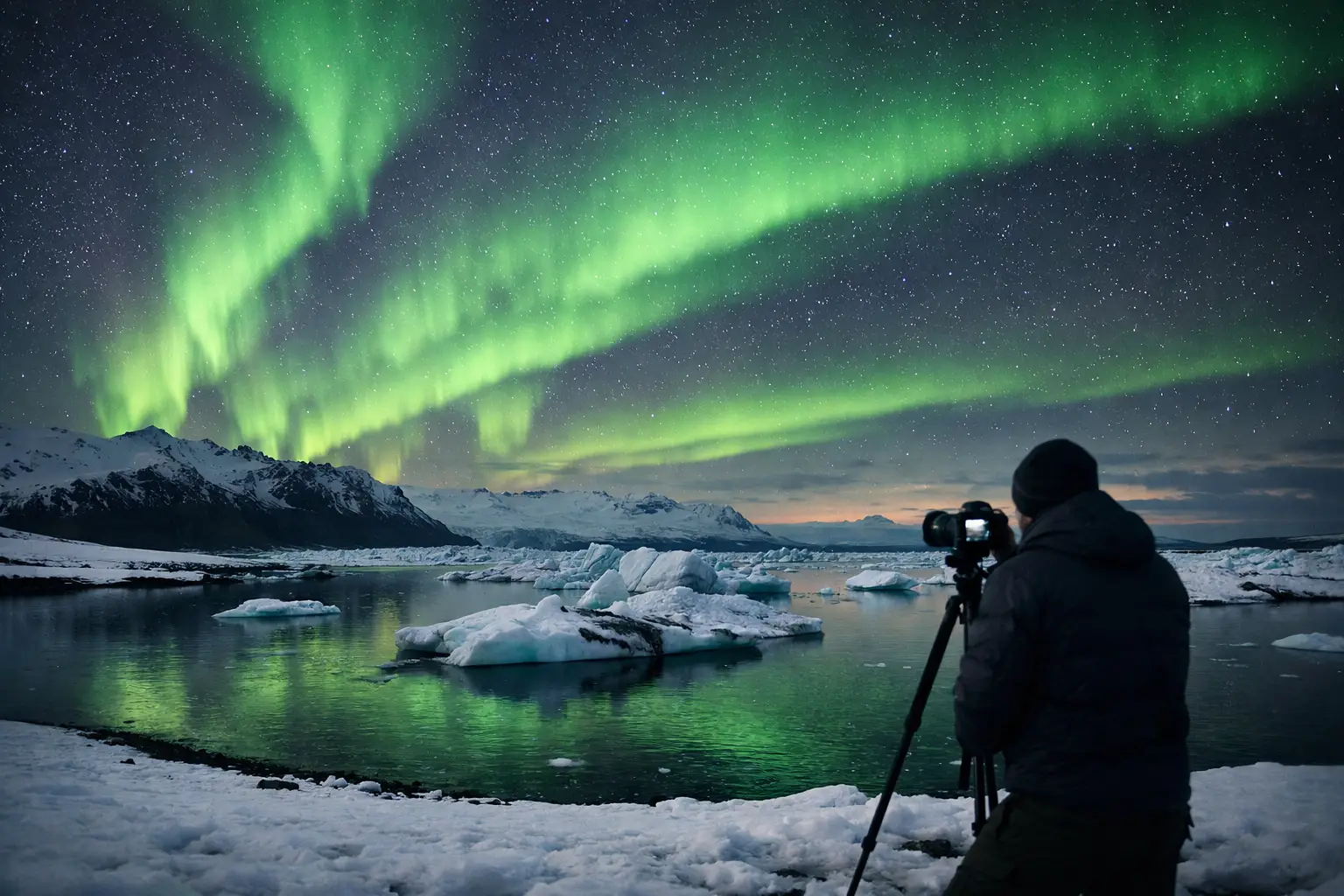
A northern lights forecast Iceland travelers can use is not a single number on a map. It is a moving decision: is there enough aurora activity, is the sky clear where you can reach it safely, and will you be outside during the right window? Iceland can produce unforgettable displays, but its fast-changing weather means a promising space-weather forecast can still lead to a quiet night under clouds.
The practical goal is not to chase the highest KP Index. It is to find the best available combination of darkness, clear sky, and active aurora conditions tonight. Read those pieces together, stay flexible about location, and you will make far better decisions than travelers who wait for one “perfect” forecast.
What a Northern Lights Forecast for Iceland Should Show
A useful forecast combines conditions high above Earth with conditions directly over your viewing spot. The aurora begins with solar particles and magnetic fields interacting with Earth’s magnetic field. That activity determines whether the lights are possible. But clouds, precipitation, wind, road conditions, moonlight, and local light pollution determine whether you will actually see them.
This is why the KP Index alone is incomplete. KP is a broad, three-hour measure of geomagnetic activity. It can provide helpful context, especially during stronger events, but it is not a live visibility guarantee for Iceland. A moderate KP night can deliver excellent aurora if the sky is clear and the solar wind is favorable. A high KP night is disappointing if thick cloud covers the entire region.
For an actionable forecast, look for a live aurora visibility assessment, solar-wind conditions, interplanetary magnetic field direction, cloud cover by area, weather, moon phase, and a best-time window. Each metric answers a different question. Together, they tell you whether to go, where to drive, and how long to wait.
Start With the Sky Over Your Exact Location
Cloud cover is often the deciding factor in Iceland. The country sits in the North Atlantic, where weather systems can move rapidly and conditions can vary sharply over short distances. Reykjavik may be overcast while the Reykjanes Peninsula, Borgarfjordur, the South Coast, or a northern valley has open sky. The reverse can be true an hour later.
Do not treat a national cloud forecast as a verdict. Check the cloud layer over the part of Iceland you can realistically reach, then watch how it is expected to move through the evening. A small clear break can be enough if aurora activity is present. It is often smarter to wait under a clearing for 30 minutes than to drive several hours toward a vague promise of better weather.
Also separate high cloud from low cloud when the forecast allows it. Thin high cloud may still permit a visible green arc, though colors and structure can look muted. Low, dense cloud usually blocks the sky completely. Rain, snow, fog, and blowing snow can create similar problems even when a basic cloud percentage appears acceptable.
Iceland’s Weather Changes the Plan, Not Just the View
A forecast is a planning tool, not a reason to take unnecessary risks. Winter roads can be icy, winds can be severe, and roadside pullouts may be inaccessible or unsafe. If conditions deteriorate, prioritize a safe accommodation area, a guided tour with local operational judgment, or a nearby dark location rather than pushing deeper into the countryside.
For independent travelers, a rental car provides flexibility when forecasts show a clear corridor outside town. It also creates responsibility. Check road and weather conditions before leaving, carry warm layers, keep fuel adequate, and never stop in a travel lane for a photograph. The best aurora location is one where you can park legally, stand safely, and keep your attention on the changing weather.
Read Solar Wind and IMF Bz in Plain English
Solar wind is a stream of charged particles flowing from the Sun. Faster and denser solar wind can increase the energy available to power aurora, particularly when other conditions align. Speed is commonly measured in kilometers per second, while density describes how many particles are arriving. Neither number works alone, and neither creates a guaranteed show.
The IMF Bz value is especially useful because it describes the north-south direction of the magnetic field carried by the solar wind. When Bz is negative, also called southward, it can connect more effectively with Earth’s magnetic field and transfer energy into the system that produces aurora. Sustained negative Bz is generally more encouraging than a brief dip below zero.
Think of the data as a trend rather than a scoreboard. Rising solar-wind speed, increased density, and a negative Bz can support a stronger display. If Bz turns positive, activity may weaken even when the KP Index remains elevated. Conditions can also take time to respond, so watch for persistence rather than reacting to every short-lived fluctuation.
Why the KP Index Still Has a Role
KP is not useless. It helps describe the scale of geomagnetic activity and can indicate how far south the aurora oval may expand. In Iceland, which lies at a favorable latitude, you do not need an extreme KP level to see the Northern Lights. Clear skies and a reasonably active aurora are often enough.
A low or moderate KP forecast should not keep you indoors automatically. Many memorable Iceland displays begin as a faint arc low in the northern sky before brightening, spreading, or developing moving rays. On the other hand, a high KP forecast is a reason to pay closer attention, not a promise that the clouds will part over your hotel.
If you are planning a multi-night trip, use KP as one element of expectation-setting. If you are choosing whether to step outside tonight, prioritize live conditions and local cloud breaks. That distinction prevents a common mistake: planning an entire evening around a dramatic number that does not reflect what is visible overhead.
Moonlight, Darkness, and What Your Eyes Will See
The moon does not stop the aurora. A bright moon can make the sky less dark and reduce the contrast of faint displays, but stronger aurora remains visible. Moonlight can even improve foreground photography by illuminating glaciers, mountains, lava fields, and snow without artificial light.
The trade-off depends on your goal. If you want to spot a weak green band with your eyes, darker conditions are better. If you want a landscape image and the aurora is active, moonlight can be an advantage. The moon’s position matters as much as its phase, since a bright moon below the horizon has no direct effect on your view.
In Iceland’s darkest season, nights are long enough to allow patience. Around the edges of the season, darkness is shorter, so timing becomes more important. Aurora is usually best sought from late evening through the early morning, but there is no fixed hourly appointment. A quiet sky at 9:30 p.m. can become active at midnight, while an early display may fade before many travelers arrive.
Make a Tonight Plan That Can Change
Build your evening around a decision window rather than a single departure time. Check local clouds first, then confirm that aurora conditions are at least plausible. Choose one safe dark location or a small cluster of nearby options. Arrive with enough time to let your eyes adjust and to wait through short changes in activity.
Avoid constantly driving from one spot to another because a social post claims the lights appeared elsewhere. Iceland is large enough that the report may no longer be useful by the time you arrive, while the conditions above your current location could improve. Move when the cloud forecast supports a clear reason, not from fear of missing out.
AuroraVision brings these moving pieces into one live view: its Live Aurora Score combines solar wind, IMF Bz, geomagnetic activity, cloud cover, moon phase, and weather instead of asking travelers to interpret the KP Index alone. Check the current score and Best Time Tonight before leaving, then enable alerts so you can respond when conditions improve rather than refreshing several unrelated forecasts.
Choose the Right Viewing Setup
Travelers based in Reykjavik can sometimes see aurora from darker waterfront or edge-of-city areas, but escaping streetlights improves contrast. Staying outside the capital can make a clear-sky strategy easier, particularly when your hotel offers open northern views and a safe place to wait. A guided Northern Lights tour can be a sensible choice for first-time visitors who do not want to navigate winter roads or read regional weather maps after dark.
Photographers should treat the forecast as the first half of preparation. Bring a tripod, spare batteries kept warm, a wide-angle lens, and a remote release or timer. Start with a stable exposure rather than copying a fixed setting from another night. Bright, fast aurora needs shorter exposures to preserve structure; faint aurora may require a longer exposure and a higher ISO. Check your histogram and adjust as the lights change.
For everyone else, the essential equipment is simpler: insulated clothing, windproof outer layers, warm boots, gloves that allow phone use, and a red-light option that protects night vision. The cold and wind can end a viewing session before the aurora does. Comfort gives you the patience that this experience demands.
Common Forecast Mistakes to Avoid
The first mistake is canceling because KP is not high. In Iceland, a clear sky with modest activity can be far more productive than an impressive KP number beneath cloud. The second is assuming a clear forecast means clear sky all night. Keep checking, because cloud edges and showers move quickly.
Another mistake is expecting the aurora to look like a long-exposure photograph. Your camera may reveal more color than your eyes, especially during faint activity. Human vision often sees a pale green or gray-green glow at first. When the aurora strengthens, movement, brighter green, and occasional pink or purple tones become easier to notice.
Finally, do not confuse a forecast with certainty. Space weather changes, local weather changes, and viewing conditions depend on your horizon and light pollution. A good forecast helps you choose the best odds, not manufacture a guarantee.
Tonight, give yourself a real chance: find the clearest safe sky within reach, watch the live conditions instead of one headline number, and stay outside long enough for the sky to answer.