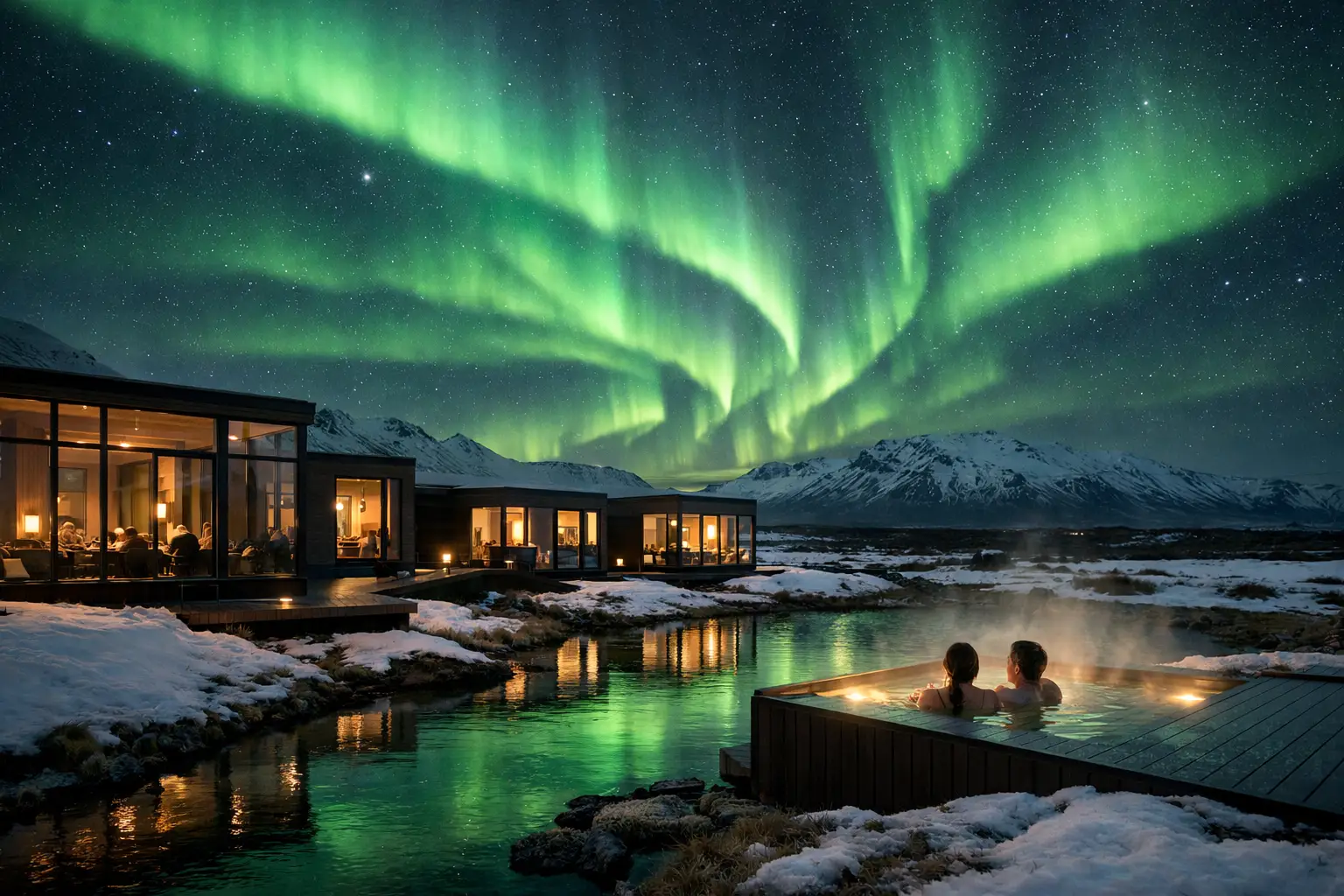
A hotel can give you a dark terrace, a wake-up call, and a beautiful view across an Icelandic fjord. It cannot guarantee the aurora. The best northern lights hotels Iceland travelers choose are the ones that make it easy to act when the sky and space weather finally line up - often at short notice.
That distinction matters. Iceland’s aurora season brings long, dark nights, but clear skies can shift quickly from one valley to the next. A hotel that looks perfect in photos may sit under persistent coastal cloud, strong local light, or a location that leaves you with few alternatives when conditions change. Choose a base for flexibility first, then comfort and scenery.
What Makes a Northern Lights Hotel Worth Booking?
A good aurora hotel solves practical problems after sunset. The property should have a genuinely dark viewing area within a short walk, with open sightlines toward the north and enough space to set up a tripod without standing in a parking lot. Remote is helpful, but remote is not automatically better. A hotel surrounded by mountains may have excellent darkness yet a limited horizon, while a slightly less isolated property on open farmland can offer a much wider view of the sky.
Ask whether the hotel provides an aurora wake-up service, and clarify how it works. Some staff monitor the sky and call guests when lights are visible. Others send a message based on a forecast, which is less useful because a forecast is not confirmation. Treat a wake-up call as a welcome extra, not as your only plan.
Also look at the details that matter at 1:00 a.m.: exterior lights that can be switched off, a sheltered patio, hot drinks, parking close to the entrance, and rooms with curtains that make it easy to rest before heading outside. For photographers, a ground-floor room near the viewing area can be more valuable than a premium suite facing the wrong direction.
Best Areas for Northern Lights Hotels in Iceland
There is no single best region for every trip. Your ideal location depends on how many nights you have, whether you will drive, and how willing you are to move for a clearer forecast.
Reykjavik and the nearby countryside
Reykjavik is practical for short trips, arrivals after dark, restaurant choices, and guided tours. It is not Iceland’s darkest place, and city lights reduce visibility during weaker displays. Still, a hotel in the capital can work well if you reserve one or two flexible evenings for a tour that heads toward clearer skies.
For a stronger balance of convenience and darkness, consider country hotels within driving distance of Reykjavik. Areas around the Golden Circle, Hvalfjordur, and the Reykjanes Peninsula can provide darker skies without committing your entire itinerary to a long drive. This is a sensible option for first-time visitors who want daytime sightseeing and realistic aurora chances.
The South Coast
The South Coast has some of Iceland’s most dramatic hotel settings: black-sand beaches, glacier views, open fields, and wide horizons. It is especially appealing for travelers combining the aurora with waterfalls, ice caves, and Jökulsárlón.
The trade-off is weather exposure. Atlantic systems often reach the south first, and wind can be severe in winter. A South Coast hotel is an excellent choice for a multi-night road trip, but do not assume a cloud-free forecast in Reykjavik applies near Vik or farther east. Conditions can differ substantially over a few hours of driving.
Snæfellsnes and West Iceland
Snæfellsnes is popular with photographers because its coast, mountains, and small fishing villages create strong foregrounds beneath the aurora. Hotels here can feel pleasantly secluded while remaining accessible from Reykjavik in reasonable conditions.
Its weather can be changeable, though, and mountain terrain can block parts of the horizon. Choose a property with a broad northern or coastal view rather than booking solely for a famous daytime landmark. A beautiful mountain is less useful if it hides the portion of sky where a low auroral arc is developing.
North Iceland and the Lake Myvatn area
North Iceland often feels quieter, darker, and more spacious than the busiest southern routes. Around Akureyri and Lake Myvatn, travelers can find rural hotels with fewer nearby lights and good access to dramatic winter landscapes.
The north can benefit when southern cloud is stubborn, but it is not a permanent clear-sky shortcut. Winter roads may be more demanding, daylight driving is limited, and some services operate on reduced schedules. It is best for travelers who can give the region several nights rather than treating it as a one-evening detour.
Book for Flexibility, Not Just a View
The most effective Iceland aurora itinerary usually includes at least three nights outside the city, preferably split between two regions if your schedule allows. A one-night stay is a gamble because aurora visibility needs darkness, clear or partly clear sky, and favorable solar activity at the same time.
When comparing hotels, prioritize cancellation terms and the ability to alter dates. A property with a slightly less dramatic view but a flexible reservation can be the smarter booking. If the forecast favors another region, you want the freedom to relocate rather than waiting under thick cloud because your room is nonrefundable.
Travelers who do not want to drive should consider staying in Reykjavik or Akureyri and reserving a guided tour on a night with promising conditions. Tours do not control the aurora, but experienced operators can choose routes based on clouds, road conditions, and local observation. If you are self-driving, rent a suitable vehicle for the season and treat road safety as part of the aurora plan. Never chase a gap in the clouds along a road that is closed, icy, or exposed to dangerous wind.
Don’t Judge Tonight by the KP Index Alone
A high KP Index can look exciting, but it does not tell you whether your hotel has clear skies, whether the aurora is active at your location, or whether the magnetic field is currently favorable. In Iceland, cloud cover is often the immediate deciding factor. A modest display beneath a clear sky can be far more memorable than a strong event hidden behind an overcast front.
Check the full picture before dinner and again after dark. The AuroraVision app combines a Live Aurora Score with real-time solar wind, IMF Bz, cloud cover, moon phase, and local weather, so you can judge whether it is worth staying at the hotel, joining a tour, or driving to a clearer area. Use alerts when conditions improve, but keep expectations grounded: live data improves decisions, not nature’s timetable.
Moonlight is another useful trade-off. A bright moon can make faint aurora harder to see and can reduce contrast in photos, yet it also illuminates glaciers, mountains, and snow-covered foregrounds. For casual viewing, a clear moonlit night can still be spectacular. For photography, plan exposure settings around the moon and look for stronger displays or darker sections of sky.
A Hotel-Night Aurora Routine That Works
After check-in, walk outside before full darkness and find the hotel’s best viewing spot. Note where the exterior lights are strongest, where the ground is uneven, and which direction gives you the clearest northern horizon. If you plan to photograph, set up your tripod early rather than assembling equipment in wind and darkness.
At nightfall, check conditions and avoid making a final decision too early. The aurora can appear briefly after twilight, fade, then return later. If skies are clear, scan the north every 20 to 30 minutes. Look for a pale gray-green band or an unusual vertical glow. Your camera may reveal green before your eyes recognize it, especially during a weaker display.
Dress for waiting, not for a quick walk from the lobby. Insulated boots, warm layers, gloves that let you use camera controls, and a windproof outer shell will keep a promising night from ending after ten minutes. Bring a headlamp with a red-light mode if possible, and keep its beam pointed down so you do not ruin your own night vision or disturb other guests.
The right hotel does not have to be the most expensive, the farthest from Reykjavik, or the one with the boldest aurora marketing. Pick a place that gives you darkness, a safe place to stand, and enough itinerary flexibility to respond when the sky finally opens. That is how you give yourself the best chance not to miss the moment.