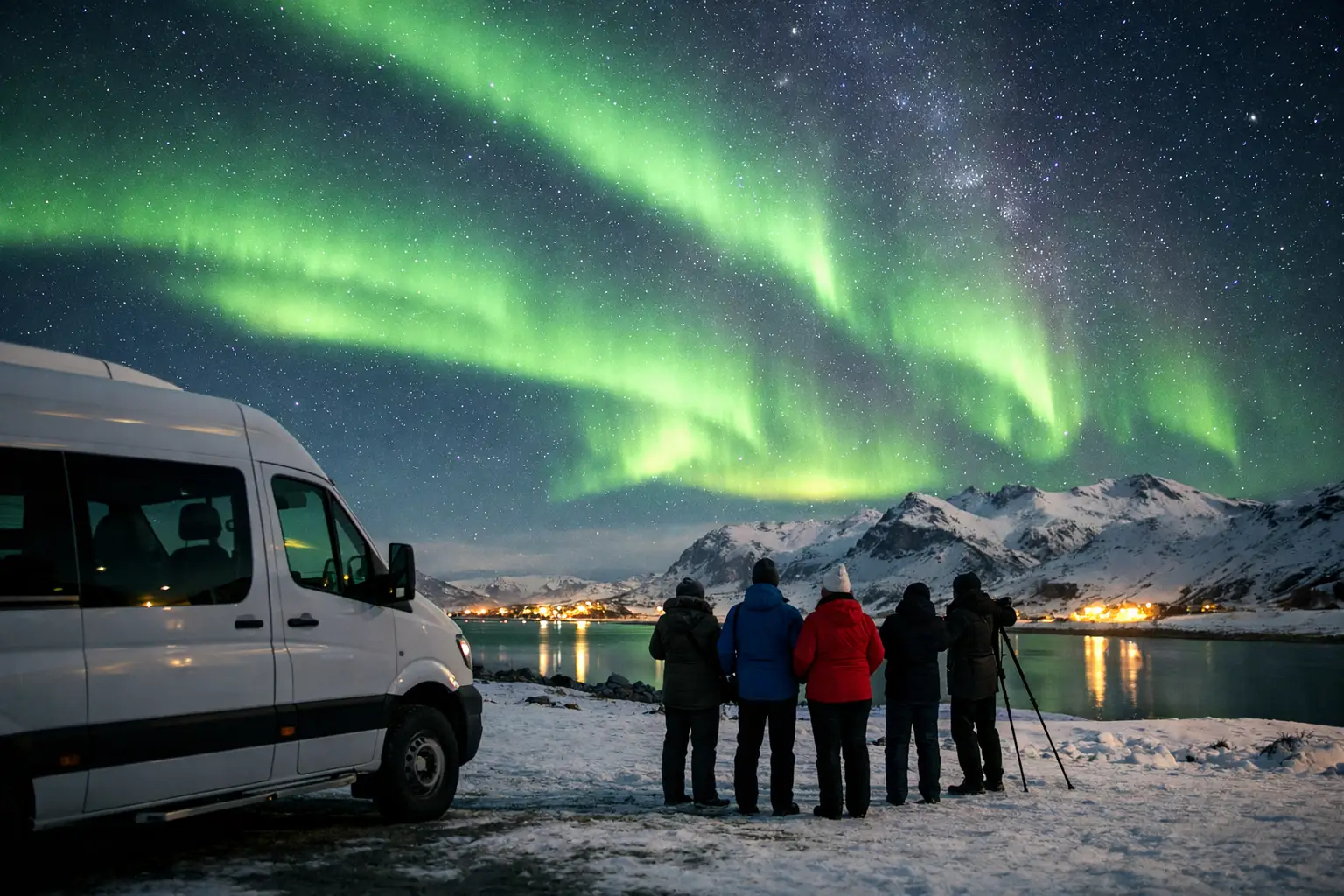
A tour can get you away from Reykjavík’s city glow, but it cannot make a cloudy sky clear or force the solar wind to cooperate. That is the key decision behind northern lights tours Iceland: choose the right kind of trip, then use live conditions to decide whether tonight is worth going.
For many visitors, the aurora is the trip’s big moment. You may have only two or three nights in Iceland, a fixed hotel booking, and no desire to navigate icy roads after dark. A good tour adds safety, local route knowledge, and a guide who knows where the breaks in the cloud cover may be. The trade-off is less control over timing and location than you would have with a rental car and an independent plan.
What Northern Lights Tours in Iceland Actually Offer
Most Reykjavík departures fall into three categories: large-coach tours, small-group minibus tours, and private tours. None is automatically best. The right choice depends on your budget, flexibility, group size, and how much comfort matters once you are standing in the cold at midnight.
Large-coach tours are usually the most affordable option. They work well for travelers who want a straightforward pickup, a guide, and transport beyond the city lights without paying for a premium experience. Expect more people, several hotel pickup stops, and less flexibility if the guide wants to move quickly after conditions change.
Small-group tours typically cost more but make it easier to adjust the route, stop at a darker roadside location, or spend longer at a productive viewing spot. They are often a strong fit for couples, solo travelers, and first-time photographers who want more interaction with the guide. The vehicle is not necessarily more luxurious, but the experience can feel more responsive.
Private tours make the most sense for families, groups of friends, serious photographers, or travelers who want to control the evening. A private guide can tailor pickup times, help with camera setup, and change direction as clouds move. That flexibility is valuable, although it still does not overcome a fully overcast region or weak aurora activity.
Some operators also pair aurora viewing with activities such as hot springs, snowmobiling, or countryside dining. These can be memorable, but treat the aurora portion as weather-dependent rather than guaranteed. A combo tour is often best when the daytime or evening activity would still feel worthwhile if the lights remain hidden.
The Forecast Matters More Than the Tour Brochure
Tour descriptions understandably emphasize dramatic green skies. Your decision should begin with what is happening overhead tonight.
A high KP index can signal elevated geomagnetic activity, but KP alone does not tell you whether you will see the aurora from your location. In Iceland, cloud cover is frequently the deciding factor. A moderate display under clear skies can be far more rewarding than a major geomagnetic storm behind thick cloud.
Solar-wind speed, particle density, and the Bz orientation also influence activity. In plain English, a sustained southward Bz helps energy enter Earth’s magnetic field and can support brighter, more active aurora. But even excellent solar conditions have limited impact if you are under cloud, still in twilight, or looking from a bright urban area.
That is why a location-specific visibility forecast is more useful than a single headline such as “KP 5 tonight.” Look for a view that combines solar activity with cloud cover, astronomical darkness, moonlight, and local light pollution. AuroraVision’s live visibility score is designed for this exact call: not just whether the aurora is active somewhere, but whether viewing conditions are favorable where you plan to be.
Check conditions twice: once before you commit to a tour and again close to departure. Icelandic weather can shift quickly. A cloud gap that looks unlikely at dinner may become the best viewing window of the night, while a promising forecast can deteriorate just as fast.
When to Book a Tour
The practical aurora season in Iceland generally runs from late August through mid-April, when nights are sufficiently dark. The deepest winter months offer long dark windows, but they also bring more difficult weather, colder waits, and possible road disruptions. September, October, March, and early April can provide an appealing balance of darkness, milder temperatures, and daytime travel opportunities.
If the northern lights are a major priority, schedule at least three nights in or near Reykjavík rather than relying on one tour on your final evening. That buffer is one of the most effective ways to improve your odds. It gives you room to rebook after a cancellation, switch nights when the forecast improves, or pursue a clear patch independently.
Avoid booking your only tour on arrival day. Flight delays, jet lag, and a late hotel transfer can turn a long evening into an exhausting one. The aurora can appear at any time during darkness, but many tours return well after midnight. Plan the next morning accordingly.
Questions to Ask Before You Pay
Cancellation and retry policies matter more than extras such as onboard Wi-Fi. Operators commonly cancel when cloud conditions are poor or forecasts offer little chance of a meaningful sighting. Others may run the trip because conditions are uncertain, which is reasonable - forecasts are probabilities, not promises.
Before booking, confirm whether a canceled trip receives a refund, a free rebooking, or a voucher. Also ask what happens if the tour runs but the aurora does not appear. A “free retry” policy can be useful, but only if you have another available night in Iceland. If you fly home tomorrow, a future retry has no practical value.
Check the pickup instructions closely. Reykjavík has designated bus stops and hotel-area rules that can require a short walk from your accommodation. Pickup windows may begin 30 minutes or more before the advertised departure. Have warm layers on before leaving the hotel, and keep your phone charged in case the operator sends a weather update.
Guide quality is harder to judge from a booking page, but it shapes the night. The best guides explain what you are seeing without overselling it, monitor changing clouds, help guests use cameras, and know when it is smarter to relocate. They also set realistic expectations: the first visible aurora may look pale or gray to the eye before a camera reveals stronger green.
Coach Tour, Small Group, or Rental Car?
A guided trip is usually the safest choice if you are unfamiliar with winter driving, do not want to monitor weather maps, or have limited time. Iceland’s conditions can change abruptly, and nighttime roads outside the capital may involve wind, ice, darkness, and low visibility. A guide handles the driving while you watch the sky.
A rental car offers freedom but requires preparation. You need to assess road conditions, avoid stopping in unsafe locations, understand your insurance, and remain willing to abandon a plan if weather turns. It can be a great option for road-trip travelers staying outside Reykjavík, especially if you can wait for short clear intervals and move between regions.
For a single night from the capital, a small-group tour often provides the best balance. For a multi-night road trip, independent chasing can be more efficient, particularly when your accommodation is already in a dark rural area. The answer depends less on the size of the solar storm than on your confidence driving and your ability to change plans quickly.
Dress for Waiting, Not for Walking
Aurora viewing often means standing still for long stretches. A temperature that feels manageable during a walk can feel sharply colder once you are motionless in wind. Wear a warm base layer, insulating mid-layer, windproof outer shell, insulated boots, thick socks, gloves or mittens, and a hat that covers your ears.
Bring a warm drink if your tour allows it, plus hand warmers if you run cold. Keep your camera batteries in an inner pocket until you need them. Cold drains batteries quickly, and touchscreen controls become frustrating with bare hands.
For phone photos, turn off flash and brace the device against a vehicle, railing, or small tripod. Night mode can capture more color than your eyes see, but it needs a steady hold. For a dedicated camera, start with a wide aperture, a high ISO, and a shutter speed that matches the aurora’s movement. Fast-moving curtains need shorter exposures than a faint, slow arc.
Make the Call Before You Leave
Do not judge a tour only by its marketing photos or its price. Check the current visibility outlook, look at the cloud map along the likely route, and weigh the operator’s cancellation policy against the nights you have left. If the status is aurora suppressed or clouded out across southwest Iceland, preserving your energy for tomorrow can be the smarter move.
When conditions shift to excellent viewing, act promptly. Charge your phone, dress before pickup, step away from bright lights, and give your eyes time to adjust. The aurora does not follow a schedule, but a well-timed decision can make an unpredictable Icelandic night feel like the moment you came for.