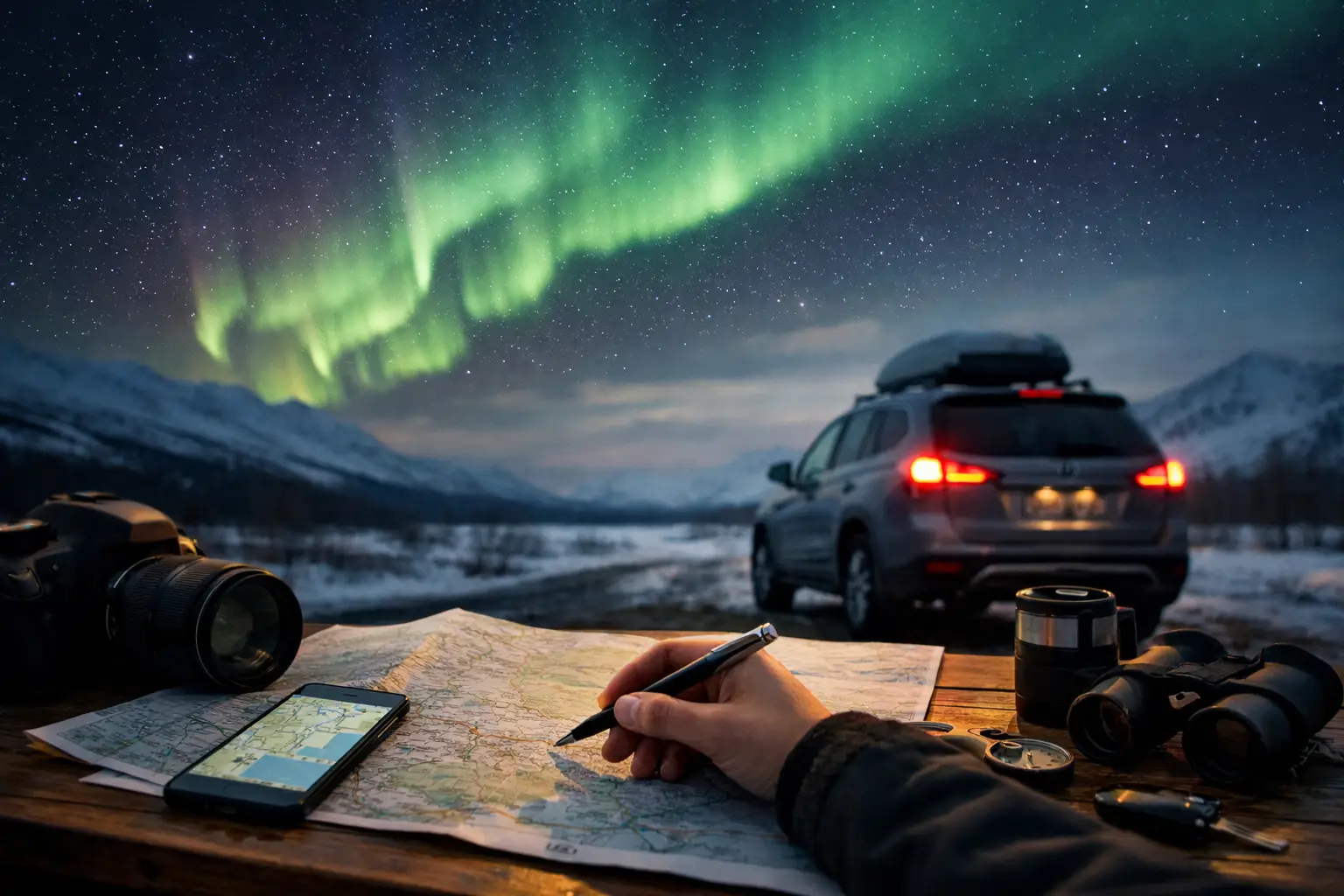
A good aurora road trip is not a chase across a map at midnight. It is a flexible plan built around darkness, safe roads, clear breaks in the cloud, and enough time to wait when the sky finally turns on. When you plan an aurora road trip, the biggest advantage is not finding the most remote location. It is giving yourself several realistic options, then using live conditions to choose the right one on the night.
The Northern Lights are wonderfully unpredictable from a travel perspective, even when the space weather is favorable. You may have active aurora overhead but thick cloud at your hotel. You may have a low KP Index and still see a striking display because the solar wind, magnetic field, and local sky conditions are working in your favor. Build your route around that reality, and you will spend less time driving blindly and more time outside under a useful sky.
Start With a Flexible Base, Not a Fixed Nightly Target
The most common road-trip mistake is booking a long loop with a different hotel every night. It looks efficient on paper, but it can work against aurora viewing. A forecast may point to clearer skies 45 minutes west of your accommodation, while the next night may favor a region you already passed. If every evening requires a three-hour transfer, you lose the freedom to respond.
For a five- to seven-night trip, choose two or three bases rather than moving daily. In Iceland, that might mean splitting time between the Reykjavik area, the south coast, and a darker rural region such as Snæfellsnes or West Iceland. In northern Norway, a Tromsø base with a rental car can work well for short-range weather decisions, while a longer drive may make sense only when road conditions are stable. The right setup depends on season, daylight hours, and your comfort with winter driving.
Choose lodging outside bright town centers when possible, but do not confuse darkness with isolation. A rural hotel with a safe parking area, warm indoor waiting space, and open northern horizon is often better than a spectacular but exposed pullout reached by icy roads. Ask whether exterior lights can be reduced, whether there is direct access to open ground, and whether late-night returns are practical.
Build Routes Around Road Reality
Aurora travelers sometimes plan routes as if every road is equally usable after dark. They are not. In Arctic winter, a short distance can involve wind, drifting snow, black ice, mountain passes, single-lane bridges, or roads that close with little notice. Your route should always include a conservative option close to your accommodation and a second option in a different weather zone.
Before setting out, identify fuel stations, restrooms, grocery stores, and safe turnaround points during daylight. Download offline maps, charge a power bank, and keep the vehicle above half a tank whenever conditions are unsettled. If you rent a car, confirm the winter tires, insurance coverage, emergency contact process, and any restrictions on unpaved roads. A four-wheel-drive vehicle can improve traction and confidence, but it does not shorten stopping distance on ice.
Do not pull over wherever the aurora appears. Find a legal, plowed, wide parking area before you need it. Stopping on a narrow road or shoulder can put you, your passengers, and other drivers at risk. If cloud breaks open during the drive, continue to a known stop rather than making a rushed decision in the dark. The lights may last minutes or hours, and a safer viewpoint is worth the extra distance.
Know What Actually Makes an Aurora Night Promising
The KP Index is useful as a broad measure of geomagnetic activity, especially for deciding how far south the aurora might be visible. It is not a complete viewing forecast. At high latitudes, including much of Iceland, northern Scandinavia, Alaska, and northern Canada, visible aurora can occur at modest KP levels when other conditions are favorable.
The practical question is not simply, “What is the KP?” It is, “Will there be visible aurora above my location while the sky is clear enough to see it?” That answer depends on several moving pieces. Solar wind carries energy from the Sun toward Earth. Its speed and density matter, but the orientation of the interplanetary magnetic field, often called IMF Bz, is especially important. When Bz is pointed south for a sustained period, it can connect more effectively with Earth’s magnetic field and support auroral activity.
Then there is the local sky. Cloud cover can erase an excellent aurora display completely, while a clear gap can make a moderate display memorable. Moon phase also changes what you see. A bright moon can reduce contrast for faint aurora, but it can illuminate mountains, snow, and foregrounds for photography. Weather matters beyond clouds too: wind chill affects how long you can wait, and blowing snow can make a viewing location unsafe.
This is why AuroraVision uses a Live Aurora Score that combines real-time solar wind, IMF Bz, cloud cover, moon phase, weather, and other relevant data rather than treating KP as the only answer. Check the app before dinner, again before leaving, and whenever conditions change. Smart alerts are particularly helpful on a road trip because they can tell you when it is time to stop waiting indoors and start moving.
Plan Your Evenings in Windows, Not Exact Hours
Aurora does not follow a timetable. In many destinations, the useful viewing period begins once the sky is properly dark and can continue until the early morning. Activity often arrives in bursts, with quiet intervals in between. If you give yourself only a 30-minute window after a late dinner, you may miss the best part of the night.
A better approach is to create two viewing windows. Spend the first near your lodging after dark, especially if conditions are already favorable. Then reserve a second, later option if cloud forecasts suggest improvement or solar conditions strengthen. This rhythm protects your energy. It also avoids the familiar road-trip problem of leaving too early, driving for hours, and discovering that the clearest patch formed near the hotel you abandoned.
For travelers with children, early departures, or limited winter-driving experience, an aurora tour can be the smarter choice on one or two key nights. A strong local guide knows which roads are realistically open, where cloud gaps often form, and when conditions do not justify a long chase. Independent driving offers more privacy and flexibility, but guided travel reduces navigation stress and lets everyone watch the sky instead of the road.
Pack for Waiting, Not Just Driving
Most people dress adequately for walking from a hotel to a restaurant, then discover that aurora viewing means standing still in wind for an hour. Layer a moisture-wicking base layer, insulating mid-layer, and windproof outer shell. Add insulated boots, thick socks, a hat, gloves, and hand warmers. Bring a warm drink and an easy snack. Cold drains both patience and phone batteries faster than expected.
For photography, use a tripod, spare batteries kept warm in an inside pocket, and a remote shutter or timer. Start with a wide lens and manual focus set carefully on a bright star or distant light. Exposure settings depend on aurora brightness, moonlight, camera sensor, and lens aperture, so avoid copying a single setting from social media. Brighter, fast-moving aurora often benefits from shorter exposures, while faint arcs may need more time. Check the image, adjust, and keep looking up.
Your phone can capture more than it used to, especially in night mode, but do not spend the whole display watching through a screen. Aurora changes in shape and intensity quickly. The strongest memory may be the moment a quiet green arc suddenly brightens, moves, and fills more of the sky than your camera frame can hold.
Give Bad Forecasts a Place in the Plan
A road trip should still be worthwhile when the sky is cloudy. Put daytime experiences close to each base: hot springs, coastal walks, museums, wildlife outings, snow activities, or scenic drives that can be shortened if evening conditions improve. Avoid planning every day around a late night. A tired driver makes poorer decisions, and the best forecast in the world cannot compensate for fatigue on an icy road.
Keep one or two nights intentionally open near the end of your itinerary. These are your recovery nights if weather blocks earlier attempts. If the forecast improves, you have room to respond. If it does not, you have still built a trip around landscapes and experiences worth traveling for. That is the difference between an aurora trip that feels disappointing and one that feels like an Arctic adventure with a genuine chance of a spectacular sky.
Before you leave your room, check the current score, cloud map, weather warnings, road conditions, and the best time tonight. Pick a safe destination, tell someone where you are going, and give yourself permission to turn back if the road deteriorates. The lights are never worth gambling on. But with a flexible route and a clear sky overhead, you will be ready when the moment arrives.