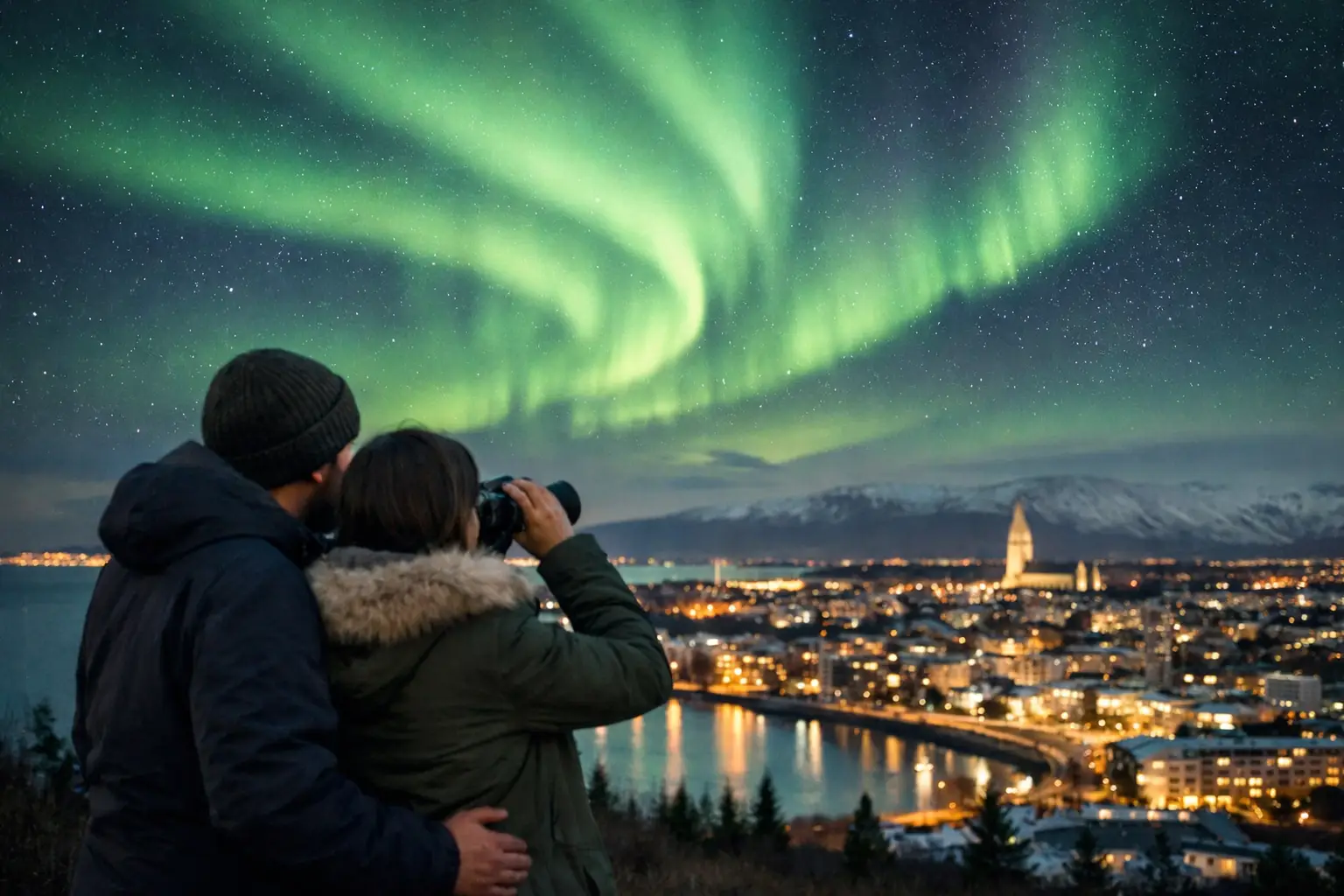
A clear sky over Reykjavik can feel like a promise, but Reykjavik northern lights viewing is never guaranteed by darkness alone. The aurora needs two things at the same time: activity in Earth’s upper atmosphere and a gap in Iceland’s famously changeable cloud cover. Get both, and the city can deliver a genuinely memorable display. Miss either one, and a high KP forecast will not help much.
Reykjavik is a practical base for first-time aurora travelers because it has hotels, restaurants, tours, and easy access to the airport. It is not Iceland’s darkest location, though. Streetlights, car headlights, and the glow of the capital reduce contrast, especially when the aurora is faint. The smartest plan is to treat the city as your base camp, then make a flexible decision each evening based on live space weather, clouds, wind, and road conditions.
When can you see the Reykjavik northern lights?
The viewing season generally runs from late August through mid-April, when Iceland has enough nighttime darkness. September and October often offer relatively mild driving conditions and longer twilight than midwinter. November through February brings the deepest darkness, but also more winter weather, icy roads, and frequent cloud systems. March and early April can be excellent because daylight is longer for sightseeing while true darkness still arrives at night.
There is no single "best month" that works for everyone. A photographer who wants long nights may prefer winter. A road trip traveler who values easier driving might choose September, October, or March. If the northern lights are a top priority, stay at least three or four nights. A one-night stop in Reykjavik can work, but it leaves too much to chance.
Aurora activity can occur at any hour of darkness. In practice, many displays become visible between about 9 p.m. and 1 a.m., but that is a useful planning window, not a rule. Strong activity can start earlier, build after midnight, or appear briefly between cloud bands. Do not leave after an hour just because the sky looks quiet. A dim arc can intensify quickly when solar wind conditions change.
Why the KP Index is not enough
The KP Index is a global measure of geomagnetic disturbance. It can provide broad context, but it does not tell you whether you will see aurora from a particular Reykjavik beach or hill at a particular hour. It does not show whether clouds are covering your view, whether the solar wind is arriving efficiently, or whether moonlight will wash out a faint display.
For Iceland, KP 2 or KP 3 can be enough when the sky is clear and you are away from city lights. Conversely, KP 5 can be disappointing if thick cloud sits over southwest Iceland. This is the trade-off many travelers miss: stronger activity helps, but visibility is local.
The most useful aurora decision combines several signals. Solar wind speed tells you how quickly charged particles are reaching Earth. Density adds information about how much material is available. IMF Bz describes the direction of a magnetic-field component in the solar wind. When Bz stays negative, especially alongside favorable solar wind, energy can connect more effectively with Earth’s magnetic field and support aurora activity.
Those signals still need to be interpreted with local conditions. Check the Live Aurora Score in the free AuroraVision app alongside real-time solar wind, IMF Bz, cloud cover, moon phase, and weather. That combination is far more actionable than waiting for one KP number to look impressive. If the score is favorable but clouds are thick above Reykjavik, shift your attention to a clearer nearby area only if the roads are safe.
Best places to look near Reykjavik
You do not always need a long drive. On a strong, clear night, you may see the aurora from the waterfront, a hotel balcony facing away from the brightest lights, or a darker residential edge of the city. For a better chance of seeing detail and color, choose a location with an open northern horizon and as little direct lighting as possible.
Grótta Lighthouse on the Seltjarnarnes Peninsula is a popular first choice. It is close to central Reykjavik, has wide views across the water, and feels darker than downtown. Expect company on promising nights, and use a red-light setting on your phone if possible. White screens and headlights make it harder for everyone’s eyes to adjust.
Öskjuhlíð, the wooded hill near Perlan, can offer a convenient escape from some city glare. It is useful if you do not have a car, though nearby lights and trees can limit parts of the horizon. The shoreline around the Sun Voyager sculpture is visually striking for a quick look, but it is not an ideal dark-sky spot for faint aurora.
If you are driving, the biggest improvement often comes from leaving the metropolitan glow rather than chasing a famous pin on a map. Areas toward Þingvellir, the Reykjanes Peninsula, or rural stretches east of the city can provide darker skies, depending on the cloud forecast. Do not stop on narrow roads, private driveways, or unsafe pullouts. Icelandic wind can make doors difficult to control, and winter roadside snow may hide ditches.
A guided northern lights tour is a sensible option for travelers who do not want to drive in the dark. Local guides can adapt their route to cloud breaks, handle changing road conditions, and know where it is safe to stop. Independent travelers gain more flexibility, but only when they are comfortable assessing winter weather and driving responsibly.
Make your plan before sunset
Aurora nights are easier when you prepare while it is still light. Eat dinner early, charge your phone and camera batteries, pack warm layers, and decide whether you are staying in Reykjavik or need a car. Icelandic weather can change rapidly, so a plan that requires a two-hour drive with no backup is fragile.
Dress for standing still, not for a brisk walk from your hotel to a restaurant. Start with a warm base layer, add insulating mid-layers, and bring a windproof outer shell. Insulated boots, thick socks, a hat, and gloves matter more than most visitors expect. Cold hands make camera controls frustrating, and a chilled phone battery can drain much faster.
If you are renting a car, ask about winter tires, insurance coverage, and current road conditions before departure. Keep fuel well above empty, bring water and snacks, and tell someone where you are heading. Wind and ice are often more relevant than snow depth around Reykjavik. If conditions deteriorate, return to the city or choose a nearby viewing point instead of forcing the original plan.
How to read the sky once you are outside
The northern lights do not always begin as bright green curtains. Often, the first sign is a pale gray-green band low in the north, a hazy patch that seems slightly brighter than nearby clouds, or a thin arc that cameras reveal more clearly than the naked eye. Look for shapes that hold their position against the stars and slowly change form.
Clouds usually look softer, move across a larger part of the sky, and block stars behind them. Aurora can also appear faint because human eyes see low-light color poorly. A phone camera in night mode may show green before you can see much color yourself. That is normal, but do not use the camera as the only judge. Watch for movement, structure, and gaps in cloud.
When activity strengthens, look beyond the northern horizon. The display can spread overhead, form rays, or develop a corona directly above you. Turning slowly and checking the full sky is worthwhile, particularly during stronger geomagnetic activity. If you are with a group, avoid celebrating so loudly that you forget to look up.
Camera settings that work in Reykjavik
A tripod is the biggest upgrade for northern lights photography. Use a wide-angle lens if you have one, focus manually on a bright star or distant light, and turn off flash. Start around a two- to eight-second exposure, a wide aperture, and ISO 800 to 3200. Then adjust based on brightness and movement.
Longer exposures can make a weak aurora look stronger, but they can blur fast-moving rays and overexpose city light. Near Reykjavik, a shorter exposure is often better because street glow raises the brightness of the sky. Check your histogram and review the image at full size rather than trusting the tiny preview screen.
For phones, stabilize the device against a railing, backpack, or compact tripod. Use night mode, avoid digital zoom, and tap to focus on the sky if your camera allows it. The result may look more colorful than the scene appears to your eyes, which is a limitation of low-light photography rather than proof that the display was spectacular.
A better Reykjavik aurora strategy
Start each evening with a simple question: are there enough clear skies within a safe distance of where you are staying? If the answer is no, use the evening for a museum, geothermal pool, or dinner and keep your plans flexible for tomorrow. If cloud breaks exist and aurora conditions are active or improving, be ready to leave before the opening appears.
Avoid the common mistake of treating the forecast as a yes-or-no answer. A low score can improve, cloud cover can break, and a promising solar wind setup can fade. Watch the trend, not just one reading. The best nights often reward travelers who remain warm, patient, and mobile rather than those who chase a single forecast headline.
If the sky clears above Reykjavik tonight, step outside with your layers on, your batteries charged, and your expectations grounded in the real conditions. The moment the first quiet arc begins to move, you will be glad you gave Iceland one more hour of darkness.