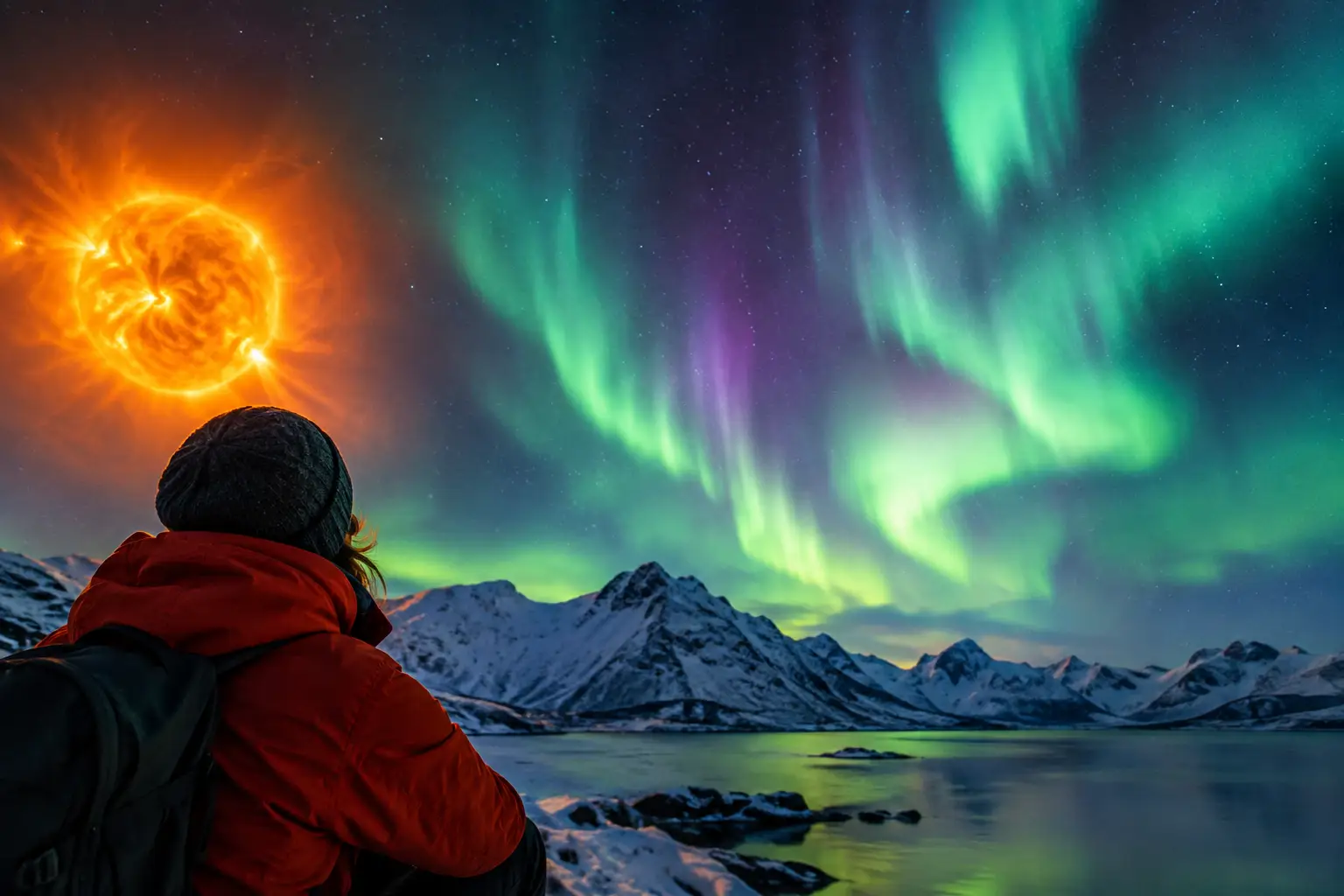
A solar storm can make the aurora visible far beyond its usual range, but solar storm viewing is rarely as simple as seeing a dramatic headline and stepping outside. The particles from the Sun still need to interact favorably with Earth’s magnetic field, the sky needs to be clear where you are, and the strongest activity may happen before or after your local nighttime window. The best plan is to treat a solar storm as an opportunity, then check the conditions that decide whether that opportunity becomes a real display.
What a solar storm means for aurora viewing
A solar storm is a broad term for increased activity from the Sun that affects space around Earth. For Northern Lights travelers, the most useful events are those that send fast, dense solar wind toward Earth, often following a coronal mass ejection or arriving from a coronal hole. When that energy reaches our planet, it can disturb Earth’s magnetic field and increase auroral activity.
That does not mean the aurora immediately appears overhead. Solar material may take days to arrive after it leaves the Sun, and forecasts of its arrival have a built-in margin of error. Even after it reaches monitoring satellites upstream from Earth, aurora conditions can rise and fall quickly. A quiet-looking evening can improve in 20 minutes. A promising storm can also weaken before darkness reaches Iceland, Norway, or Alaska.
The practical takeaway is simple: a solar storm raises potential, not certainty. Travelers who watch live conditions are usually better placed than those who plan around a single storm announcement.
The signals that matter during solar storm viewing
The KP Index is useful as a broad measure of global geomagnetic activity. Higher KP levels can mean aurora is visible farther south and brighter within the auroral oval. But it is calculated in three-hour blocks and does not tell you whether the lights are active over your specific location at this exact moment.
For a better real-time decision, look at several signals together. Solar wind speed shows how quickly charged particles are moving toward Earth. Higher speed can support stronger activity, especially when other conditions cooperate. Solar wind density adds another piece of the puzzle: a dense, fast stream can deliver a powerful push to Earth’s magnetic field.
The IMF Bz value is often the critical detail. IMF means interplanetary magnetic field, the magnetic field carried by the solar wind. When Bz turns southward, shown as a negative value, it connects more efficiently with Earth’s magnetic field and allows energy to enter the system. Sustained negative Bz is generally more helpful than a brief dip below zero.
These readings are not guarantees on their own. A high-speed solar wind with positive Bz can produce little visible activity. A modest storm with strongly negative Bz can create an excellent show. That is why a combined Live Aurora Score is more useful than following KP alone: it can account for the changing relationship between solar wind, Bz, and geomagnetic response.
Your local sky can decide the night
Space weather gets the attention, but clouds end more aurora outings than weak solar activity. You can have a strong auroral oval overhead and see nothing through solid cloud cover. Before driving out, compare the live aurora outlook with local cloud cover and weather at the exact area you plan to use.
This matters especially on road trips. In Iceland, conditions can differ dramatically between the south coast, Reykjanes Peninsula, and the north within the same evening. In northern Norway or Finnish Lapland, inland areas may offer clearer skies than the coast, while mountain roads can become a poor choice if wind, snow, or ice increase. The right move may be a short drive toward a clearer gap, not a long chase across an entire region.
Moon phase also changes what you see. A bright moon does not stop a strong aurora, and it can illuminate snow-covered landscapes beautifully for photography. But it reduces contrast, making faint green arcs harder to notice with the naked eye. During a full moon, prioritize stronger activity and darker surroundings. During a new moon, even quieter aurora can look more distinct if the sky is clear.
How to make a smart go-or-wait decision
Start by checking whether darkness has fully arrived. In high-latitude destinations, twilight can last longer than visitors expect, especially in early fall and late spring. A strong daytime space-weather event is not useful for viewing until your sky is dark enough.
Then assess the situation in this order: local cloud cover, current aurora activity, solar wind and Bz trend, and road or weather safety. This sequence prevents a common mistake: chasing impressive solar data under an overcast sky when a nearby clear area offers a better chance.
Use trends rather than a single number. If Bz has been negative for an hour, solar wind is elevated, and the Live Aurora Score is climbing, conditions may be building toward a worthwhile outing. If Bz is fluctuating quickly, be ready to wait and watch. Aurora displays often arrive in pulses, with quiet intervals between brighter bursts.
AuroraVision brings these changing conditions into one view, combining its Live Aurora Score with solar wind, IMF Bz, cloud cover, moon phase, and local weather. Use the free app before leaving your accommodation, then keep alerts enabled during a solar storm night. A timely alert is more valuable than standing outside for hours based on an outdated KP forecast.
Choose a viewing location that works after dark
The best spot is not always the most remote one. You want an open view northward in lower-latitude aurora destinations, although directly overhead activity can appear in any direction during stronger storms. Avoid streetlights, headlights, and buildings that block the horizon. Near the Arctic Circle, an open beach, lakeshore, field, or roadside pullout can be excellent if it is legal and safe to stop.
For independent travelers, keep your plan flexible. Identify two or three nearby viewing areas before sunset, including a sheltered backup with easier road access. Bring warm layers, a headlamp with a red-light setting, and enough phone battery to check live data without losing navigation. Never stop on a narrow road or walk into unsafe coastal, icy, or avalanche-prone terrain for a better photo.
Guided Northern Lights tours can be a strong option during unsettled weather. Experienced local guides may have several route options, understand road conditions, and know where clouds often break. They cannot control the Sun or promise a display, but they can remove much of the logistical pressure when conditions change quickly.
Set realistic expectations for what you will see
A camera and your eyes do not see the aurora in exactly the same way. A phone in night mode or a camera with a longer exposure can reveal green color and structure before your eyes recognize more than a pale gray arc. During stronger solar storm viewing conditions, you may see obvious green bands, moving curtains, or occasional pink and purple tones. During weaker activity, patience matters more than spectacle.
Give your eyes time to adapt. Put away bright screens for a few minutes, scan the northern horizon, and look for a faint band that holds its shape while clouds drift around it. If the band begins to brighten, develop rays, or move across the sky, stay ready. A modest arc can turn into the best part of the night quickly.
The most rewarding aurora nights usually belong to travelers who stay flexible: check the live conditions, choose clear skies over ambitious driving, and give the sky enough time to respond. When the numbers improve, the clouds open, and darkness settles in, be outside and ready to look up.