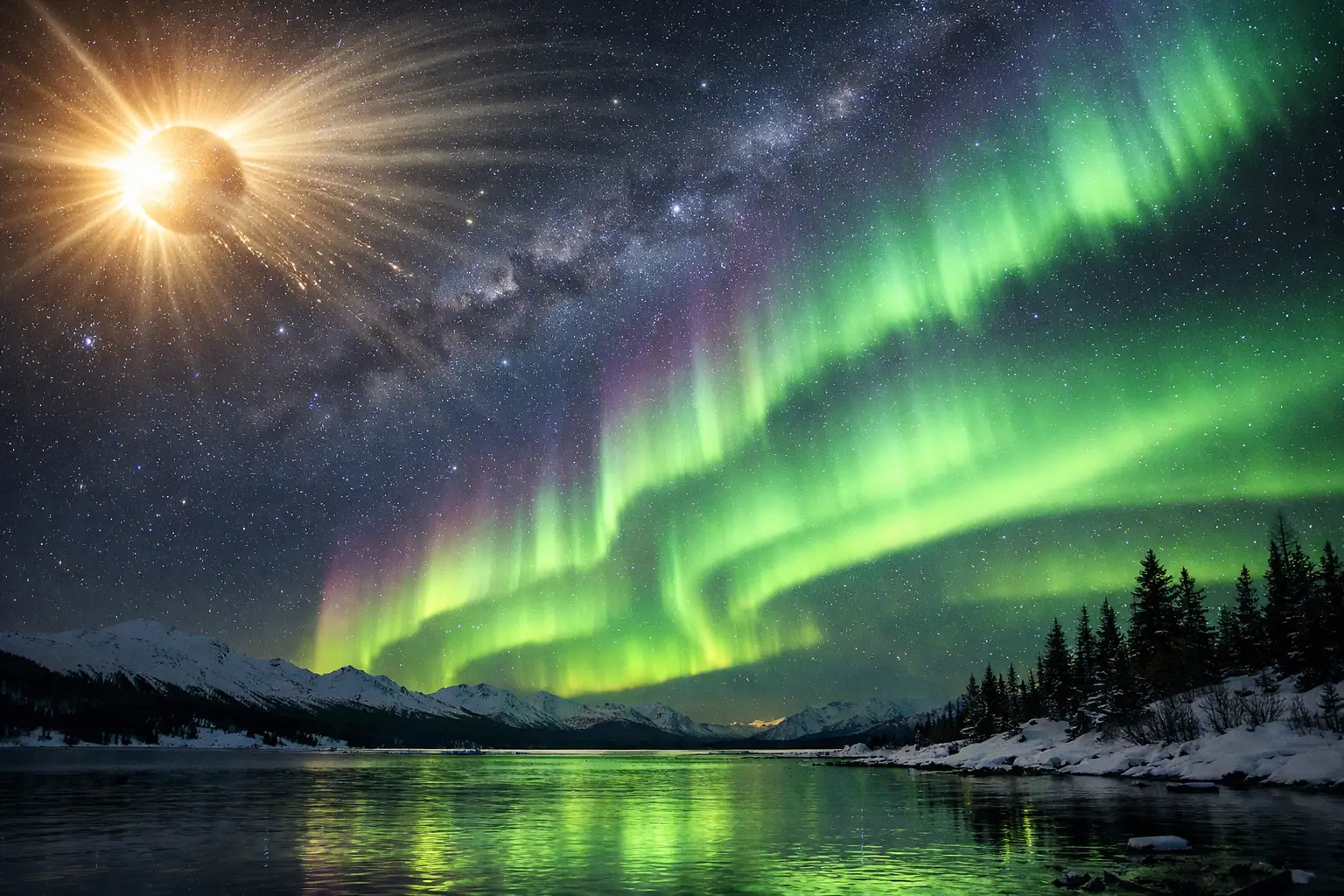
A clear Arctic sky can look completely ordinary at 9:00 p.m. and erupt in moving green arcs an hour later. That sudden change is the solar wind aurora connection at work: energy from the Sun reaches Earth, interacts with our magnetic field, and can trigger the light show travelers have crossed oceans to see.
The key word is can. Strong solar wind does not guarantee a visible aurora from your location, and a modest space-weather reading can still produce a memorable display under dark, clear skies. Knowing what the solar wind is doing helps you make better decisions, but it is only one part of the forecast.
What Is the Solar Wind?
The solar wind is a continuous stream of electrically charged particles flowing outward from the Sun. It is mostly made of electrons and protons, and it travels through space all the time. Speeds vary widely, often from about 250 to more than 500 miles per second, with faster streams and eruptions carrying extra energy toward Earth.
Earth is protected by its magnetic field, which creates a large region called the magnetosphere. Rather than allowing most solar-wind particles to strike the atmosphere directly, the magnetosphere redirects and stores much of that incoming energy. Near the polar regions, magnetic field lines guide some charged particles into the upper atmosphere.
There, the particles collide with oxygen and nitrogen atoms. Those collisions release light. Oxygen most often creates the familiar green aurora, while red can appear higher in the atmosphere. Nitrogen contributes blue and purple tones, although cameras often record those colors more strongly than the human eye does.
That is why the Northern Lights are concentrated at high latitudes. Travelers in Iceland, northern Norway, Finnish Lapland, Alaska, Greenland, and northern Canada are closer to the auroral oval - the ring-shaped zone where aurora activity is most likely.
How Solar Wind Creates an Aurora
Solar wind speed matters because faster-moving particles carry energy more quickly. Density matters because a denser stream contains more particles. But the most useful measurement for aurora watchers is often the direction of the interplanetary magnetic field, usually shown as IMF Bz.
When Bz points southward, it is more favorably aligned with Earth's northward-facing magnetic field. This can allow magnetic reconnection: a process that transfers solar-wind energy into the magnetosphere more efficiently. Think of it as opening a more effective pathway for energy to enter Earth's magnetic environment.
A sustained negative Bz is therefore a promising signal. A reading of -10 nanoteslas is generally more helpful than +10 nanoteslas, especially when solar-wind speed is elevated. However, there is no single magic number. A brief dip south may not produce much at ground level, while several hours of moderately southward Bz can build conditions for a stronger response.
Solar-wind density can also create sudden changes. A dense pulse raises pressure on the magnetosphere and may brighten the aurora quickly, particularly if the magnetic field is already favorably oriented. These bursts are one reason it pays to keep watching rather than leaving after one quiet hour.
The response is not always immediate. Energy can accumulate in the magnetosphere before being released during a substorm. When that happens, a faint band low in the north can expand overhead, brighten sharply, and develop rays or fast-moving structures. For photographers and road-trip travelers, this is the moment when being parked at a safe dark location matters more than scrambling to find one.
Why the KP Index Is Not the Whole Forecast
The KP Index is useful, but it is a broad, delayed measure of global geomagnetic activity. It is calculated in three-hour intervals from a network of ground stations. It can help show the general scale of disturbance and estimate how far south the aurora may be visible, but it cannot tell you whether clouds are covering your exact viewpoint or whether the display is intensifying right now.
A higher KP can improve the odds of seeing aurora farther from the polar regions. In Tromsø or northern Iceland, however, a moderate KP under clear skies may be enough for an excellent night. In other words, the right threshold depends on where you are, how dark the sky is, and whether the auroral oval is positioned overhead.
The solar wind is more immediate. Its speed, density, and IMF Bz give context for what may happen next, while local cloud cover tells you whether you can actually see it. Moon phase matters too: moonlight can wash out faint aurora, though it also lights up foregrounds for landscape photography.
For a decision you need to make tonight, use a forecast that combines these signals rather than treating KP as a yes-or-no answer. AuroraVision brings together Live Aurora Score, real-time solar wind, IMF Bz, KP Index, cloud cover, moon phase, and weather so you can assess both activity and visibility before you drive.
Reading Solar Wind Conditions for Tonight
Start by looking for a combination, not a single dramatic value. Fast solar wind with a northward Bz may lead to little visible activity. A southward Bz with average speed can still support a good display at high latitudes. The most encouraging setup is sustained southward Bz paired with elevated speed or density, especially when the forecast also shows a clear window over your location.
Watch the trend. If Bz has remained negative for an extended period and solar-wind speed is rising, conditions may be building. If Bz turns strongly positive, the immediate outlook often weakens, even if KP remains elevated from earlier activity. This is why a forecast should be checked again shortly before heading out.
Also remember where solar-wind measurements come from. Spacecraft monitor conditions upstream of Earth, so there is often a short lead time before those particles affect the magnetosphere. The timing is helpful, but not exact. Treat it as an opportunity to prepare, not a promise that lights will appear at a precise minute.
Turn Space Weather Into a Viewing Plan
Space-weather data is most useful when it changes your behavior. If the outlook is quiet but skies are clear, choose a nearby dark location and give yourself time. Faint arcs can strengthen without warning, and clear, dark conditions are worth using even on an average forecast.
If the solar wind looks favorable but clouds are widespread, mobility becomes the priority. In Iceland or northern Norway, conditions can differ dramatically across a few hours of driving, but never chase a gap without checking road conditions, wind warnings, and your fuel level. A guided Northern Lights tour can be a practical choice when you are unfamiliar with winter roads, because local guides can make cloud decisions while you focus on the sky.
For independent travelers, prepare before sunset. Pack warm layers, a headlamp with a red mode, a charged phone, water, and a tripod if you plan to photograph. Avoid stopping on narrow roads or private driveways. A safe pullout with an open northern horizon is better than an impressive viewpoint you cannot reach safely in the dark.
When you arrive, give your eyes 15 to 20 minutes to adjust. The first visible aurora may look like a pale gray-green cloud or a subtle arc rather than a neon ribbon. Check the northern sky, then look overhead. During a stronger substorm, the most active structures can move far from the horizon.
The Best Time Depends on More Than Midnight
Aurora often becomes more active around local magnetic midnight, but the exact clock time shifts by location and season. In many destinations, the practical viewing period runs from late evening into the early morning. Solar-wind conditions can produce activity at any point in that window.
Do not wait for a perfect forecast before going outside. If clouds are clear and the score is improving, be ready. If conditions are already strong, leave promptly rather than spending another hour comparing charts indoors. The goal is not to predict every curve in the sky. It is to put yourself under clear, dark skies when the Sun and Earth are cooperating.
The solar wind tells you whether energy is arriving. Your local sky decides whether you get to see the result. Check both, choose a safe viewing spot, and stay patient long enough for the next brightening to find you.