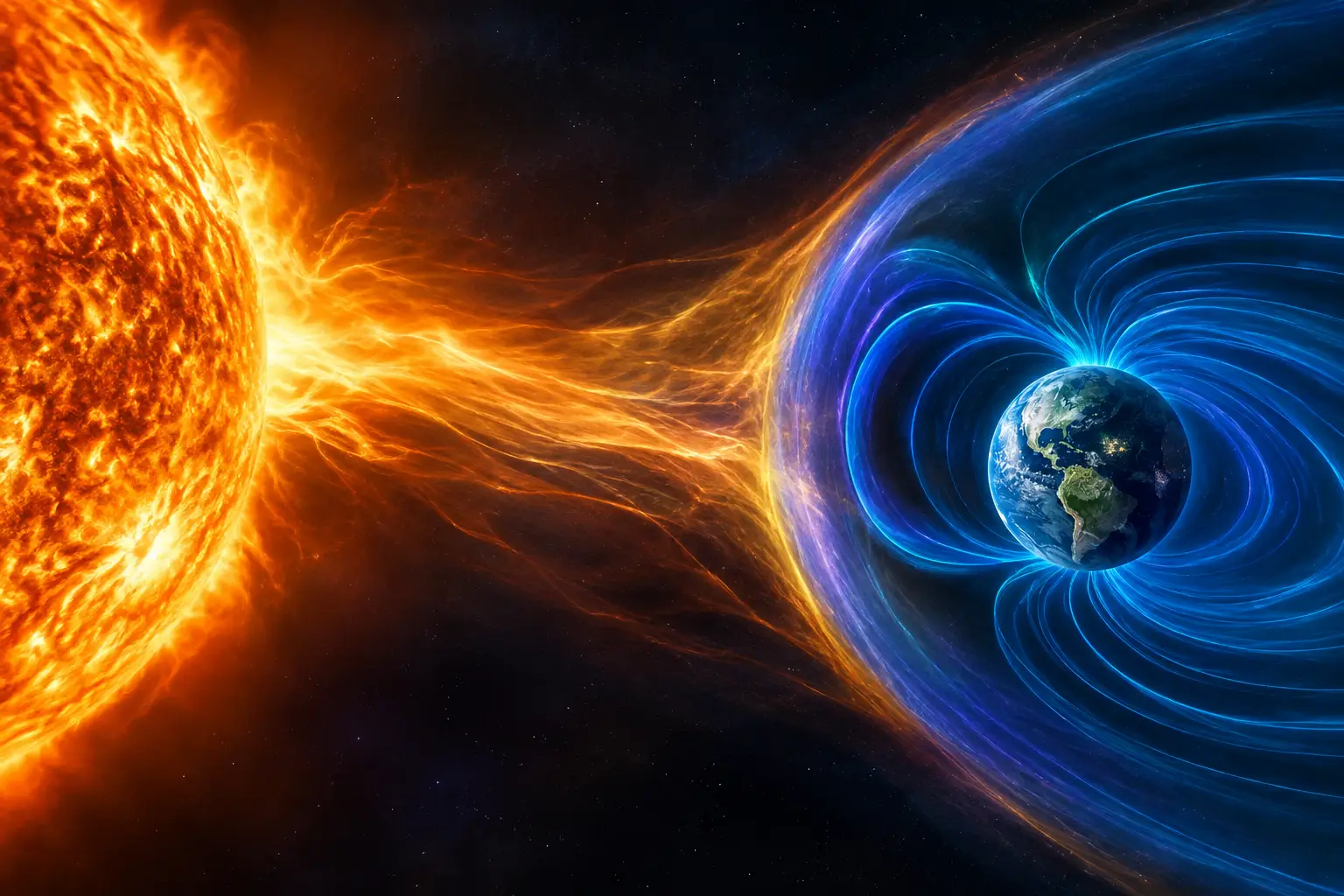
A bright aurora can begin while the KP Index looks modest, and a high KP forecast can pass with little to see from your location. The reason is found in the relationship between solar wind versus geomagnetic activity. They are connected, but they are not the same measurement, and knowing the difference helps you decide whether tonight is worth the drive, the camera setup, and the lost sleep.
Solar wind tells you what is arriving from the Sun. Geomagnetic activity tells you how strongly Earth is responding. For Northern Lights travelers, the most useful forecast is not a single number. It is the full chain of conditions, from incoming solar wind and IMF Bz to local darkness, clouds, moonlight, and weather.
Solar Wind Versus Geomagnetic Activity: The Key Difference
The solar wind is a continuous stream of charged particles flowing outward from the Sun. It carries energy and a magnetic field through space, eventually reaching Earth roughly 93 million miles away. Its conditions can change quickly, especially when a coronal hole sends a fast solar-wind stream toward us or when a coronal mass ejection arrives.
Forecasters watch several solar-wind measurements. Speed shows how fast the particles are moving, usually expressed in kilometers per second. Density shows how many particles are present. Dynamic pressure describes how forcefully that stream presses against Earth’s magnetic shield. These values help indicate the amount of energy available, but they do not guarantee that energy will enter Earth’s magnetic system.
Geomagnetic activity is Earth’s reaction to that incoming stream. When solar wind transfers energy efficiently into Earth’s magnetosphere, it can disturb magnetic fields around the planet. Those disturbances are measured by indices such as KP, which summarizes global geomagnetic activity on a scale from 0 to 9.
Think of solar wind as the weather approaching a coastline and geomagnetic activity as the waves you actually see on shore. A strong offshore system may have the potential to create large waves, but local conditions determine what reaches the beach. In the same way, impressive solar-wind numbers can produce limited aurora if the magnetic connection is weak.
Why IMF Bz Often Decides the Night
The most influential solar-wind value for aurora viewing is often IMF Bz, the north-south direction of the interplanetary magnetic field carried by the solar wind. When Bz points south, shown as a negative value, it can connect more effectively with Earth’s northward-pointing magnetic field. This connection lets solar-wind energy flow into the magnetosphere.
A sustained negative Bz is generally more useful than a brief dip. If Bz turns south for only a few minutes, Earth’s system may not have enough time to respond meaningfully. If it remains negative while solar-wind speed and density are elevated, the chances of stronger geomagnetic activity rise.
That is why a speed reading alone can mislead. Solar wind moving at 700 kilometers per second sounds exciting, and it can be. But if Bz is strongly positive, the energy transfer may remain limited. Conversely, moderate speed combined with a stable southward Bz can create a surprisingly productive aurora window.
There is also a timing issue. Solar-wind data are measured upstream of Earth, often near the L1 monitoring point between Earth and the Sun. Conditions observed there may reach Earth about 15 to 60 minutes later, depending on solar-wind speed. Geomagnetic indices describe a response that is already underway or has just occurred. Neither is a perfect advance promise, which is why short-term forecasts should be monitored through the evening.
What the KP Index Can and Cannot Tell You
KP is valuable because it gives travelers a familiar, broad picture of geomagnetic activity. Higher KP levels generally mean the auroral oval can expand farther from the polar regions and that brighter, more active displays are possible. A high KP can matter greatly for observers in locations such as southern Iceland, northern Scotland, or more southerly parts of Canada and Alaska.
But KP is not an aurora visibility score. It is calculated from magnetic observations over a three-hour interval, so it can lag behind a fast-changing display. It also does not know whether your sky is covered by cloud, whether twilight is still bright, or whether mountains block your northern horizon.
For travelers inside or near the normal auroral oval, a low or moderate KP does not mean there is no chance. In northern Norway, Finnish Lapland, northern Sweden, Greenland, and parts of Iceland, a quiet night can still produce a delicate arc or moving bands if skies are clear and darkness is complete. The display may be subtle rather than dramatic, but it can still be beautiful and photographable.
Use KP to understand the geographic reach of an event, not as the only decision rule. If the number is low but solar wind is favorable, Bz is negative, and local skies are clear, stay alert. If KP is high but clouds are solid overhead, your immediate priority is finding a clearer area, not refreshing the index.
A Better Way to Read Tonight’s Aurora Conditions
The most practical approach is to follow the order in which the aurora becomes visible. Start with solar wind and IMF Bz to assess potential. Then check geomagnetic activity to see whether Earth is responding. Finally, focus on the conditions that determine whether you can actually see anything from where you are standing.
Cloud cover is often the deciding factor for a road trip. A mediocre space-weather night under a clear sky can be more rewarding than an active storm behind thick overcast. Weather maps help identify breaks in the cloud, but safe driving conditions matter just as much. In Iceland and Arctic regions, wind, ice, reduced visibility, and road closures can make a distant clear patch a poor choice.
Moon phase also changes the experience. A bright Moon does not erase a strong aurora, but it washes out faint structures and reduces contrast for the eye and camera. On moonlit nights, look toward darker parts of the sky and adjust photography expectations. On darker nights, even a quieter green arc can stand out beautifully.
AuroraVision brings these live factors together through its Live Aurora Score, real-time solar wind, IMF Bz, KP Index, cloud cover, moon phase, weather, and alerts. That combination is more useful than relying on any single metric because it answers the question that matters: will you have a realistic viewing opportunity at your location tonight?
When Conditions Change Fast
Aurora forecasts are not static. A southward Bz can turn northward in minutes. A cloud break can close just as quickly. Geomagnetic activity can also surge after a period of calm, particularly during the arrival of changing solar-wind conditions.
If you have a flexible evening, check conditions before leaving your hotel, then check again once you reach a dark viewing area. Give yourself time. Many displays build gradually, beginning as a pale arc low in the north before developing visible movement, rays, or wider bands. Cameras can reveal green color earlier than the human eye, especially when the aurora is faint.
For guided Northern Lights tours, ask what the operator considers beyond KP. Experienced guides typically monitor clouds, road conditions, and real-time space weather because they need to make location decisions quickly. For independent travelers, a rental car provides flexibility, but only when you are comfortable with winter driving and local conditions. Never let a promising solar-wind chart override safe travel decisions.
The Forecast Habit That Prevents Missed Auroras
The best habit is simple: treat solar wind as incoming potential, geomagnetic activity as Earth’s response, and local weather as your final gatekeeper. Watch for a favorable combination rather than waiting for a single dramatic number.
A clear, dark sky with modest activity can become the night you remember most. Keep your plans flexible, dress for the wait, and check the live conditions before you decide where to stand. The aurora does not perform on a schedule, but travelers who read the full picture are far less likely to miss the moment.