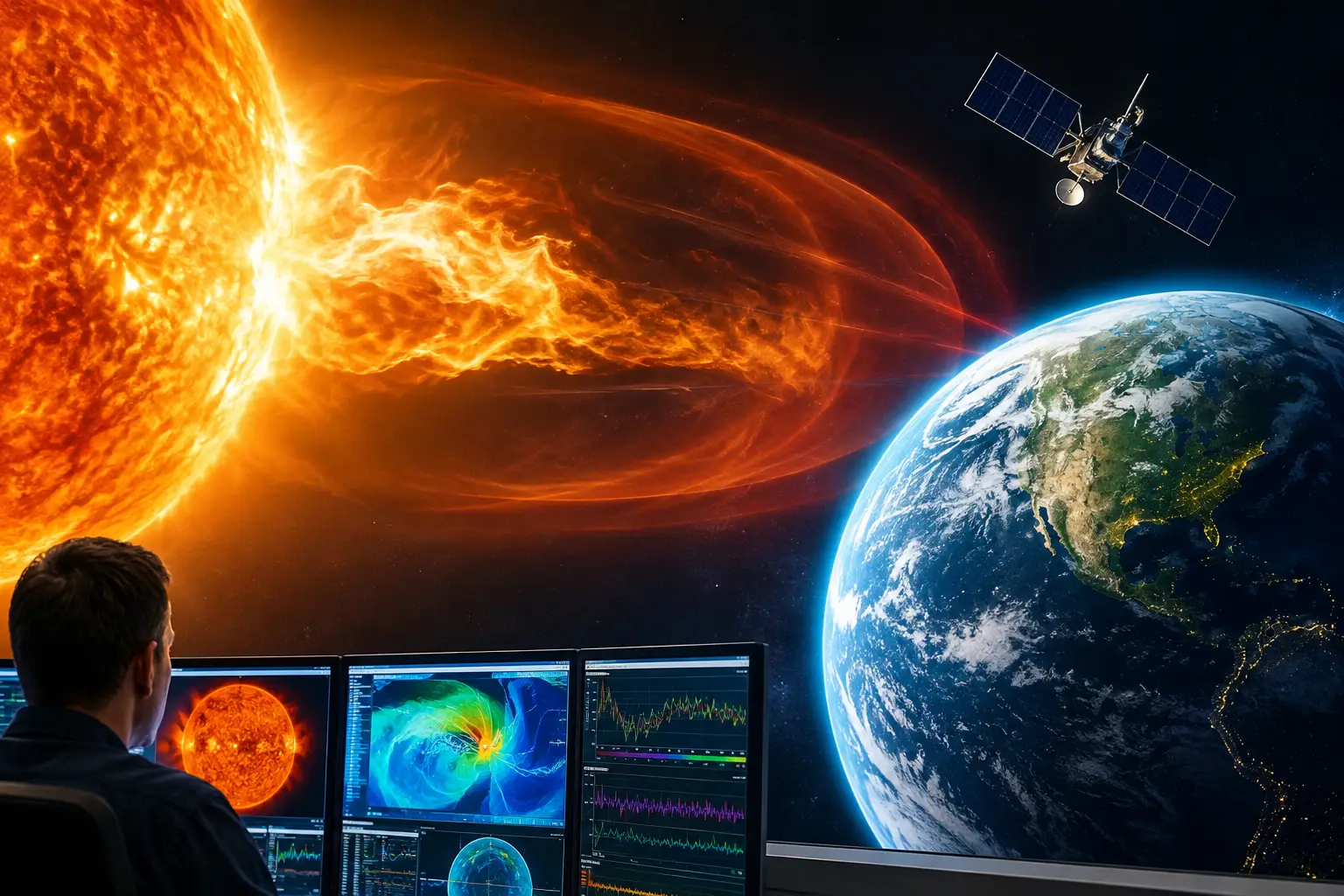
A green arc can appear over a quiet Icelandic road while the KP Index looks unremarkable. It can also fail to appear during a headline-worthy geomagnetic storm because thick cloud arrives first. That gap between a space-weather headline and what you can actually see is why space weather forecasting trends matter to travelers. The best forecasts are moving beyond one number toward a live, location-aware view of the whole aurora chain.
Space Weather Forecasting Trends Changing Aurora Plans
Aurora forecasting begins at the Sun, but the result is decided much closer to Earth. Solar eruptions and fast solar-wind streams can send charged particles toward our planet. When conditions in the solar wind connect efficiently with Earth's magnetic field, energy enters the magnetosphere and can trigger aurora activity.
For years, many travelers planned around the KP Index alone. KP remains useful because it describes global geomagnetic disturbance on a scale from 0 to 9. But it is a three-hour planetary index, not a minute-by-minute promise for a specific beach, mountain pass, or hotel parking lot. A modest KP can still produce a memorable display at high latitudes, especially in northern Iceland, Norway, Finland, Sweden, Greenland, Alaska, and Northern Canada.
The strongest forecasting trend is therefore not simply higher KP predictions. It is the shift from broad storm forecasts to continuously updated conditions that answer a more practical question: will you see aurora from your location tonight?
Faster solar-wind measurements
Spacecraft positioned upstream of Earth measure the solar wind before it reaches our magnetic environment. Depending on solar-wind speed, those observations can offer roughly 15 to 60 minutes of warning. That is short notice, but it is extremely valuable during a time-sensitive aurora night.
Travelers increasingly see live readings for solar-wind speed, density, and the interplanetary magnetic field, often called IMF. Of these, IMF Bz gets special attention. When Bz turns southward, it can make it easier for solar-wind energy to couple with Earth's magnetic field. A sustained negative Bz is generally favorable, while positive Bz can limit activity even when solar-wind speed is high.
There is a trade-off. Bz can change quickly. It is not a standalone viewing forecast, and one negative reading does not guarantee visible lights. Its value is in context: strong or rising solar wind, favorable Bz, an active geomagnetic response, darkness, and clear skies together tell a more useful story than any single metric.
Better estimates before disturbances arrive
Some solar events can be observed leaving the Sun days before they reach Earth. Forecast centers use solar imagery and models to estimate whether a coronal mass ejection, or CME, may arrive and when. These forecasts have improved, but their uncertainty is real. A CME can slow down, speed up, miss Earth, or arrive with a magnetic orientation that is less favorable than expected.
That uncertainty is becoming more visible in quality forecasts. Rather than treating a predicted arrival time as exact, modern services increasingly use arrival windows and update them as new observations come in. For travelers, this changes how to plan. A forecast window is a reason to keep evenings flexible, not a reason to drive three hours through unsafe weather for a guaranteed show.
Recurring high-speed streams from coronal holes are also becoming easier to track across successive solar rotations. They can create several active nights, particularly useful for visitors with a week-long itinerary. Still, local visibility remains the deciding factor once you are on the ground.
Why AI Helps, but Does Not Replace Physics
Machine learning is now being applied to solar imagery, solar-wind data, magnetometer readings, and historical aurora observations. These tools can identify patterns quickly, improve short-range estimates, and help translate complex data into probability-based alerts.
For an aurora traveler, the useful outcome is not a mysterious AI score. It is a clearer estimate of timing and confidence. Models may flag that conditions are becoming more favorable over the next hour, or that an incoming disturbance has a wider-than-usual uncertainty range. This helps photographers decide whether to stay ready at a dark location or return after a break.
But aurora forecasting has limits that no algorithm can erase. The solar wind is variable, magnetic coupling is complex, and visible aurora depends on your latitude, local light pollution, horizon, weather, and darkness. Forecasts should guide your decisions, not replace them.
A good rule is to treat long-range forecasts as planning signals and live data as operational signals. Use the first to choose flexible travel dates, tours, and overnight locations. Use the second to decide when to put on your boots, check the sky, and go outside.
Ground Sensors Are Making Forecasts More Local
Another important development is the growing use of ground-based magnetometers, all-sky cameras, and citizen observations. Magnetometers detect how Earth's magnetic field is responding in specific regions. This can reveal active conditions that a global index smooths over.
All-sky cameras and reports from observers add another layer. They can confirm that aurora is appearing in a region, although a camera may capture faint color that the eye sees only as a pale gray or greenish glow. A live camera is evidence of activity, not proof that the same brightness is visible at your exact location.
Local data matters most near the edge of the auroral oval. In Reykjavik, for example, a visitor may need stronger activity and a clear northern horizon than someone farther north in Iceland. In Tromso or Fairbanks, lower activity can be enough, but cloud cover can still end the night before it starts.
The Visibility Forecast Is Catching Up
The most useful space-weather forecasts now combine geophysics with conditions at the destination. That means cloud cover, precipitation, wind, temperature, moon phase, darkness, terrain, and light pollution belong beside solar data.
Cloud cover is often the immediate deal-breaker. A powerful storm above an overcast sky is invisible. Short-term cloud forecasts can help road-trip travelers choose between nearby valleys, coastlines, or inland clearings, but they should be checked frequently because Arctic weather changes fast.
Moonlight is more nuanced. A bright moon can reduce contrast and make faint aurora harder to notice, especially for photography, but it also illuminates landscapes and can produce striking images with snow, mountains, or ice. Strong aurora remains visible under a full moon. Do not cancel a trip just because the moon is bright.
This combined approach is the purpose of AuroraVision's free app. Its Live Aurora Score brings together real-time solar wind, IMF Bz, KP Index, cloud cover, moon phase, weather, and darkness so travelers can judge conditions as a whole rather than chase one dramatic number.
What These Trends Mean for Your Trip
The practical change is simple: build flexibility into aurora travel. If you are booking a guided Northern Lights tour, choose an operator with weather-aware routing and a clear rescheduling policy. If you are driving independently, prioritize safe roads, fuel, warm layers, and several nearby viewing options over one remote “perfect” spot.
Check conditions in stages. During the afternoon, look for a broad space-weather opportunity and identify clear areas. After dark, watch the live solar-wind trend, Bz direction, and local cloud movement. When the Live Score rises, move early rather than waiting for a perfect forecast. Aurora can intensify suddenly, and the best display may last minutes rather than hours.
Photographers should also plan for variability. Bring a tripod, spare batteries kept warm, and a wide-angle lens, then set up before conditions peak. First-time viewers should give their eyes time to adjust and scan the northern sky for faint arcs or bands. Do not stare only at one point overhead.
The Forecast to Trust Is the One That Shows Its Work
The future of aurora forecasting is not a single, bolder prediction. It is a more honest combination of solar observations, Earth-based measurements, local weather, and confidence that changes with the data. That is better science and better travel advice.
If the sky is clear and live conditions are improving, do not wait for a perfect KP number. Get to a safe dark viewpoint, give the night time, and stay ready for the moment the forecast becomes visible.