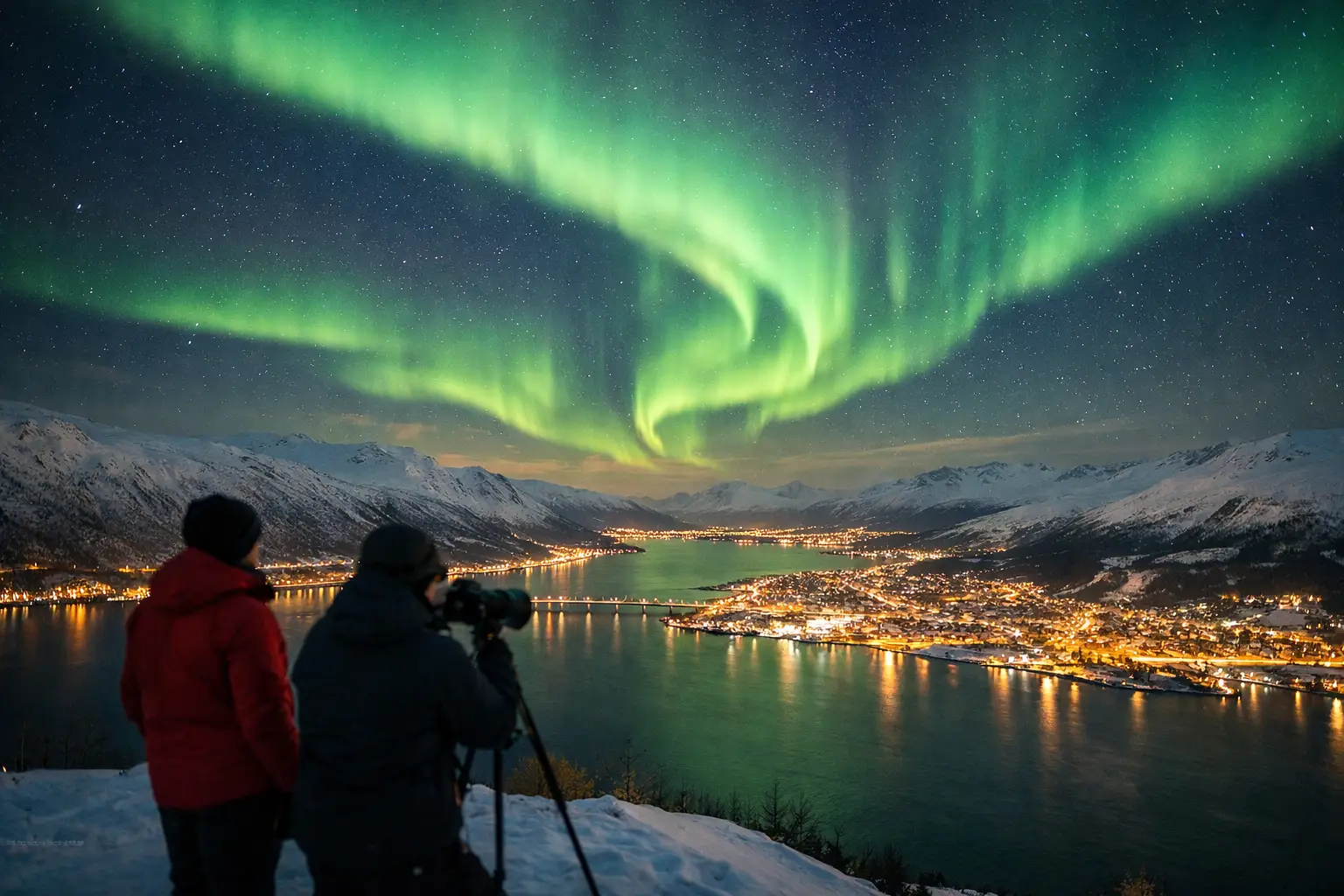
Tromso northern lights locations are not all equal on a cloudy, windy Arctic night. A map may show dozens of scenic pullouts within an hour of the city, but the right choice depends on where the clear sky is moving, whether moonlight will affect your photos, and how safely you can get there. The best plan is not to chase the most famous viewpoint. It is to give yourself several realistic options in different directions.
Tromso sits on an island, surrounded by bridges, fjords, mountains, and open coast. That geography makes it a strong aurora base, but it also creates local weather differences that can be dramatic over short distances. A location under clouds can be only 30 minutes from clear stars. Build your evening around flexibility, and you will have a much better chance of seeing the lights.
Start with the sky, not the scenic photo
The Northern Lights can appear above Tromso city when solar activity is strong and the sky is clear. However, city lighting reduces contrast, especially when the aurora is faint. For your first serious viewing attempt, get away from the brightest streets and give your eyes 15 to 20 minutes to adjust.
Cloud cover is usually the deciding factor. A high KP Index does not help if a thick cloud layer sits above you, while a modest aurora can look remarkable under a dark, clear sky. Look at the whole picture: cloud movement, local weather, moon phase, solar wind, and the IMF Bz direction. A southward Bz is generally more favorable because it helps energy from the solar wind connect with Earth's magnetic field.
Use a live forecast before leaving rather than deciding at breakfast. The free AuroraVision app brings these signals together in a Live Aurora Score, alongside real-time solar wind, IMF Bz, cloud cover, weather, moon phase, and the best time tonight. It is designed to answer the question that matters when you are putting on your boots: where should you go now?
Best Tromso northern lights locations by direction
Kvaloya: the flexible westward escape
Kvaloya, the large island west of Tromso, is one of the most practical areas for independent travelers. Cross the Sandnessund Bridge and you can follow coastal roads toward Ersfjordbotn, Kattfjord, Sommaroy, and several smaller bays and open shorelines. The appeal is simple: there are many places to stop, so you are not committed to one valley if the clouds settle in.
Ersfjordbotn is popular because its fjord and steep mountains make a striking foreground. It can also become busy, and the mountains may block parts of the horizon. It is a good choice for a visible overhead display or for photographers who want landscape composition, but less ideal if you need an open northern view.
Farther west, the coast around Sommaroy offers darker surroundings and broader views across the water. This is often a better choice when you want space, but weather can be more exposed. Strong wind, snow-covered roads, and changing conditions are normal. Do not park on narrow roads or in passing areas simply because the sky looks promising.
South of Tromso: Balsfjord and the inland route
Driving south and southeast toward Balsfjord can be a smart move when coastal weather is poor. Inland areas are not automatically clearer, but they may sit outside the same cloud pattern affecting the islands. Look for safe pullouts, open fields where parking is permitted, and broad views away from house lights.
The Balsfjord region has fewer dramatic coastal landmarks than Kvaloya, yet that can be an advantage. Open horizons make it easier to spot a low aurora band before it grows. If the lights are weak, a location with a clear northern sky and little artificial light is usually more useful than a famous viewpoint framed by mountains.
Travelers with rental cars should plan this route conservatively. Winter darkness arrives early, roads can be icy, and some pullouts disappear beneath snow. Keep your fuel level high, bring warm layers that work outside the car, and avoid turning an aurora drive into a long-distance chase after midnight.
North and northeast: Ramfjord and Lyngen views
Ramfjord, southeast of the city, provides another useful direction when conditions favor that side of Tromso. It is close enough for a short evening trip, with sections of open water and lower terrain that can provide wider sky views than central Tromso. As always, assess each stop for safe parking and avoid private driveways.
For travelers willing to drive farther, the Lyngen area can deliver exceptional mountain-and-aurora scenery. It is not a casual backup plan, though. Distances increase, road conditions can be more demanding, and the mountains may conceal part of the sky. Choose this route when the forecast supports it and when you are comfortable with a longer winter drive.
The right question is not, “Which place has the best photos online?” Ask, “Which reachable location has the clearest sky in the direction I can safely travel?” That is how experienced aurora guides make decisions.
City locations when you do not have a car
You do not need to cancel your night because you are staying in central Tromso. The waterfront, quieter edges of Tromsoya, and areas away from the strongest streetlights can all offer a view during a bright display. Look north over the water where possible, and avoid standing directly beneath lamps.
City viewing is especially worthwhile when the forecast calls for a strong aurora overhead or when road conditions are poor. It is also a sensible first check. Step outside, let your eyes adjust, and use your phone camera in night mode to scan the sky. Cameras often reveal a faint green band before it becomes obvious to the eye.
For the highest odds without driving, a guided Northern Lights tour is often the practical choice. Good guides monitor clouds, know safe stopping areas, and can change direction quickly. They also remove the stress of navigating unfamiliar winter roads while tired and focused on the sky. Ask whether the operator actively relocates based on weather rather than following a fixed sightseeing route.
Pick locations for the conditions you have
An open coast is excellent when the aurora is low on the northern horizon, but it can be bitterly cold and windy. A sheltered inland location is more comfortable for waiting, although surrounding hills may limit your view. Moonlight can brighten the landscape for photos and help you see your footing, yet it also makes faint aurora less distinct. There is no single perfect location for every night.
If clouds are broken, avoid committing too early. Park legally at a safe viewing point and watch the stars for 10 to 15 minutes. Cloud gaps often move faster than travelers expect. If the sky closes, relocate only when the forecast shows a meaningful improvement somewhere else. Constant driving can make you miss the best display directly above you.
A basic aurora kit helps. Bring insulated boots, windproof outer layers, gloves you can use with camera controls, a headlamp with a red-light setting, a hot drink, and a fully charged power bank. Cold batteries drain quickly. For photography, use a tripod and start with a wide aperture, a few seconds of exposure, and an ISO high enough to reveal the sky without turning it into grain. Adjust from there as the aurora brightens or begins moving faster.
Timing: give the night enough time
Aurora can appear anytime after dark, but many displays build between late evening and the early morning hours. Do not treat a quiet sky at 9:00 p.m. as a final verdict. Conditions can change quickly after a shift in solar wind or a break in cloud cover.
Arrive at your chosen area before the strongest forecast window, rather than driving there during it. That gives you time to park safely, find your composition, protect your camera from snow, and let your eyes adjust. If you are taking a tour, be ready to leave at the scheduled time even if the city sky looks disappointing. The clearer conditions may be well beyond the bridge.
Tromso rewards travelers who stay mobile, patient, and realistic. Choose a safe location with the clearest available sky, keep one backup route in mind, and spend enough time outside for the Arctic night to change its mind.