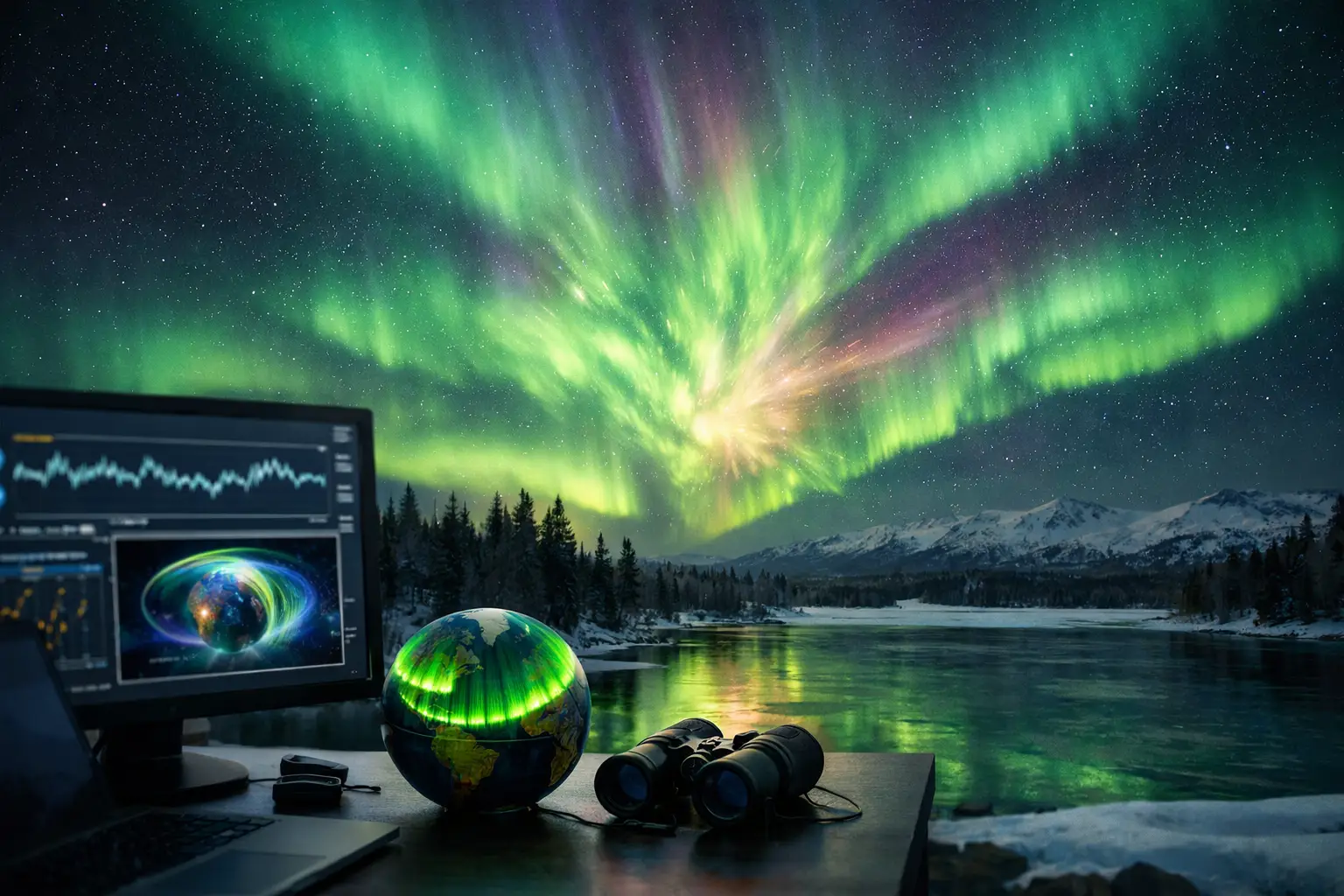
A quiet aurora can change character in minutes. One moment, a pale arc sits low over the northern horizon. Then it brightens, breaks into fast-moving curtains, and spreads overhead in green, violet, or red. What causes aurora substorms is not simply a higher KP Index. It is a rapid release of energy that has been stored in Earth’s magnetic environment, and it can produce some of the most memorable displays of an aurora night.
For travelers and photographers, that distinction matters. A substorm can make an otherwise modest night suddenly exciting, but it cannot overcome thick cloud, daylight, or a poor viewing location. Understanding the process helps you recognize when conditions may be building - and when it is worth staying outside a little longer.
What causes aurora substorms?
Aurora substorms begin with the solar wind, the continuous stream of charged particles flowing outward from the Sun. As that wind reaches Earth, it interacts with our planet’s magnetic field, or magnetosphere. Think of the magnetosphere as a protective bubble that is compressed on the day side by the solar wind and drawn into a long magnetic tail on the night side.
The key ingredient is often the direction of the interplanetary magnetic field, usually shortened to IMF. When IMF Bz points south, it is more likely to connect with Earth’s northward-pointing magnetic field on the sunward side of the planet. This process, called magnetic reconnection, allows solar-wind energy and particles to enter the magnetosphere more efficiently.
That incoming energy does not instantly become visible aurora. Much of it is transported into Earth’s magnetic tail, where magnetic energy builds over time. Eventually, conditions in the tail become unstable. Another episode of magnetic reconnection can occur there, converting stored magnetic energy into motion, heat, electric currents, and accelerated particles.
Some of those particles are guided along magnetic field lines toward the upper atmosphere near the polar regions. They collide with oxygen and nitrogen high above Earth, exciting those gases and causing them to emit light. The result is an aurora that may brighten quickly and become far more active across the sky.
The three stages of an aurora substorm
A substorm is often described in three stages: growth, expansion, and recovery. These names are useful because they match what observers may see, although the space physics behind them is far more complex than any single forecast number.
Growth phase: energy builds in the magnetotail
During the growth phase, solar-wind coupling adds energy to the magnetosphere. A sustained southward Bz is often favorable, especially when solar-wind speed and density also support stronger energy transfer. The aurora may remain a relatively quiet arc during this period, commonly toward the northern horizon for observers below the main auroral oval.
This is one reason a stable-looking sky should not automatically send you back indoors. If solar-wind conditions are favorable, a quiet arc can be part of a developing situation rather than the end of the show.
Expansion phase: the visible outburst
The expansion phase is the dramatic portion people usually mean when they talk about an aurora “exploding.” Energy stored in the magnetotail is released rapidly. Electric currents intensify, charged particles are accelerated toward the atmosphere, and the auroral oval can expand toward lower latitudes.
From the ground, the arc may brighten, form rays and folds, and begin pulsing or racing across the sky. Overhead coronas can appear when active auroral structures align with your viewing direction along Earth’s magnetic field. These patterns are not merely visual decoration - they reveal changing currents and particle precipitation high above you.
The onset can happen quickly. A display may go from subtle to highly photographic in five or 10 minutes, then change again before you have adjusted your camera settings. That is why photographers should keep a usable starting setup ready rather than waiting for the perfect moment to prepare.
Recovery phase: activity settles, but not always immediately
After the main release, the magnetosphere begins returning toward a less energized state. The aurora may fade, retreat northward, or become more diffuse. Yet recovery does not always mean the night is over. Further solar-wind energy input can trigger another substorm, creating several active intervals over a few hours.
For a road-trip traveler in Iceland or northern Norway, this is the practical challenge: do not judge the whole night by one bright burst or one quiet half-hour. Conditions can cycle. If skies remain clear and solar-wind input stays supportive, patience can be the difference between seeing a faint arc and witnessing a full-sky display.
Why substorms are not the same as geomagnetic storms
Aurora substorms and geomagnetic storms are related, but they are not interchangeable. A geomagnetic storm is a larger, longer-lasting disturbance of Earth’s magnetic environment, often driven by a coronal mass ejection or a high-speed solar-wind stream. Storms can raise the chance of aurora at lower latitudes and may create favorable conditions over many hours or even days.
A substorm is a more localized and shorter-lived unloading of energy in the magnetotail. Substorms can occur during a geomagnetic storm, but they also occur under less dramatic global conditions. In other words, a low or moderate KP value does not guarantee a dull sky in the auroral zone, and a high KP value does not guarantee a visible display at your location.
KP is a useful broad measure of global geomagnetic disturbance. It is not a minute-by-minute visibility forecast. It does not tell you whether clouds cover your exact viewpoint, whether the aurora is currently brightening, or whether a substorm is developing on the nightside.
What to watch if you are outside tonight
There is no single metric that announces a substorm with certainty. Scientists continue to study the detailed trigger mechanisms, and local aurora behavior can be complicated. Still, a few signals are more meaningful together than they are alone.
Look for sustained southward IMF Bz, supportive solar-wind speed and density, and a rising level of geomagnetic activity. Then check the factors that decide whether you can actually see the result: darkness, cloud cover, weather, moonlight, and your distance from city lights. A bright moon rarely prevents a strong aurora from being visible, but it can make faint structures harder to see and photograph.
AuroraVision brings those pieces into one live view with its Aurora Score, real-time solar wind and IMF Bz, KP Index, cloud cover, moon phase, weather, and smart alerts. Use it as an operational check before leaving your hotel or changing locations, not as a promise that the sky will perform on schedule.
How to respond when activity starts building
If a faint arc is visible and the sky is clear, stay ready. Find an open horizon away from direct lights, keep warm enough to remain outside for at least an hour, and avoid constantly driving between locations unless cloud forecasts clearly favor another area. Frequent relocation can mean missing the exact interval when a substorm begins.
For photography, start with a composition before the aurora peaks. Include a mountain, shoreline, cabin, or road only if it does not force you to face into strong light pollution. When the display accelerates, shorten your exposure to preserve structure. Long exposures can turn fast rays into a soft green blur, while a shorter exposure may capture the sharp curtains your eyes are seeing.
Most of all, look up beyond the camera screen. During a substorm, the most impressive movement can develop behind you or directly overhead. If an arc starts brightening and widening, step back, scan the full sky, and give yourself room to experience the change.
Aurora substorms are reminders that the Northern Lights are not a static forecast symbol. They are the visible edge of a living interaction between the Sun, Earth’s magnetic field, and the upper atmosphere. When the sky is clear and the signals begin to align, stay alert - the quiet arc on the horizon may be only the opening scene.