Why Northern Lights Colors Change in the Sky

·Published by AuroraVision
Why Northern Lights Colors Change in the Sky

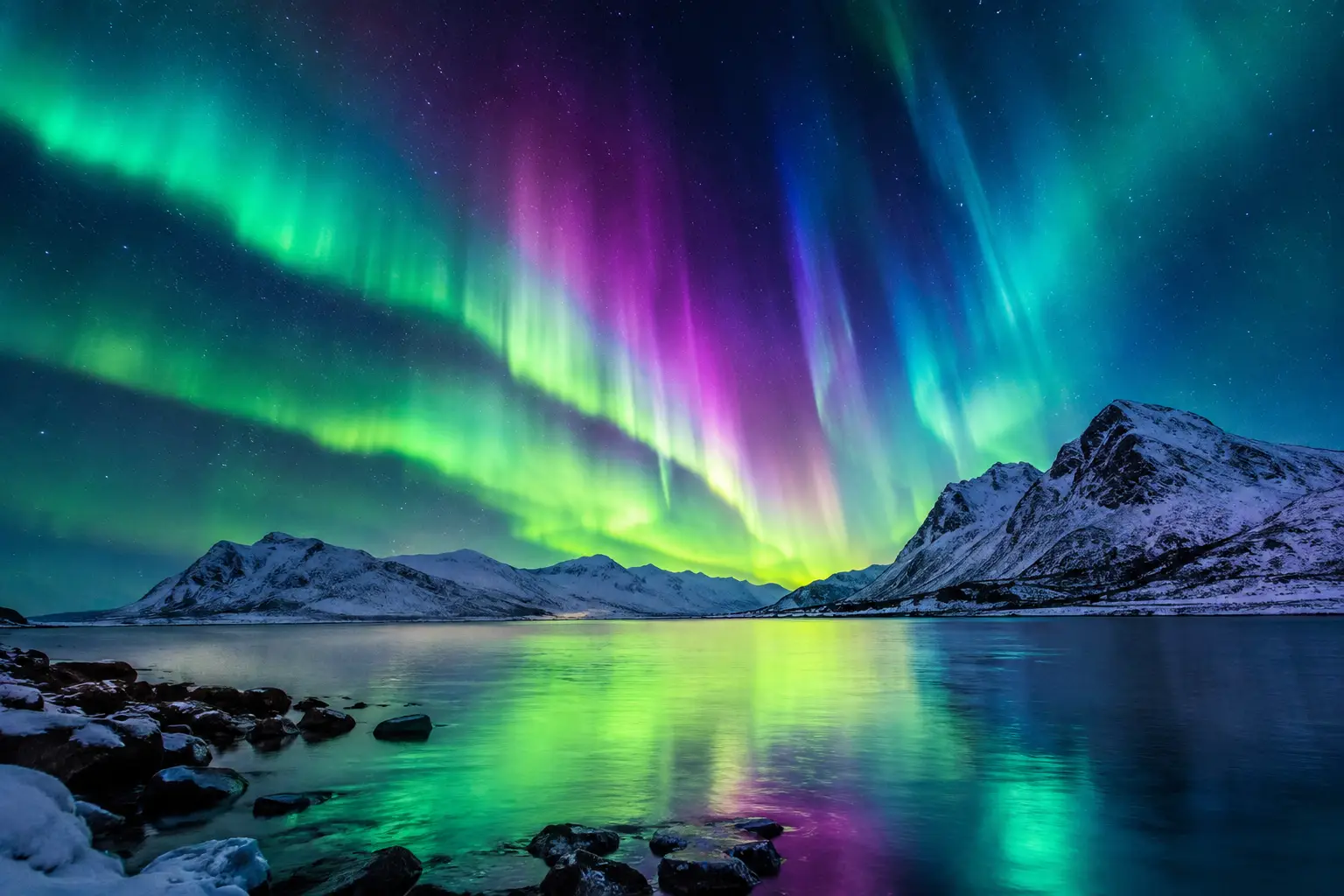
A pale green arc can suddenly develop pink edges, a crimson glow can spread above it, and a camera may reveal purple that your eyes barely notice. That is why northern lights colors are so captivating: they are not one fixed display. Each color is evidence of a different interaction between solar particles, Earth’s atmosphere, altitude, and the way human vision works in low light.

For travelers, color is also a useful reminder that a great aurora night is about more than a single forecast number. A strong display can look mostly white-green to the naked eye, while a less intense but high-altitude event may show a remarkable red glow. Here is what creates those colors and what they can tell you when you are standing beneath the Arctic sky.

Why Northern Lights Colors Appear

The aurora begins about 93 million miles away at the Sun. The Sun releases a stream of electrically charged particles called the solar wind. When conditions are favorable, some of that energy enters Earth’s magnetic environment and is guided toward the polar regions by magnetic field lines.

High in the atmosphere, these energized particles collide with oxygen and nitrogen. The collisions briefly excite the gases. As the gases return to their normal energy state, they release light at specific wavelengths. Those wavelengths are the aurora’s colors.

The gas matters, but altitude matters just as much. Oxygen at one height does not behave exactly like oxygen at another, because the atmosphere becomes thinner as altitude increases. Nitrogen also produces different colors depending on whether it is electrically excited or ionized. This is why a single auroral curtain can have several layers of color at once.

Green: the classic aurora color

Green is the color most visitors hope to see, and for good reason. It is the most common visible aurora color and often appears between roughly 60 and 150 miles above Earth. It is produced mainly when energized particles collide with atomic oxygen.

Green is especially easy for our eyes to detect compared with red or blue in dark conditions. A modest display may look like a soft grayish band at first, then reveal green as it brightens or begins to move. During an active period, green can form arcs, rippling curtains, rays, and fast-moving bands that stretch across much of the sky.

A green aurora does not automatically mean conditions are weak. Some of the most powerful displays remain overwhelmingly green because the strongest activity is occurring at the altitudes where green oxygen emissions dominate.

Red: high, rare, and often subtle

Red aurora is also created by oxygen, but much higher in the atmosphere, usually above about 150 miles. At those elevations, collisions are less frequent, giving oxygen atoms enough time to emit red light after being energized.

Because red emissions are faint and often occur above the brighter green layer, they can be difficult to spot with the naked eye. Look for a dim red wash at the top of a green curtain or a broad red glow farther north. A camera using a longer exposure may show red much more clearly than your eyes do.

Red can appear during strong geomagnetic activity, but it is not a simple measure of storm strength. It depends on where energy is being deposited in the atmosphere and on the type of particles involved. In Iceland, northern Norway, Alaska, and northern Canada, a red upper edge can be a memorable sign that the display has real vertical structure.

Pink, purple, and blue: nitrogen joins the show

Pink, purple, and blue tones are usually linked to nitrogen. These colors are often seen lower in the atmosphere, beneath the green oxygen layer, where incoming particles penetrate deeper and collisions are more energetic.

Pink is commonly the most visible of these shades. It may appear as a bright lower border on a green curtain, particularly when the aurora is active and sharply defined. Violet and blue can occur too, but human night vision is relatively poor at detecting them. They may be obvious in photographs while appearing gray, pale lavender, or simply dark to the eye.

These lower-edge colors are often easiest to notice during fast motion. When curtains twist, fold, or break into rays, the contrast between green above and pink or violet below can become striking. A still photo cannot always convey how quickly that color boundary changes.

What Determines the Color You Actually See?

Aurora physics sets the available colors, but the display you personally see depends on several practical factors. Brightness is the biggest one. Human eyes rely more heavily on rod cells in low light, which are excellent at detecting movement and faint light but poor at distinguishing color. That is why a weak aurora may look silvery white, even when a camera identifies green.

Your viewing conditions matter too. Moonlight, nearby town lights, haze, and thin cloud reduce contrast. A bright moon does not stop the aurora, but it can make faint colors harder to see. On a clear, dark night, the same aurora will look more saturated than it does through coastal cloud or beside a well-lit parking area.

Camera settings create another difference. Modern phone cameras and dedicated cameras can collect light over several seconds, often recording greens, reds, and purples that are barely visible in real time. This does not mean the photograph is fake. It means the sensor is gathering light differently than the human eye. Extremely long exposures, however, can make a moving aurora look smoother and more colorful than the live scene felt.

The angle of the display also changes perception. A distant aurora near the horizon passes through more atmosphere and may look muted. When an overhead corona forms, you are looking along magnetic field lines, and the rays can appear more intense and detailed. The color mix may change as the aurora moves from the northern horizon toward the zenith.

Can Aurora Color Predict a Better Night?

Color alone cannot forecast what happens next. A red glow does not guarantee a major storm, and green does not mean a quiet night. The best operational clue is the aurora’s behavior: Is it brightening? Is it spreading across more sky? Are arcs becoming structured, moving curtains, or rays?

The underlying drivers are solar wind speed and density, the direction of the interplanetary magnetic field, especially IMF Bz, and the overall transfer of solar energy into Earth’s magnetic system. A southward Bz can support stronger coupling, while cloud cover determines whether you can see the result at all. Local weather and darkness matter just as much as space weather when you are deciding whether to leave your hotel or continue a road trip.

That is why AuroraVision combines a Live Aurora Score with solar wind, IMF Bz, cloud cover, moon phase, and weather rather than treating the KP Index as a complete answer. Before heading out, check the Best Time Tonight, choose the clearest practical location, and allow enough time for conditions to change. The aurora often arrives in pulses rather than following a fixed schedule.

How to See More Color With Your Own Eyes

Give your eyes time to adapt. Avoid looking at bright screens for 15 to 20 minutes, or use a dim red screen setting when you need to check conditions. Step away from direct lights, face the darkest open part of the sky, and scan beyond the obvious green arc. The faintest color is often above the main band, not inside it.

If you are driving independently in Iceland or northern Scandinavia, do not chase color at the expense of safe travel. A clear viewing site close to your accommodation is often better than a long drive into uncertain weather. Keep warm, bring a tripod if you plan to photograph, and watch the sky continuously during an active window. A display can transform from a quiet green line to green-and-pink curtains in a few minutes.

For photography, begin with a stable tripod, a wide aperture, and an exposure short enough to preserve movement. Adjust from there based on brightness. A very bright aurora may need only one or two seconds; a faint arc may need longer. Review images occasionally, but do not spend the entire event looking at the back of the camera.

The Best Color Is the One You Catch Live

There is no single “correct” northern lights color. A faint green ribbon over a frozen lake, a red-topped curtain above a Norwegian fjord, and a sudden pink edge racing through the sky are all products of the same extraordinary Sun-Earth connection. Watch the live conditions, get under clear skies when you can, and keep looking up. The next change in color may be the moment you remember most.

Guided Aurora Experiences

← Back to Blog