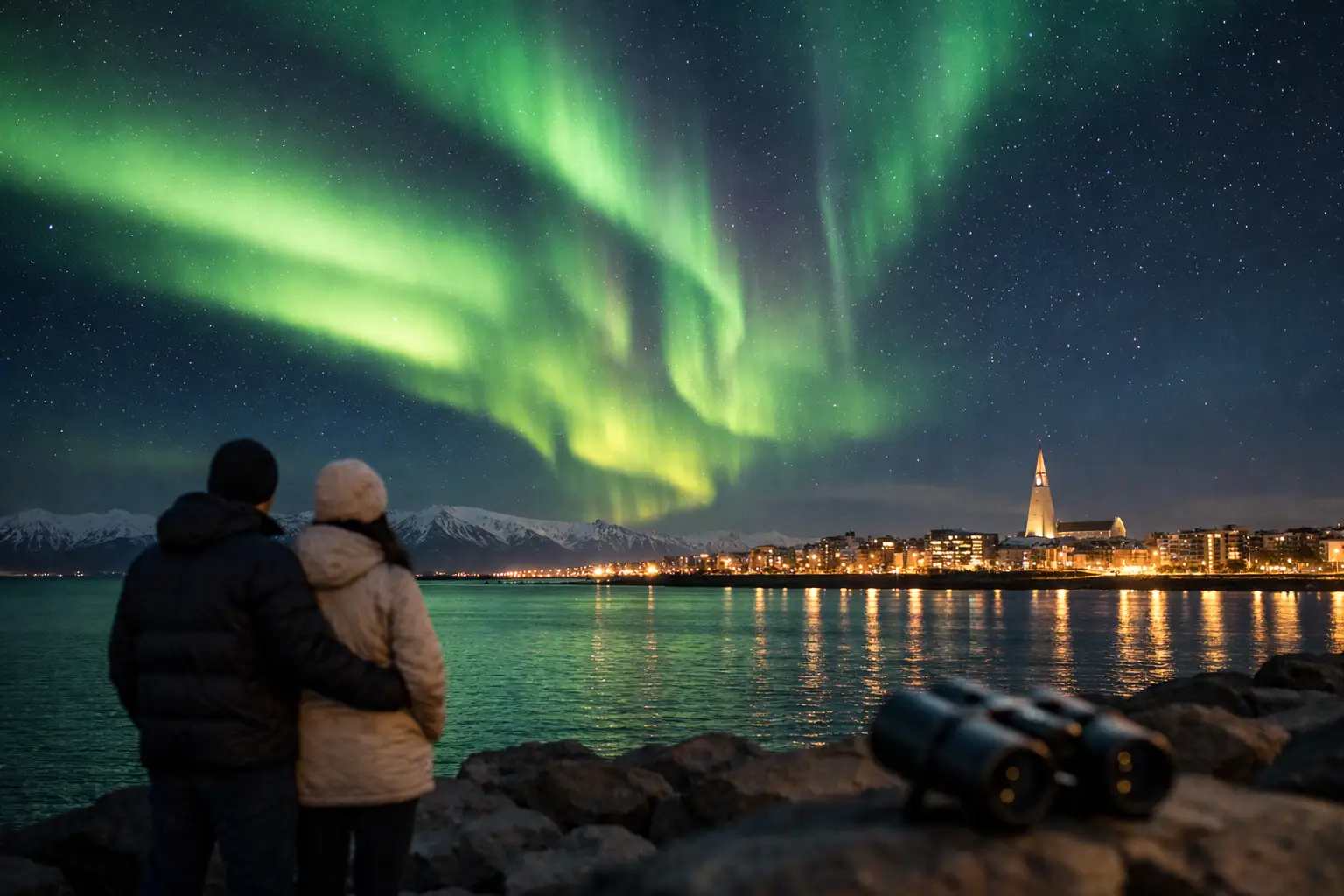
Reykjavík can deliver a memorable Northern Lights display without a long drive into the Icelandic countryside. It can also leave visitors staring at a bright city sky beneath a thick layer of cloud. That is the reality of an aurora Reykjavík night: success depends on more than solar activity. You need darkness, a clear gap in the clouds, a view away from city lights, and the patience to act when conditions change.
The good news is that Reykjavík is a practical base for aurora hunting. You can stay in the city, monitor conditions, and decide whether to walk to a nearby shoreline, join a tour, or drive toward clearer skies. The key is treating the forecast as a live decision tool, not a promise made earlier in the day.
Can You See the Aurora in Reykjavík?
Yes, especially from late August through mid-April, when nights become properly dark. Reykjavík sits far enough north that moderate geomagnetic activity can produce visible aurora when the sky is clear. During strong activity, the lights may be visible even from central neighborhoods, although streetlights and buildings reduce contrast and make faint displays harder to notice.
Winter is the easiest season for darkness, but not automatically the best season for every traveler. December and January offer long nights, yet Icelandic weather can be unsettled and daylight is brief for sightseeing. September, October, March, and April often give a more balanced trip, with darker evenings, more daytime driving hours, and potentially better access to trails and roads.
A clear sky is usually more valuable than a high KP Index. KP is a broad measure of geomagnetic disturbance, useful for understanding overall activity but not for telling you whether clouds are blocking your exact viewing location. A modest aurora under a clear Reykjavík sky can be far better than a major event hidden above an overcast city.
Why Reykjavík Forecasts Change So Quickly
Iceland lies in the path of fast-moving North Atlantic weather. Clouds can arrive, break apart, and clear again within an hour. That means a single evening forecast is not enough. Look for cloud cover by hour and by area, then be ready to move when a clearer window appears.
Aurora activity also changes on short timescales. The solar wind carries charged particles from the Sun toward Earth, but the conditions that help those particles interact with Earth’s magnetic field can strengthen or weaken rapidly. One of the most useful measurements is IMF Bz, the north-south direction of the interplanetary magnetic field. A sustained southward Bz often supports stronger aurora activity because it allows energy to couple more effectively into Earth’s magnetic environment.
For practical decisions, watch the combination rather than chasing one number. The free AuroraVision app brings together a Live Aurora Score, solar wind, IMF Bz, KP Index, cloud cover, moon phase, and local weather so you can judge the full picture. Use it to check the Best Time Tonight, activate alerts, and decide whether the conditions justify heading outside or taking a drive.
Darkness and moonlight matter
Reykjavík’s city glow is the first obstacle. The second is the Moon. A bright full Moon will not prevent you from seeing a strong aurora, and it can make snow-covered landscapes look beautiful for photography. But moonlight reduces contrast, so weak green bands may be harder to distinguish, especially near streetlights.
Do not wait for a moonless night if the forecast is otherwise excellent. Instead, choose a darker location, face away from the Moon when possible, and give your eyes at least 15 to 20 minutes to adjust. The aurora often begins as a pale gray-green arc or haze before becoming more defined.
Weather decides where to go
Do not assume the weather in downtown Reykjavík represents the whole area. One side of the city may be cloudy while the coast or nearby countryside is clearer. Look at the direction clouds are moving and identify a realistic route before sunset. Strong winds, rain, and icy roads can turn a promising chase into a poor decision quickly.
If road conditions are difficult, stay local or book a guided excursion rather than driving beyond your experience level. Iceland’s winter roads demand attention even when the aurora forecast is exciting.
Best Places to Watch Aurora Near Reykjavík
The best location is not always the darkest spot on a map. It should also be safe, accessible, and open enough to see the northern horizon. In Reykjavík, coastal paths and parks are often more practical than remote viewpoints after dark.
Grótta Lighthouse and Seltjarnarnes
The Grótta area, west of central Reykjavík, is one of the city’s best-known aurora locations. It offers more open sky and less direct light than downtown, with the sea adding a clear horizon. Check tide conditions and stay on safe paths. The lighthouse is on a small island that may not be accessible at high tide.
It can be busy on popular aurora nights, but that does not make it a bad choice. For first-time visitors without a car, it is a sensible place to start because it is straightforward to reach and does not require a remote winter drive.
Öskjuhlíð and Perlan area
The wooded hill around Öskjuhlíð can provide darker surroundings than central streets, with elevated views over parts of the city. Trees may block sections of the horizon, so walk a little to find an open clearing. It is a good option for travelers staying near Reykjavík’s center who want a shorter outing.
Heiðmörk and the eastern outskirts
For a darker escape, the countryside and open areas east of Reykjavík can offer better contrast than the city itself. Heiðmörk is close enough for a short drive but feels noticeably removed from urban light. This option suits confident drivers with a suitable rental car, current road information, warm clothing, and a clear plan for returning safely.
If you want the least stressful option, a Northern Lights tour can be worthwhile. Experienced guides monitor weather patterns, know alternate viewing areas, and handle the driving. Tours cannot create clear skies or guarantee aurora, but they can improve your odds when conditions are variable.
A Better Plan for Tonight
Start checking conditions in the late afternoon, not only after dinner. Identify whether clouds are expected to clear near Reykjavík and whether solar activity has enough support to make a trip worthwhile. Pack insulated layers, gloves, a hat, waterproof outerwear, and footwear that handles wet or icy ground. Standing still for an hour feels much colder than walking through the city.
After dark, reassess. If the Live Score rises and local clouds are thinning, head to your chosen spot promptly. If the city is clouded in but a nearby clear band is moving in, wait rather than assuming the entire night is lost. Many successful sightings happen after an early disappointment.
Give each location time. Watch the sky for at least 30 minutes if clouds allow. Look north first, but scan overhead and toward the northeast or northwest too. The aurora does not always stay in one direction, particularly during stronger activity.
For photography, keep expectations realistic. A camera sensor can collect more light and color than your eyes, so images may look greener or more saturated than the live scene. Use a tripod, a wide-angle lens, manual focus set on a distant light or star, and a short test exposure. Start around two to six seconds, then adjust based on brightness and movement. A fast, active aurora needs shorter exposures to retain structure.
Choose Flexibility Over a Perfect Forecast
The best Reykjavík aurora nights are rarely the ones that looked perfect at breakfast. They are the nights when travelers check the live conditions, dress for the wait, and stay flexible about where and when to go. Book accommodation with easy access to the coast or a tour pickup point, keep your evening schedule light when the forecast improves, and let the sky make the final call.
If the lights do appear, resist the urge to spend the entire moment looking at a screen. Take a few photos, then look up. A moving aurora above Reykjavík is one of those travel experiences that feels different when you give it your full attention.