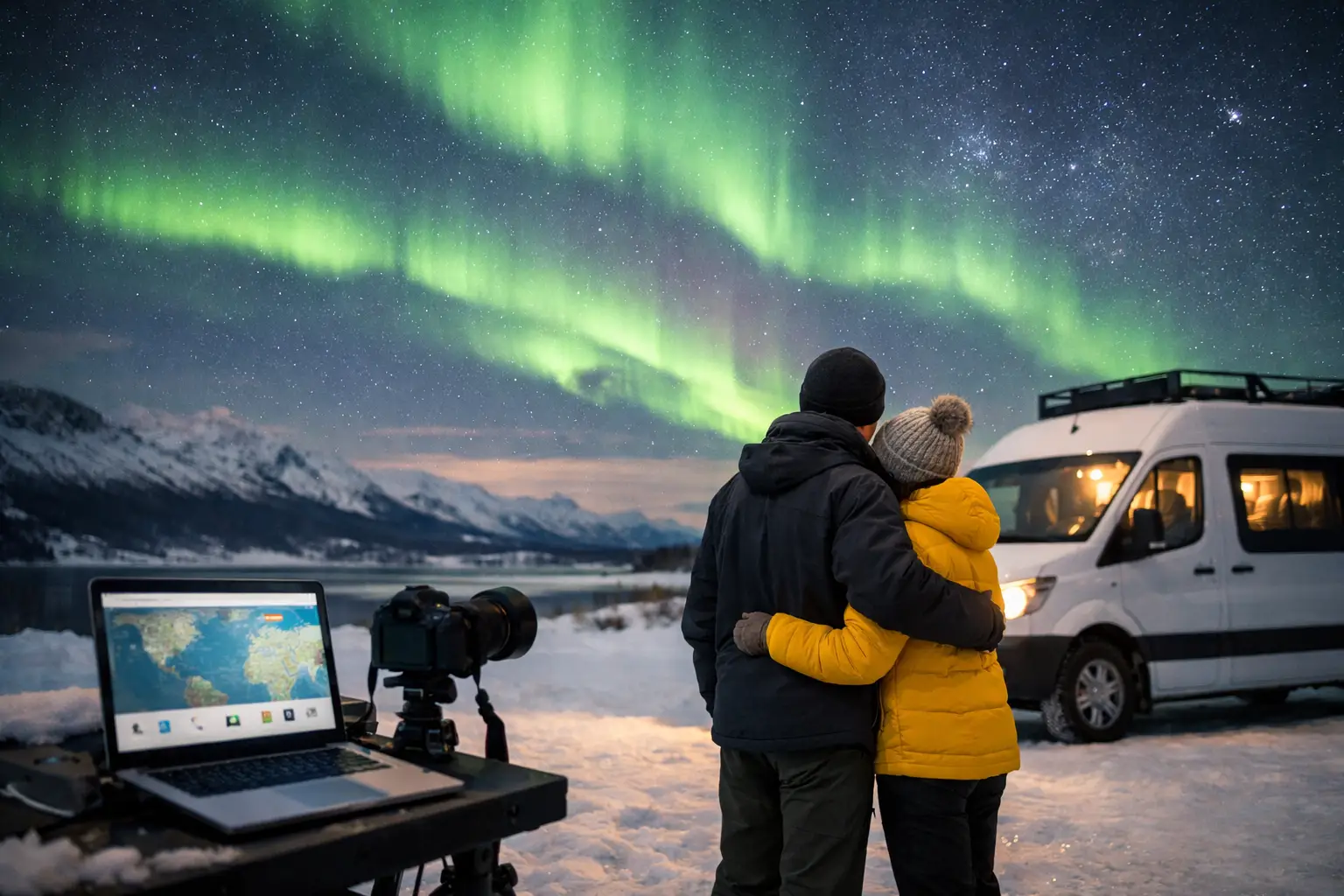
A good aurora tour booking is not simply a reservation for a dark-sky drive. It is a decision about how you will respond when the forecast changes, clouds move in, or the lights appear for 10 minutes in a gap that was not visible on an app that morning. The right tour gives you mobility, local judgment, warmth, and enough time outside to make a real opportunity count.
Northern Lights trips are time-sensitive by nature. Space weather can improve quickly, local weather can ruin an otherwise strong display, and the best viewing area may be an hour from your hotel. Book with those realities in mind, rather than choosing solely by the lowest price, the largest social media following, or a promised KP number.
What to Check Before Aurora Tour Booking
Start with the tour’s operating area. A tour based in Reykjavik may drive west, east, or inland depending on the cloud forecast, while a Tromso operator may cross islands, follow fjords, or head toward the Finnish border. That flexibility matters more than a fixed “best viewing spot.” Aurora is visible beneath clear skies, so a guide who can relocate has a practical advantage when conditions are mixed.
Next, read the cancellation and retry policy closely. Weather cancellations are normal, not a sign of a poor operator. The useful question is what happens after one. Some tours offer a free retry on the next available departure, while others provide a partial refund, a voucher, or no compensation once the vehicle leaves. A retry policy has the most value when you schedule your tour early in a three- to five-night stay. Booking it on your final night removes your backup plan.
Also check the planned duration and pickup logistics. A four-hour tour can be enough on a clear, active night close to town. In Iceland, Northern Norway, Alaska, and Northern Canada, however, travel time can consume a large part of the evening. Longer tours often provide more chances to wait through cloud breaks or move to a second location. They can also be more tiring, especially for families with young children or travelers arriving on an overnight flight.
Ask what is included, but keep expectations realistic. Warm drinks, insulated outerwear, tripods, photos, and hotel pickup can make a tour far more comfortable. They do not make the aurora appear. A company that explains this plainly is usually setting better expectations than one that treats a strong light display as guaranteed.
Choose the Tour Style That Fits Your Trip
The best tour type depends on your confidence, budget, photography goals, and access to a vehicle.
A large coach tour is often the simplest first choice. It is usually less expensive, handles pickup efficiently, and works well for travelers who want a straightforward evening without driving icy roads. The trade-off is less flexibility. A full-size bus cannot always use narrow roads or make quick route changes, and a large group can make the viewing site feel busy.
Small-group van tours are a strong middle ground. They tend to offer more interaction with guides, easier movement between locations, and more help with cameras. They cost more, and seating may be tighter during a long drive, but they suit first-time aurora travelers who value guidance and mobility.
Private tours make sense for photographers, families, travelers with limited time, or groups splitting the cost. You can set the pace, spend longer at one location, and ask for help with camera settings. A private trip is not automatically better at finding aurora - it still depends on the guide, roads, clouds, and solar conditions - but it gives you control over the experience.
Self-driving offers the greatest independence and can be excellent in Iceland or Finnish Lapland if you are comfortable with winter conditions. It also places all the work on you: monitoring roads, finding safe pullouts, reading cloud maps, staying warm, and knowing when to leave a location. Never turn an aurora chase into a risky drive. If wind, ice, visibility, or road closures are concerning, a guided tour is the safer choice.
Read Forecasts the Way Guides Do
The KP Index is useful, but it is not a booking tool by itself. KP describes global geomagnetic activity on a scale from 0 to 9. It does not tell you whether clouds cover your location, whether the aurora is bright enough to see with your eyes, whether the display is happening now, or whether conditions will improve later tonight.
Guides watch several moving parts. Solar wind carries energy from the Sun toward Earth. A sustained southward IMF Bz can help that energy couple with Earth’s magnetic field. Aurora visibility also depends on cloud cover, local weather, darkness, moonlight, and your distance from the auroral oval. A lower KP night can be memorable under clear skies near the oval, while a higher KP night can be a complete miss under thick cloud.
Before departure, check AuroraVision’s free app for the Live Aurora Score, real-time solar wind, IMF Bz, cloud cover, moon phase, weather, and the Best Time Tonight view. This is especially useful when deciding whether to keep a self-drive plan, accept a tour operator’s proposed departure, or reserve a second attempt later in your stay. The goal is not to predict a perfect photograph. It is to make the best decision with the conditions available now.
A useful habit is checking conditions twice: once in the afternoon, when tours are confirming routes, and again shortly before pickup. The second check can reveal a cloud break, a solar wind change, or a weather shift that turns an ordinary evening into one worth staying awake for.
Book Early, But Leave Room to Adapt
Popular periods sell out, particularly around new moon weekends, school holidays, and peak winter travel dates. Book early enough to secure a reputable operator, then protect flexibility wherever you can. Choose a refundable rate if the price difference is reasonable, avoid putting every tour on your last available night, and do not book back-to-back late-night activities that leave no room for sleep or a weather reschedule.
If your itinerary allows, plan at least two potential aurora nights. This does not mean paying for two tours immediately. It means keeping the evenings open and selecting accommodations that make a second attempt easy. A remote hotel with dark surroundings may be ideal for independent viewing; a city hotel may be more convenient for tours with pickup and free retries.
For travelers visiting remote areas, confirm the operator’s pickup radius before reserving. Hotels outside central Reykjavik, cabins in the Lofoten Islands, and stays beyond Fairbanks can require a meeting point or an additional fee. Ask before booking rather than assuming a map pin means door-to-door collection.
Questions Worth Asking a Tour Operator
You do not need a long interrogation. A few direct questions reveal whether a tour fits your plans: How far can the guide travel to find clearer skies? What happens if the trip is canceled for weather? Is a retry valid only on the next night or throughout your stay? Are photos included, and will the guide help with your own camera? Is there a restroom stop or indoor warming break on longer routes?
For photographers, ask whether tripods are supplied and whether the itinerary prioritizes scenery as well as aurora. A dark parking area may be excellent for viewing but disappointing if you want mountain, coast, or cabin foregrounds. Conversely, a scenic location can have limited room for a large group. Be clear about your priority.
Prepare for the Part No One Can Book
Your reservation creates access, not comfort. Dress in layers, with insulated boots, warm socks, gloves that let you operate a camera, and a hat that covers your ears. Standstill cold feels much harsher than the temperature shown in a weather app, especially in wind. Bring a fully charged phone, a power bank, water, and a small snack for longer trips.
Keep your expectations open. Some nights bring a faint gray-green arc that becomes vivid only in a long-exposure photograph. Others produce moving bands, visible color, and a sky that changes every minute. Both are real aurora experiences. Your guide can improve your position and help you interpret the sky, but the Sun and clouds still have the final say.
Book a tour that gives you a credible second chance, watch live conditions rather than headline KP forecasts, and arrive ready to spend time outdoors. When a clear gap and active sky finally line up, you will be glad your plans were built for the moment rather than for a brochure.