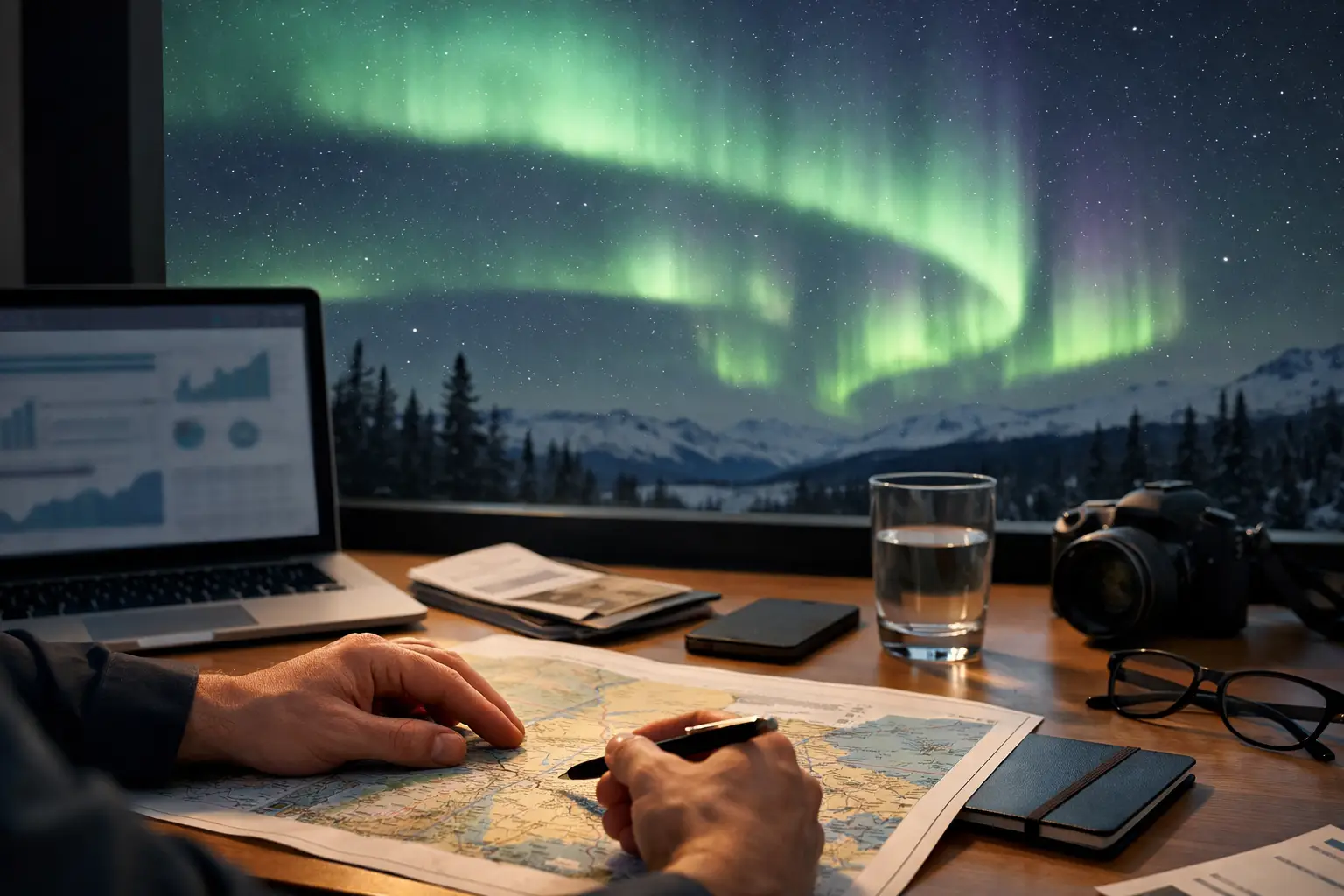
A Northern Lights trip can feel like a simple transaction: fly north, step outside after dark, look up. Aurora tourism is more rewarding - and far less frustrating - when you treat it as a weather-sensitive expedition rather than a guaranteed nightly show. The lights are real, powerful, and often spectacular. But solar activity, cloud cover, darkness, your location, and your willingness to stay flexible all decide whether you see them.
For travelers, that uncertainty is not a flaw in the experience. It is the reason a successful aurora trip needs a better plan than “go out when the KP Index is high.”
What Aurora Tourism Really Involves
Aurora tourism sits at the intersection of science, travel logistics, and patience. Visitors travel to places such as Iceland, northern Norway, Finnish Lapland, Alaska, and Northern Canada because these regions combine dark winter nights with locations beneath or near the auroral oval. Yet being in the right latitude is only the starting point.
The Northern Lights occur when charged particles from the Sun interact with Earth’s magnetic field and upper atmosphere. That interaction can be quiet, active, or suddenly intense. A strong solar event may create a bright display, but it cannot push light through thick clouds. A clear sky can reveal a delicate, slow-moving arc even when broad regional activity appears modest.
That is why the best aurora tourism experiences are built around probability, not promises. A visitor who gives themselves several nights, watches changing conditions, and has a backup daytime itinerary will usually have a better trip than someone chasing one perfect forecast.
The Trade-Off Between Convenience and Opportunity
Every destination offers a different version of the Northern Lights trip. Reykjavik is easy to reach and has excellent dining, tours, and hotels, but city lights and coastal weather can complicate viewing. Rural Iceland offers darker skies and more room to move, though winter driving requires confidence and careful road-condition checks.
In Tromsø, guided tours make sense for many first-time visitors because local guides can choose routes based on clouds and road access. In Finnish Lapland, a remote cabin or glass-roof accommodation may provide an atmospheric base, but a beautiful room does not replace a clear forecast. In Alaska or Northern Canada, longer distances and colder conditions can create remarkable darkness, while also raising the stakes for transportation, clothing, and contingency planning.
There is no universally best choice. Travelers who value comfort and local knowledge may prefer a guided tour from a major Arctic hub. Photographers and road-trip travelers may want a rental car, several possible viewing locations, and the freedom to wait for a break in the clouds. The right choice depends on your experience, budget, driving ability, and tolerance for late nights.
Build More Than One Good Night Into Your Itinerary
If seeing the aurora is a priority, plan at least three nights in a suitable region. Five to seven nights gives you a much stronger cushion against cloud, storms, weak activity, or simple bad timing. This does not mean you will need every night. It means you will not spend the entire trip feeling that one cloudy evening ended your chance.
Book daytime activities you would enjoy even if the sky stays overcast: hot springs, snowshoeing, museums, wildlife trips, local food, or scenic drives when conditions allow. A well-designed itinerary protects the trip from becoming a pass-or-fail aurora mission.
Why the KP Index Is Not a Complete Travel Forecast
The KP Index is useful, but it is often treated as a verdict when it is only one broad measure of geomagnetic disturbance. It can help indicate how far south the aurora may be visible and whether activity is elevated over a three-hour period. It does not tell you whether the sky above your exact location is clear right now, whether a brief substorm is developing, or whether the lights will appear bright enough for the naked eye.
For an Arctic traveler already near the auroral oval, a moderate KP value can still produce a memorable display. A lower value under clear, dark skies may be more useful than a high value hidden behind a weather system. Conversely, a high KP forecast is not a reason to ignore cloud cover or drive into unsafe conditions.
The more immediate signals come from solar wind conditions and the interplanetary magnetic field, commonly called IMF Bz. Solar wind brings particles and energy toward Earth. When the IMF Bz turns southward, it can connect more favorably with Earth’s magnetic field, allowing energy to build and supporting stronger auroral activity. These values change quickly, which is why a forecast from earlier in the day can become outdated by evening.
AuroraVision brings these signals together in a Live Aurora Score, alongside real-time solar wind, IMF Bz, cloud cover, moon phase, weather, and alerts. Instead of asking only, “What is the KP?”, travelers can ask the more useful question: “Will I have a realistic viewing opportunity tonight, and when should I go outside?”
Make a Night Plan Before Darkness Arrives
Good viewing decisions happen before you are tired, cold, or reacting to a sudden alert. Choose two or three legal, safe viewing locations during daylight. Look for an open northern horizon when possible, low nearby lighting, a place to park safely, and a clear route back to your accommodation. In mountainous or coastal areas, the best horizon may be east, west, or overhead rather than due north, so avoid treating direction as a rigid rule.
Bring insulated layers, warm boots, gloves that let you operate your phone or camera, a headlamp with a red-light mode, and a warm drink. Winter waiting is part of aurora tourism. If you are uncomfortable after ten minutes, you are more likely to miss the moment after an hour.
For self-drive trips, never let a forecast override road safety. Ice, wind, low visibility, avalanche closures, and fatigue are more consequential than a possible display. Stay within your driving experience, keep fuel well above empty, tell someone where you are going, and be prepared to view the sky from a safe location near your hotel if conditions deteriorate.
Know What You Are Looking At
The camera often sees more color than your eyes. A faint aurora may look like a pale gray or greenish band at first, especially under moonlight or near artificial lighting. Watch for a strip that changes shape, develops vertical rays, or slowly strengthens over several minutes. Let your eyes adjust to darkness by avoiding bright screens.
When activity rises, the experience can change fast. A quiet arc may brighten, spread overhead, or begin moving in visible waves. That is why checking the sky repeatedly matters. Do not glance up once, see nothing obvious, and decide the night is over.
Photographers should use a tripod and start with settings that favor a sharp image over an overly long exposure. A wide aperture, a moderate-to-high ISO, and an exposure of a few seconds are often a better starting point than a 20-second exposure that turns moving structures into a green blur. Adjust as the aurora changes. For many travelers, though, the best first response is to put the camera down briefly and look up.
Respect the Places That Make the Experience Possible
The finest aurora destinations are also homes, working landscapes, protected areas, and fragile winter environments. Do not block driveways, stop in travel lanes, trespass for a foreground photo, or leave litter at a roadside pullout. Keep voices low near accommodations and respect local restrictions on drones, camping, and off-road driving.
Guided tours can be especially valuable when access is complicated or when you do not want to manage winter roads. Choose operators that explain weather decisions honestly, prioritize safety, limit disturbance at viewing sites, and avoid selling certainty. A responsible guide should be willing to say that clouds are winning or that conditions are not worth a long drive.
The same principle applies to your expectations. The aurora is not an attraction that performs on command. It is a natural event seen best by travelers who give it time, make informed choices, and leave space for the night to surprise them.
When darkness arrives, check the live conditions, dress for longer than you think you will stay out, and keep a safe viewing option close by. The best aurora memory often begins quietly: one clear gap in the clouds, one faint band above the horizon, and the decision to wait five more minutes.