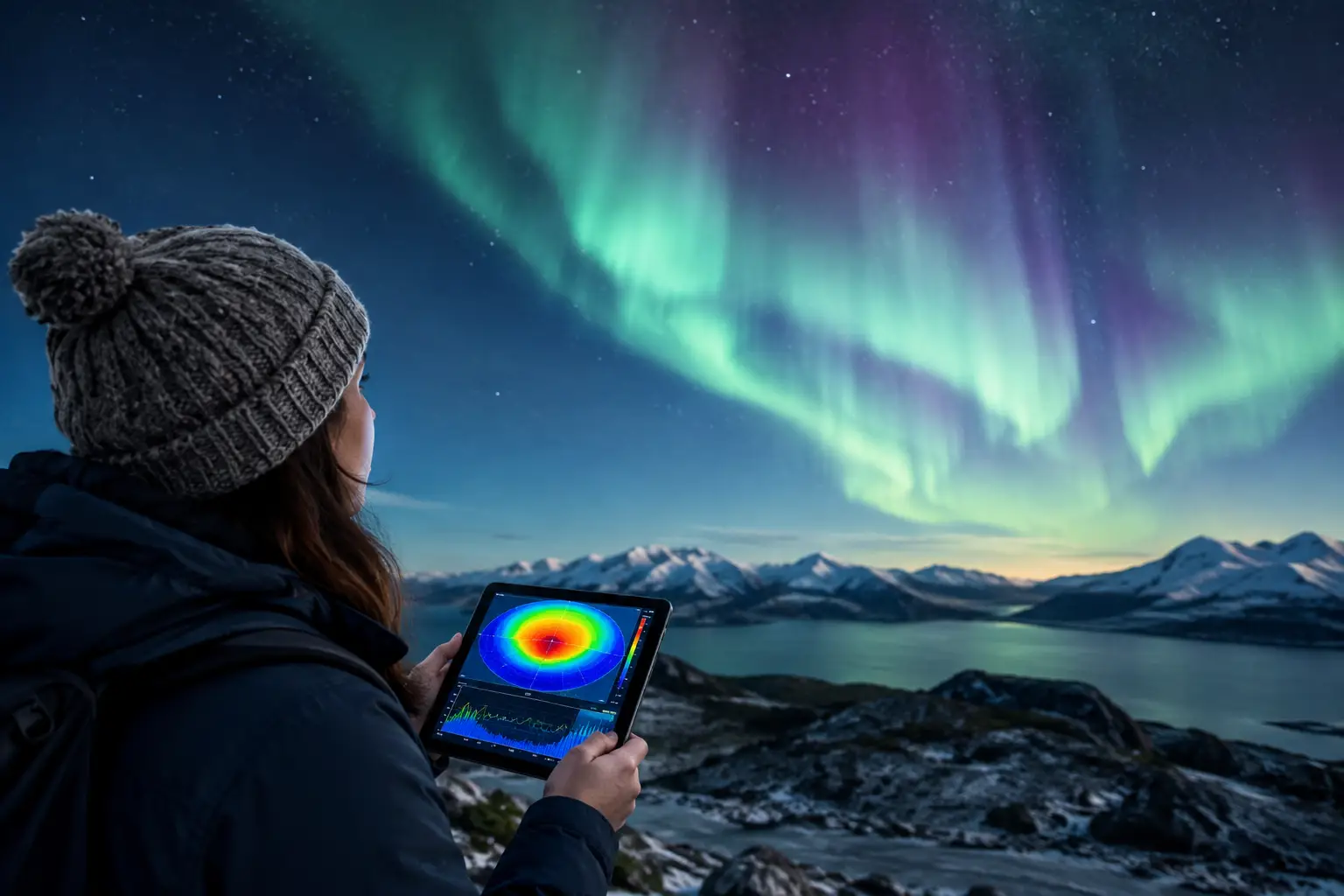
A geomagnetic forecast can look reassuring while the sky stays empty, or look modest just before a memorable aurora display begins. That is because travelers need to read geomagnetic forecasts as one part of a live visibility picture, not as a simple yes-or-no prediction. Space weather tells you whether energy may reach Earth’s magnetic field. Your local clouds, darkness, location, and timing determine whether you can actually see it.
For an aurora trip, the useful question is not only “What is the KP Index?” It is “Will I see aurora tonight, from where I am, during the hours I can be outside?” Reading the forecast well helps you decide whether to wait near your hotel, drive toward clearer skies, join a guided tour, or get some sleep and try again tomorrow.
What a Geomagnetic Forecast Is Actually Predicting
A geomagnetic forecast estimates likely disturbance in Earth’s magnetic field. That disturbance is measured by ground-based instruments and influenced by activity on the Sun. When charged particles from the solar wind interact with Earth’s magnetic environment, they can energize the upper atmosphere and produce the Northern Lights.
Forecasts are valuable, but they are not a reservation for aurora. Solar activity must travel from the Sun to Earth, then interact favorably with the magnetic field. Conditions can strengthen or weaken on short timescales. A forecast issued earlier in the day is therefore best treated as a planning signal, while live measurements are what help you make a decision after dark.
The most common forecast metric is KP, a planetary index that describes the overall level of geomagnetic disturbance on a scale from 0 to 9. Higher numbers generally mean aurora may be brighter, more active, and visible farther from the polar regions. But KP is averaged over three-hour intervals and across a network of stations. It does not tell you whether clouds are covering your viewing spot, whether the lights are active this minute, or exactly where the best break in the sky will be.
Start With KP, But Do Not Stop There
KP is useful for setting expectations based on latitude. In Iceland, northern Norway, Finnish Lapland, Swedish Lapland, Greenland, Alaska, Northern Canada, and Svalbard, aurora can be visible during relatively quiet conditions if skies are dark and clear. A KP 2 can be worth watching in these high-latitude locations. Farther south, a stronger event is usually needed for visibility.
That does not make a high KP irrelevant. A higher reading can mean a larger auroral oval, faster movement, and a better chance of seeing activity farther south. It may also create the kind of bright arcs and active curtains photographers hope for. The trade-off is that a high forecast can attract crowds, and cloudy conditions can still ruin the view.
Use KP as a geographic context tool. It helps answer whether your destination sits under, near, or well outside the likely auroral zone. It should not be used alone to decide whether to leave your accommodation. A clear sky under modest activity often beats a cloudy sky under an impressive KP forecast.
Why the Three-Hour KP Window Can Mislead
A three-hour KP value smooths out the action. Aurora can intensify for 15 minutes, fade for 30, then return with a much stronger substorm. If you only check the next KP block, you may miss a brief but excellent display.
For this reason, patience matters. When the weather is clear and the broader forecast is promising, give yourself time outside. Look north first in many locations, but scan the full sky as activity grows. A faint green arc can sit low on the horizon before expanding overhead, and a phone camera may reveal color before your eyes see it clearly.
Read Solar Wind Speed and Density Together
Solar wind is the stream of charged particles flowing outward from the Sun. Two measurements commonly shown in aurora dashboards are speed and density. Faster solar wind can deliver more energy to Earth’s magnetic environment. Higher density can add pressure and support stronger responses, especially when other conditions line up.
There is no single magic number that guarantees aurora. A moderately fast wind with a favorable magnetic field can outperform a faster stream with the wrong orientation. Similarly, a short spike in density may not produce a lasting display. Watch whether the numbers are elevated and holding, rather than reacting to one brief jump.
For travelers, the practical interpretation is simple: rising speed and sustained density improve the potential for activity, but they are not a viewing forecast on their own. They tell you to keep checking live conditions and be ready if darkness and cloud cover cooperate.
IMF Bz Is the Direction That Often Changes the Night
IMF Bz refers to the north-south direction of the interplanetary magnetic field carried by the solar wind. When Bz turns southward, shown as a negative value, it can connect more effectively with Earth’s magnetic field. That connection allows more solar energy to enter the system and can support stronger aurora.
A negative Bz is encouraging, particularly when it stays southward for a sustained period. A deeply negative Bz that lasts can be a much more useful signal than a brief dip. But it still is not a guarantee. The response can lag, and aurora behavior remains dynamic.
When Bz is positive, the chance of a strong response often decreases, although aurora can still appear, especially at high latitudes. Do not cancel a clear-sky plan simply because one metric is less favorable. Read the direction of travel: Is Bz turning south? Is solar wind speed increasing? Are conditions holding long enough to matter?
Turn Space Weather Into a Local Viewing Plan
This is where many forecasts become genuinely useful. First, confirm darkness at your location. In summer Arctic destinations, strong geomagnetic activity may be scientifically exciting but invisible against a bright sky. Around the equinoxes and through the darker months, your window is much better.
Next, check cloud cover at the specific place you can reach safely. Broad regional weather icons are not enough in mountainous, coastal, or island terrain. Iceland is a good example: one side of a peninsula can be overcast while a drive of 30 to 60 minutes reaches clearer conditions. In Norway and the Faroe Islands, local terrain and fast-moving weather can create similar differences.
Then consider the moon. A bright moon does not erase the Northern Lights, and it can make snowy landscapes easier and safer to photograph. However, it reduces contrast and makes faint aurora harder to notice. During weaker activity, darker skies give you an advantage. During a bright, active display, the moon may matter very little.
Finally, match your plan to your energy and transport. If roads are icy, visibility is poor, or you are unfamiliar with the area, a guided Northern Lights tour can be the sensible choice. Guides can monitor conditions, select safer routes, and adjust locations as clouds shift. If you are driving independently, keep your route conservative, check road conditions, fuel up, and choose legal pullouts well away from traffic.
How AuroraVision Combines the Signals
AuroraVision is designed around the fact that no single metric answers “Will You See Aurora Tonight?” Its Live Aurora Score brings together real-time solar wind, IMF Bz, geomagnetic activity, cloud cover, moon phase, weather, and local viewing conditions into a clearer operational view. Instead of chasing KP alone, you can compare the space-weather potential with the conditions above your actual destination.
Use the live view close to your planned viewing time, then activate alerts if you do not want to monitor every fluctuation. The most useful moment to check is not just at breakfast when you see a promising forecast. Check again after sunset, before leaving, and whenever clouds or solar wind conditions change.
A live score is still a decision aid, not a promise. It works best when you pair it with common sense: get away from city lights, allow your eyes time to adjust, dress for standing still in the cold, and stay outside long enough to catch changing activity.
A Quick Way to Read the Forecast Tonight
Think in layers rather than numbers. Start with whether darkness and weather make viewing possible. If clouds are solid overhead, look for a safe route toward clearer skies or save your energy for another night. Once you have a clear-sky option, check whether KP is appropriate for your latitude and whether solar wind and Bz are supporting activity.
If the sky is clear, KP is moderate or better for your location, solar wind is active, and Bz is southward, treat that as a strong reason to be outside. If only one signal is favorable, the night may still be worth watching, especially close to the Arctic Circle. The aurora rewards prepared travelers more often than travelers waiting for perfect numbers.
Bring a warm extra layer, a charged phone, and a realistic plan for getting back safely. Then watch the northern horizon, stay flexible, and let the live conditions decide whether tonight is the night to wait a little longer.