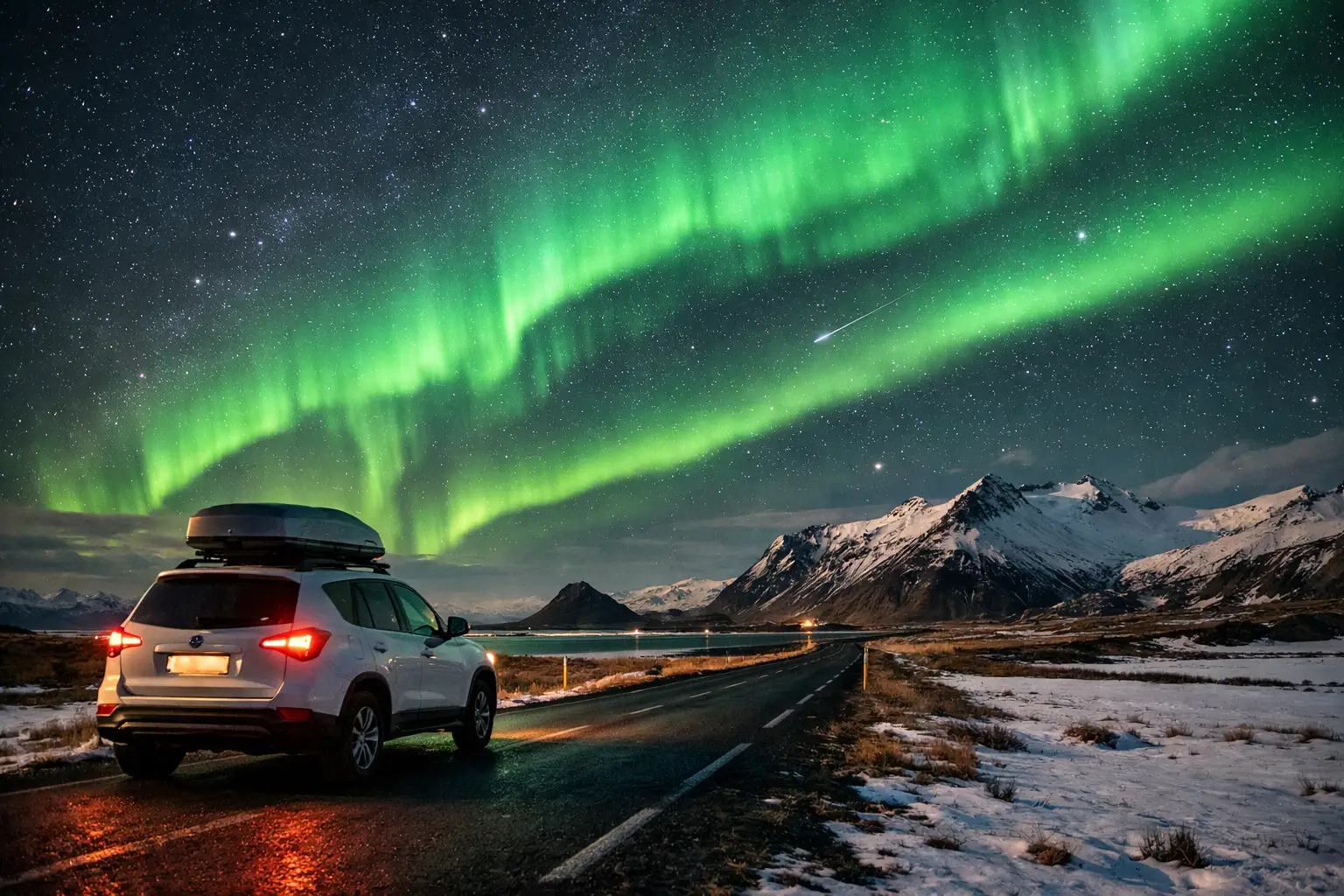
The best Iceland aurora roadtrip does not begin with a fixed destination. It begins with a decision made a few hours before dark: where is the cloud breaking, is the road safe, and is there enough solar activity to make the detour worthwhile? In Iceland, the Northern Lights can appear above a famous waterfall, a quiet harbor, or an empty roadside pullout. Flexibility is what turns a hopeful drive into a well-timed night outside.
Build Your Iceland Aurora Roadtrip Around Flexibility
A short winter trip can tempt you into planning a neat loop around the country. For aurora viewing, that approach often creates unnecessary pressure. Iceland’s weather moves quickly, mountain passes can close, and clear skies may sit 50 miles away from the place you booked months earlier. Treat your accommodation as a base, not a promise that you must stay put every evening.
For most first-time visitors, the southwest offers the best balance of accessible roads, services, and dark areas. Reykjavík is practical for arrival and departure nights, but light pollution makes it a poor place to wait for a faint display. The Reykjanes Peninsula, the South Coast near Selfoss or Hella, and the Golden Circle’s quieter stretches all offer realistic options when conditions cooperate.
If you have five to seven nights, add the Snæfellsnes Peninsula or the South Coast toward Vík. These routes have dramatic scenery in daylight and enough open horizon for aurora viewing at night. Do not try to drive the full Ring Road in winter solely to chase the lights. It can work for experienced winter drivers with extra time, but the mileage, wind exposure, and changing road conditions can leave you tired at exactly the moment you need to make a clear-headed decision.
The strongest itinerary has spare capacity. Book refundable or changeable hotels when possible, avoid stacking long daytime drives on consecutive days, and keep at least two evenings geographically flexible. A car rental with proper winter tires is more useful than an ambitious list of distant photo stops.
Pick a Route That Works in Daylight Too
Aurora is never guaranteed, so choose places worth seeing even if the sky stays gray. That is not settling. Iceland’s short winter days reward travelers who combine daylight landscapes with an efficient plan for night.
The Golden Circle is a sensible first route because roads are generally well traveled and services are close. It is not automatically dark enough near the busiest attractions, however. After visiting Þingvellir, Geysir, and Gullfoss during the day, move away from parking lots, visitor centers, and town lights before waiting. A safe turnout or quiet rural lodging is better than stopping beside a popular attraction after dark.
The South Coast provides bigger horizons, especially around the open farmland west of Vík. It also receives frequent wind, rain, and low cloud. On a marginal forecast, check conditions rather than assuming a clear afternoon will continue into the evening. Coastal weather can change rapidly after sunset.
Snæfellsnes is excellent for travelers who want a more remote feel without committing to a full Ring Road journey. The peninsula can be spectacular under a clear sky, but its exposed roads demand caution in wind and snow. If the forecast is unsettled, a shorter drive from Reykjavík toward a break in the cloud may be the smarter choice.
Read the Forecast Beyond the KP Index
KP is useful context, but it is not a roadtrip plan. It describes global geomagnetic activity on a scale, not whether the sky above your exact location is clear, whether the aurora is bright enough for local light pollution, or whether conditions are improving right now. A modest KP night under clear, dark skies can be more rewarding than a high KP night hidden behind thick cloud.
For a practical decision, combine several signals. Cloud cover tells you whether there is a visible gap to chase. Weather and wind tell you whether the drive is sensible. Moon phase matters because a bright moon can wash out faint detail, though it can also illuminate snow, mountains, and foregrounds for photography. Solar wind and IMF Bz help explain whether energy from the solar wind is coupling effectively with Earth’s magnetic field. A sustained southward Bz is generally more favorable than a northward one.
AuroraVision brings these inputs together in a Live Aurora Score, alongside real-time solar wind, IMF Bz, cloud cover, moon phase, weather, and the KP Index. Before leaving dinner or checking out of your hotel, use the free app to compare the best time tonight with the clearest nearby area. That is a more informed choice than driving toward the first dark road you see.
A Simple Go or No-Go Check
Start with the sky. If cloud cover is solid across your planned route, save fuel and energy unless a nearby clearing is realistic. Next, look at road and wind conditions. A forecast that supports aurora does not make an icy mountain road safe. Then check whether solar conditions are active or trending upward. If the sky is clear and the score is promising, go early enough to settle in before the display begins.
On uncertain nights, stay close to your base and choose a location with multiple directions to scan. On stronger nights, it can be worth driving farther from city lights, provided the road is open, familiar enough, and safely maintained. The right call depends on the full picture, not a single number.
Drive for Safety, Not for the Perfect Pin
Winter darkness changes the scale of Iceland. A route that took 45 minutes in daylight can feel much longer in blowing snow, crosswinds, or freezing rain. Keep your fuel tank well above empty, charge your phone and camera batteries, bring warm layers, and tell someone at your hotel where you expect to be. A roadside emergency is not an aurora experience.
Never stop in a live lane or on a narrow shoulder because green light appears overhead. Use designated parking areas, wide pullouts where stopping is clearly safe, or your accommodation’s grounds. Turn headlights off only after parking fully and confirming that you are not blocking another vehicle. If you are traveling with a group, agree on the plan before darkness so the driver is not managing navigation, weather, and excited passengers at once.
Watch the wind as carefully as the snow. Icelandic gusts can make doors difficult to control and can destabilize a car on exposed roads. When a warning is issued, accept that the best aurora location may be the safe one near your lodging. A guided Northern Lights tour can be the better option on nights when you want a local driver to manage route changes, weather calls, and visibility choices.
Choose a Viewing Site With a Real Horizon
The aurora often begins as a pale arc or a low glow in the north, especially during quieter activity. You need a broad view and time for your eyes to adjust. Avoid streetlights, gas stations, busy parking lots, and buildings that block the northern horizon. Give your eyes at least 15 minutes away from bright screens before deciding that nothing is happening.
Look for movement rather than only color. The first visible sign may be a gray-green band, a textured cloud that does not behave like cloud, or a faint line that slowly brightens. Camera sensors often reveal green before your eyes do, but do not spend the entire night looking at a screen. Watch the sky directly, then use your camera to confirm subtle structure.
Respect the land around you. Stay off private fields unless you have permission, keep gates closed, and do not walk onto icy cliffs, beaches with dangerous surf, or unstable ground for a foreground shot. Iceland’s best night landscapes are still wild landscapes.
Pack for Waiting Outside
Aurora viewing is usually more waiting than driving. The cold reaches you first through feet, hands, and the gap around your neck, particularly when standing still. Wear insulated boots, wool socks, a warm base layer, windproof outer layers, a hat, and gloves that let you operate camera controls. Bring a thermos, a headlamp with a red-light setting, and a small towel for moisture on equipment.
For photography, a tripod is more valuable than an expensive lens you cannot hold steady. Start with a wide lens, manual focus set carefully on a distant light or star, and an exposure short enough to preserve shape when the aurora becomes active. There is no universal setting: brighter, fast-moving aurora needs shorter exposures, while a faint arc may need more time. Check your histogram and adjust instead of copying a setting that worked for someone else on another night.
Let the Night Change Your Plan
The most memorable roadtrip nights are rarely the ones that followed a perfect schedule. They are the nights when you skipped a long drive because the wind rose, waited through a cloudy hour because a gap was moving in, or pulled into a safe dark turnout just as the northern arc began to ripple.
Leave room for those decisions. Eat early, keep your vehicle ready, watch conditions after sunset, and choose the safe route with the clearest sky rather than the most famous landmark. When the sky finally starts moving, you will be ready to step outside instead of wishing you had left an hour earlier.