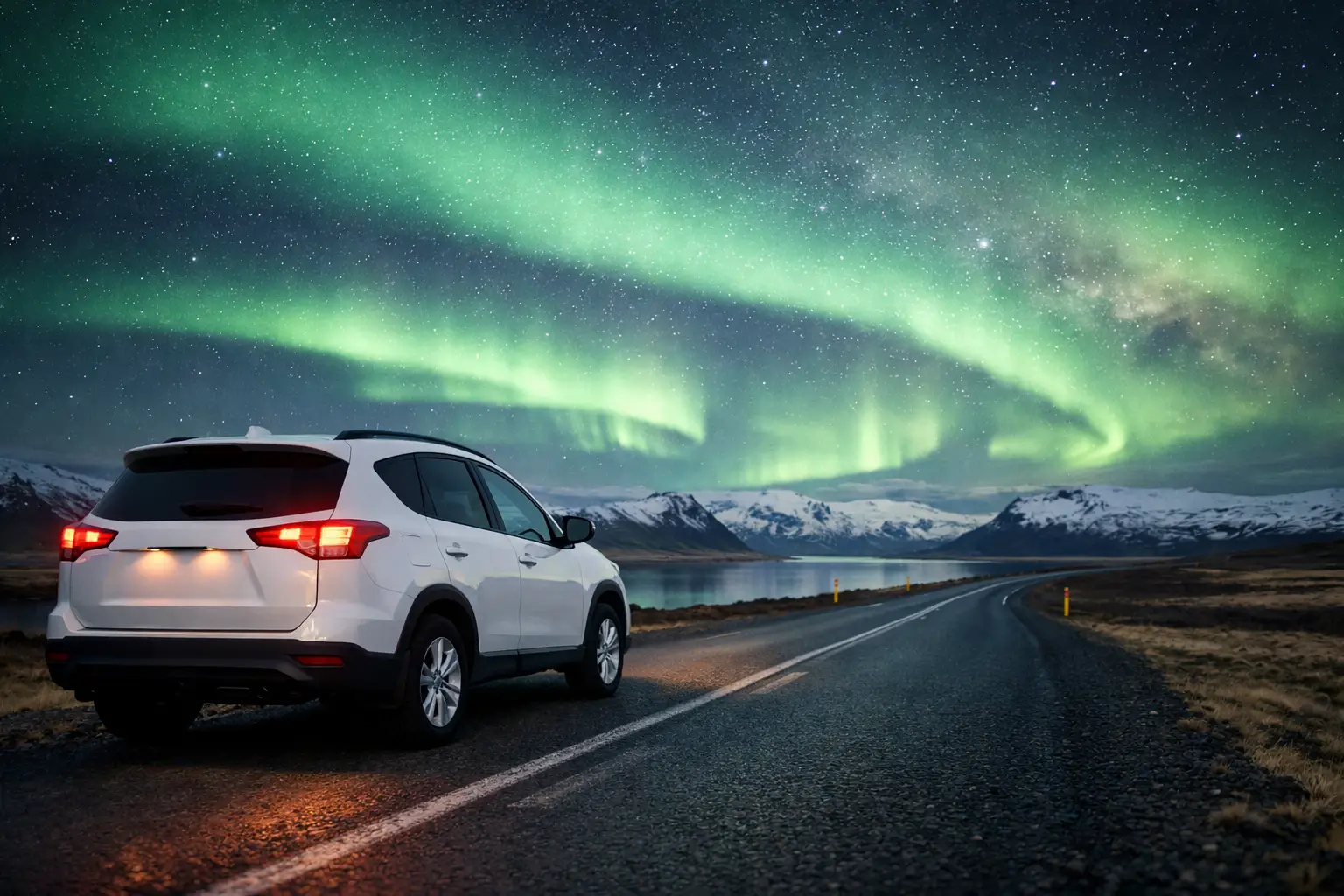
A successful Iceland car rental aurora trip is not about driving as far from Reykjavik as possible. It is about having the right vehicle, knowing when roads are genuinely safe, and moving only when clear skies and aurora activity line up. On a good night, a short drive to an open, dark location can beat a stressful all-night chase across unfamiliar winter roads.
Independent travel gives you something a fixed tour schedule cannot: flexibility. If clouds cover the south coast but a break opens in Borgarfjordur, you can change direction. If the lights strengthen after midnight, you can wait. That freedom is valuable, but Icelandic weather, wind, ice, and darkness set the limits.
Choose the right car for Iceland aurora viewing
For many visitors, a standard two-wheel-drive car is enough for an aurora trip based in Reykjavik, Keflavik, or towns along the Ring Road during mild conditions. Paved primary roads are well maintained, and several dark viewpoints are reachable without heading into remote terrain. The trade-off is that a smaller car gives you less margin when wind rises, slush freezes, or conditions turn quickly.
A 4x4 is the more sensible choice for a winter road trip, especially from November through March. It generally offers higher ground clearance, better traction, and more confidence on snow-covered access roads. It does not make driving on ice risk-free, and it does not permit you to ignore road closures. A 4x4 helps you manage challenging conditions; it does not defeat them.
Do not rent a vehicle simply because it is labeled suitable for Iceland. Confirm the tire type, included mileage, roadside-assistance process, fuel policy, and what insurance covers. Gravel damage, wind-blown doors, sand and ash exposure, and windshield chips can be costly in Iceland. Read the rental terms before booking, particularly if your route includes exposed coastal areas or unpaved roads.
F-roads are not aurora shortcuts
Highland F-roads require a proper 4x4 and are closed for much of the aurora season. Even when open in summer, they may involve rough surfaces and river crossings. They are not a practical or responsible plan for a nighttime Northern Lights chase.
You do not need the Highlands for darkness. Iceland has plenty of accessible places beyond city lights, including open coastal stretches, farmland, lake areas, and smaller communities. The best location is one you can reach safely, park legally, and leave easily if clouds or weather deteriorate.
Build your route around clouds, not KP alone
A high KP Index can look promising, but it cannot make the aurora visible through thick cloud. Likewise, a modest geomagnetic display under a clear Icelandic sky can be beautiful, particularly outside the glow of Reykjavik. That is why a practical road-trip forecast needs more than one number.
Check the cloud forecast first, then look at aurora conditions, local weather, wind, and the moon. Strong wind can make a roadside stop unpleasant or unsafe even if the sky is clear. Rain, freezing drizzle, and blowing snow can reduce visibility on the road long before they fully hide the stars. A bright moon does not stop the Northern Lights, but it can make faint displays harder to see and reduce contrast in photographs.
AuroraVision brings these moving pieces together with its Live Aurora Score, solar wind data, IMF Bz, cloud cover, moon phase, weather, and Best Time Tonight guidance. Rather than treating KP as a promise, use the free app to decide whether tonight calls for a short drive, a longer repositioning trip, or patience at your hotel. Turn on alerts before dinner so you are ready when conditions improve.
What the solar-wind data means in plain English
The aurora becomes more likely when energy from the solar wind couples effectively with Earth’s magnetic field. A southward IMF Bz is often favorable because it can allow more energy into the magnetosphere. Solar-wind speed and density also matter, but neither guarantees an overhead display in Iceland.
The useful takeaway for travelers is simple: solar conditions tell you the potential, while cloud cover tells you whether you can actually see it. Your route should respond to both. If the sky is clear locally and the Live Score rises, stay put rather than burning fuel in search of a theoretically better location.
Safe night-driving rules that protect the experience
The most memorable aurora night can become a difficult one if you are exhausted, underprepared, or driving into weather you do not understand. Before leaving, check Iceland’s current road and weather information, not only the aurora forecast. Conditions may vary sharply between the capital area, mountain passes, and the south coast.
Keep your plan conservative. Fill the tank before nightfall, charge your phone and camera batteries, bring warm layers, water, and a flashlight or headlamp. Tell someone where you are going if you plan to drive beyond populated areas. Download maps for offline use because service can be inconsistent outside towns.
When you stop, use designated parking areas, pull-offs, or established viewpoints. Never stop in a travel lane, on a narrow shoulder, near a blind curve, or where snowbanks make your car difficult for other drivers to see. Iceland’s roads can feel empty until another vehicle appears at speed in darkness.
A few habits make a real difference:
- Drive more slowly than you would on a familiar road, especially after sunset or when temperatures hover around freezing.
- Keep extra space from the car ahead because black ice can be invisible and braking distances increase quickly.
- Hold car doors firmly in strong wind. A sudden gust can damage a door, a neighboring vehicle, or both.
- If visibility drops or a road is closed, turn back. Missing one aurora window is better than creating an emergency.
Do not drive while staring at the sky or checking forecasts every few minutes. Pull over safely, review conditions, then continue. If you are traveling with a partner, assign one person to navigation and forecast checks while the other drives.
Where to drive from Reykjavik for darker skies
Reykjavik is a practical base because it has rental offices, restaurants, fuel, and a wide choice of accommodations. The city itself can still produce visible aurora when activity is strong, but light pollution and nearby buildings limit the view. A drive of 20 to 60 minutes can provide a substantially darker horizon when conditions are favorable.
The best direction changes night to night. West toward the Akranes area, east toward less developed stretches beyond the capital region, or south toward open coastal landscapes can all work, depending on clouds and road conditions. Avoid deciding on a destination days in advance. A beautiful landmark under solid cloud is not an aurora location that night.
For travelers spending several nights on the Ring Road, the same principle applies. Build flexible overnight stops, then let the forecast choose your viewing spot. A hotel just outside a town may offer enough darkness to avoid late driving entirely. That can be the better choice during storms, after a long sightseeing day, or when the forecast suggests only a narrow clear-sky window.
Make the car part of your aurora plan
Your rental car is a warm base, a way to reach darker skies, and a fallback if wind makes outdoor waiting uncomfortable. It should not turn the trip into a race against the forecast. Give yourself a turnaround time, avoid ambitious late-night routes before an early departure, and remember that the lights can appear briefly or linger for hours.
The best aurora drives are calm, informed, and flexible. Choose a safe vehicle, follow live cloud and road conditions, and stop only where the view is worth the risk-free pause. When the sky finally brightens above a quiet Icelandic landscape, you will be ready to watch rather than worrying about how to get home.