A high KP Index can look promising on a forecast and still produce a quiet sky above your hotel. Meanwhile, a moderate geomagnetic setup can deliver bright, fast-moving aurora if the solar wind is arriving with the right conditions. Learning to interpret solar wind helps explain the difference - and helps you decide whether to head out now, wait for the next update, or get some sleep before an early start.
Solar wind is one of the most useful real-time signals for Northern Lights travelers, but it is not a standalone prediction. It must be read alongside IMF Bz, local darkness, cloud cover, weather, moonlight, and your latitude. Think of it as incoming fuel from the Sun. The aurora becomes visible only when Earth’s magnetic environment can effectively use that fuel and skies above you are clear enough to see it.
What solar wind means for the Northern Lights
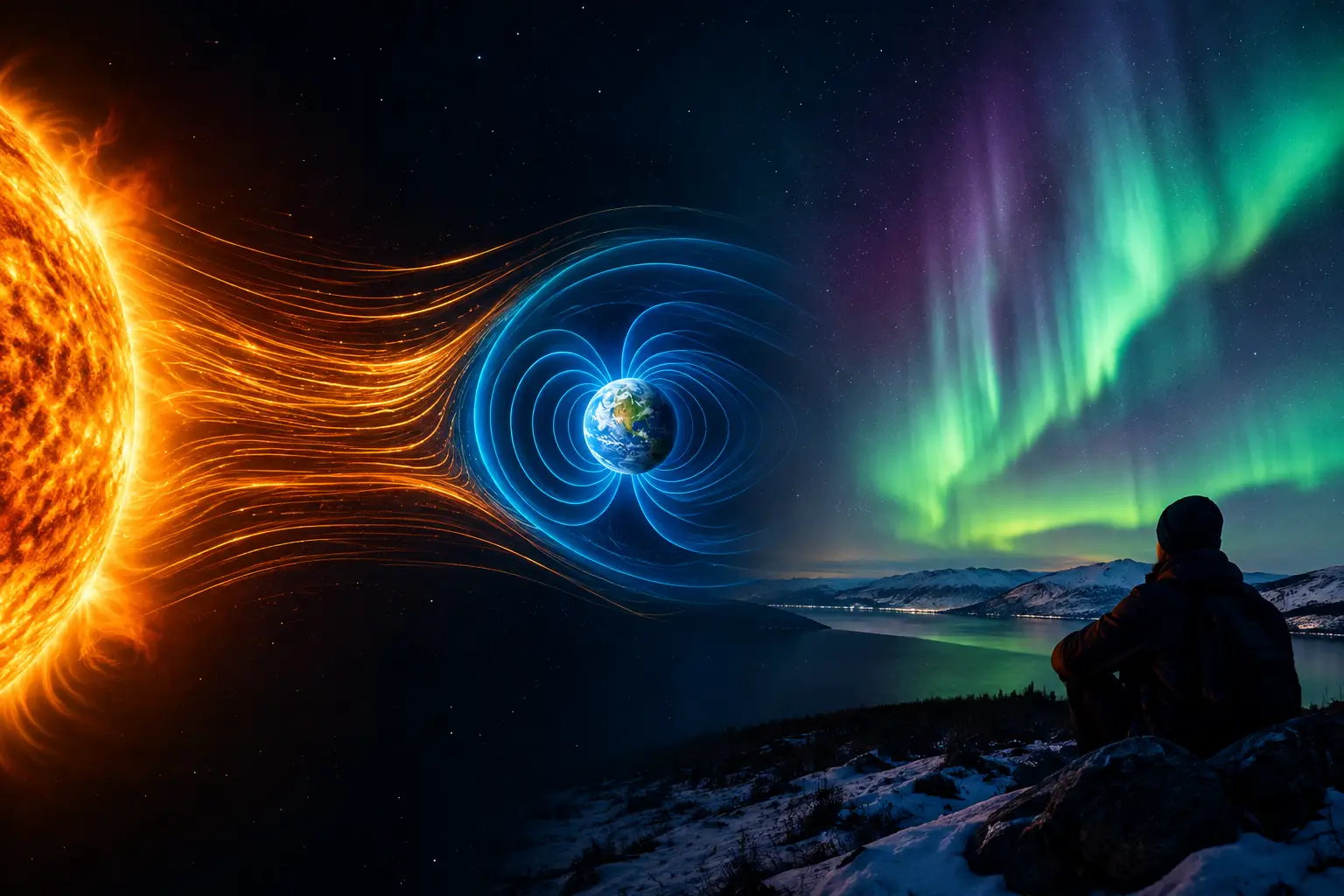
The Sun constantly releases a stream of charged particles into space. This stream is called the solar wind. When it reaches Earth, it interacts with our magnetic field, transferring energy into the upper atmosphere. That energy excites oxygen and nitrogen high above the ground, producing the light we call aurora.
For a traveler, the key question is not simply, “Is the solar wind high?” It is, “Is the solar wind delivering energy in a way that is likely to produce aurora where I am tonight?” A strong solar wind can support an active display, especially at higher latitudes such as Iceland, northern Norway, Finnish Lapland, Alaska, and Northern Canada. But solar wind data needs context.
The most practical values to watch are speed, density, and IMF Bz. You may also see pressure and magnetic field strength labeled as Bt. These metrics change throughout the night, sometimes quickly. That is why a forecast made in the afternoon can be less useful than a live dashboard checked shortly before you drive to a viewing location.
How to interpret solar wind speed
Solar wind speed is usually shown in kilometers per second, or km/s. A typical background speed often sits around 300 to 450 km/s. Once it rises above roughly 500 km/s, it can become more favorable for aurora activity. Speeds above 600 km/s can be exciting, particularly when other measurements also align.
Speed matters because faster particles carry energy toward Earth more quickly. Yet fast solar wind alone does not guarantee lights. Imagine a strong current reaching a closed gate. The current is there, but relatively little gets through until the gate opens. In aurora terms, IMF Bz often determines how open that gate is.
A useful traveler-level interpretation looks like this:
- Around 300 to 450 km/s: Normal background conditions. Aurora is still possible in strong auroral regions, especially under clear skies.
- Around 450 to 550 km/s: A more encouraging setup, particularly with a southward Bz.
- Above 550 km/s: Good potential for increased activity if Bz is negative and remains negative.
- Above 700 km/s: A notable space-weather event may be underway, but local weather and your location still decide what you can actually see.
Avoid treating these ranges as hard thresholds. A quiet-looking 430 km/s stream with a sustained negative Bz can outperform a much faster stream with a positive Bz. Solar wind is a live system, not a scorecard where one impressive number wins.
Speed is more useful when it stays elevated
A brief spike is less meaningful than a sustained period of elevated speed. If solar wind has been running near 600 km/s for hours, Earth’s magnetic environment has a more consistent energy source. This can create a better window for repeated activity, rather than a single short burst.
For photographers planning a longer session, sustained conditions are especially valuable. They reduce the temptation to chase every small change on the graph and make it more reasonable to stay set up at a dark, safe location.
Why density can trigger sudden activity
Solar wind density measures how many particles are present in a given volume. It is often displayed in particles per cubic centimeter. Higher density can increase the pressure applied to Earth’s magnetic field, sometimes helping trigger sharper changes in auroral activity.
A density rise can be useful, but it is often more of a short-term amplifier than a dependable all-night signal. You might see density jump rapidly and then fall back within an hour. When that rise arrives alongside a favorable Bz, it can coincide with a sudden aurora intensification.
Density is one reason displays can surprise people. The sky may be quiet, then a brighter arc forms, movement increases, and the aurora expands within minutes. Do not assume the night is over just because the first hour was calm. If the live solar wind data changes, conditions may be building again.
Very high density without favorable magnetic conditions may not produce much visible improvement. It can make the overall setup more interesting, but it should never be read in isolation.
IMF Bz is the direction that changes everything
If you remember one solar wind measurement, make it IMF Bz. The interplanetary magnetic field, or IMF, is the magnetic field carried by the solar wind. Bz describes whether part of that field points north or south relative to Earth.
A negative Bz, also called southward Bz, is generally favorable. It allows more efficient coupling between the solar wind and Earth’s magnetic field. In practical terms, it gives solar wind energy a better route into the magnetosphere, increasing the odds of auroral activity.
A positive Bz is less favorable because it tends to limit that energy transfer. You can have excellent solar wind speed and density, but if Bz remains strongly positive, aurora may stay weaker than expected.
The number is usually measured in nanoteslas, or nT. A Bz below -5 nT is often encouraging. Below -10 nT is stronger, especially when it persists. The word “persists” matters. A two-minute dip to -15 nT is interesting, but a sustained negative reading for 20 to 60 minutes is much more meaningful for viewing decisions.
Watch the trend, not a single Bz number
Bz can swing from negative to positive and back again. A graph that shows several southward periods may support intermittent aurora, with active bursts separated by quieter stretches. A steady negative Bz combined with fast wind suggests a more favorable window.
There is no exact delay between a change in solar wind data and what you see in the sky. Data is commonly measured upstream of Earth, and the solar wind must travel from that monitoring point to Earth before its effects develop. The delay can often be tens of minutes, but the real response varies. Treat live measurements as a near-term indicator, not an instant switch for the sky above you.
Read solar wind with the rest of the forecast
Solar wind tells you about the energy arriving from space. It does not tell you whether clouds cover your viewing area, whether a storm makes roads unsafe, or whether moonlight will wash out faint detail. For travelers, these factors can matter more than a marginal improvement in solar wind.
Start with local cloud cover. A clear sky under modest aurora conditions is often better than a fully overcast sky during a strong geomagnetic event. In Iceland and coastal Norway, conditions can vary dramatically over a short drive, so a cloud map can be more actionable than the KP Index alone.
Then consider darkness and moon phase. Bright moonlight does not prevent a strong aurora display, but it can reduce contrast, especially for faint arcs. If the Moon is bright and high, focus on locations away from city lights with open views north. For photography, adjust expectations: the aurora may still look vivid in images, while subtle structure is harder to see with the naked eye.
Weather and road conditions belong in the same decision. Do not chase a solar wind spike onto icy roads, into high winds, or through an area with poor visibility. The best viewing plan is one that gets you safely to a dark, clear location and leaves you with enough time to watch the sky rather than constantly drive.
A practical decision routine for tonight
Before leaving your accommodation, check whether the sky is dark enough and whether your nearest clear area is realistically reachable. Then look at the current solar wind speed, density, and Bz together. If speed is elevated, Bz is negative, and clouds are thinning, that is a strong reason to be ready.
If the data is mixed, do not automatically cancel. At high-latitude destinations, a low-level aurora can still be visible under clear, dark skies. Give yourself a viewing window rather than expecting a guaranteed show at a specific minute. Many memorable displays begin as a pale arc that slowly gains structure, then suddenly brightens when conditions improve.
If speed is high but Bz is positive, stay informed rather than driving blindly. A Bz turn south can change the outlook quickly. If clouds are the problem, prioritize finding a safe clearing over chasing higher KP numbers. And if conditions are excellent but you are in a bright urban area, move away from artificial light if practical.
AuroraVision brings these signals together in one live view: Aurora Score, solar wind, IMF Bz, KP Index, cloud cover, moon phase, and local weather. That combination is more useful than treating any one metric as a promise. Check the live conditions before heading out, then use alerts to avoid missing a developing window.
Common mistakes when reading solar wind
The first mistake is treating solar wind speed as a guaranteed forecast. High speed is potential, not certainty. Without a favorable Bz, the aurora response may remain limited.
The second is watching a single reading instead of the trend. Space weather changes over time, and a sustained negative Bz is generally more valuable than one dramatic-looking dip. Check whether the pattern has held long enough to matter.
The third is forgetting where you are. In Tromso, Abisko, Fairbanks, or Yellowknife, weaker activity can still be visible because these places sit under or near the auroral oval. Farther south, you generally need stronger geomagnetic activity. The same solar wind data can produce very different viewing prospects depending on latitude.
The fourth is letting scientific data override local reality. Clouds, bright lights, terrain, and unsafe roads can end an otherwise promising night. Space weather helps you choose the best opportunity. It does not replace a clear sky or sensible travel judgment.
Use solar wind to stay ready, not to chase numbers
The most rewarding way to interpret solar wind is to use it as an early-warning system. Elevated speed tells you the energy supply may be improving. A southward Bz suggests Earth is better positioned to respond. A density jump can signal a moment worth watching closely. Together, those signs can help you decide when to put on warm layers, charge your camera batteries, and step outside.
Northern Lights viewing always includes uncertainty, and that is part of what makes a real display unforgettable. Watch the data, respect the weather, give the sky time, and be ready when the conditions begin to align.