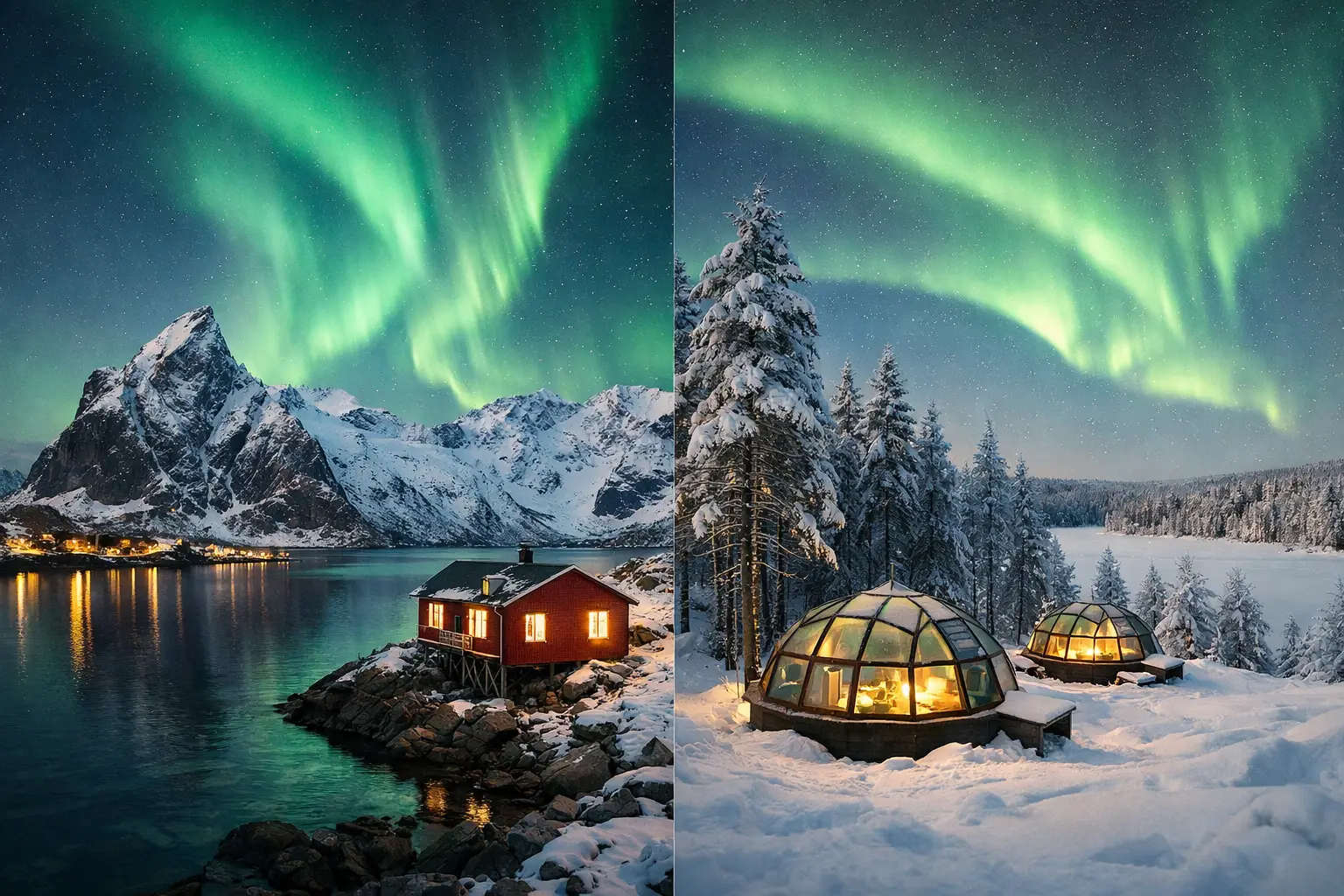
A Norway or Finland aurora trip can be extraordinary in either country, but they create very different nights under the sky. Norway offers dramatic coastlines, mountains, and fjords around the auroral oval. Finland offers easier self-drive routes, forest silence, and purpose-built glass cabins. The better choice is not simply where the forecast looks strongest. It is where you can reach dark skies, stay flexible, and enjoy the trip even when clouds win.
Norway or Finland Aurora: The Short Answer
Choose Norway if you want big coastal scenery, guided outings from a city base, and a strong chance of seeing the aurora near Tromso. It is especially appealing for travelers who want Northern Lights hunting alongside fjord cruises, whale watching in season, skiing, and dramatic photography.
Choose Finland if you want a calmer, more self-directed Arctic break. Finnish Lapland is often easier for families, first-time winter drivers who are comfortable on snowy roads, and travelers drawn to cabins, saunas, reindeer experiences, and forest landscapes. Rovaniemi, Levi, Saariselka, and Inari all offer practical bases, though the best viewing areas are usually outside the brightest resort centers.
Neither country guarantees a display. Aurora activity, cloud cover, local weather, darkness, and your ability to move all matter on the night. A week in either destination is usually a smarter plan than a rushed two-night visit.
Location: Coastal Drama vs. Forest Darkness
Northern Norway sits favorably beneath the auroral oval, the ring-shaped zone where auroras are most frequently seen. Tromso is well inside this zone, which means you do not need an extreme geomagnetic storm for a visible display. Even modest activity can produce aurora if skies are clear and the solar wind conditions are supportive.
That said, Tromso itself has city lights and variable coastal weather. Serious viewing often means driving or joining a tour that follows clearer skies inland or toward nearby islands and fjords. The reward is spectacular foregrounds: snowy peaks, open water, fishing villages, and reflections when conditions are calm.
Finnish Lapland is farther south in many popular areas, although the far north around Inari and Utsjoki is well positioned for frequent activity. A stronger aurora can be more helpful in southern Lapland than it is around Tromso, but Finland has another advantage: vast areas of dark, open forest and frozen lakes with relatively little light pollution.
The visual difference is personal. Norway feels expansive and cinematic. Finland feels intimate and quiet, with dark tree lines, snow-covered clearings, and the possibility of watching from a remote cabin. Photographers should consider which foreground suits their work, not just the likelihood of green lights overhead.
Clouds Often Decide the Night
A bright aurora above a thick cloud deck is invisible. This is why comparing Norway and Finland only by latitude or the KP Index leads to poor travel decisions.
Norway's coast can experience fast-changing weather. Maritime air, wind, and mountains can produce cloud bands that shift quickly through the night. That sounds difficult, but it can also create opportunities: a mobile guide or rental car may find a break in the clouds within a reasonable drive. Travelers who stay in Tromso and book several flexible evening tours can benefit from local route knowledge.
Finland's inland climate is typically more continental. Cold, settled winter periods can bring clearer nights, but fog, low cloud, snowfall, and long stretches of overcast still happen. The weather may be less changeable during one evening, so picking a clear region before dark can matter more than chasing clouds all night.
Before heading out, check cloud cover at the exact location you can realistically reach, not just the town name on your hotel booking. Also check hourly weather, wind, road conditions, moon phase, and the expected timing of solar activity. A clear window at 10 p.m. is more valuable than a vague all-night forecast.
Do Not Choose by KP Index Alone
The KP Index describes global geomagnetic activity over a three-hour period. It is useful context, but it cannot tell you whether an aurora is visible from your roadside pullout right now. It does not account for clouds, local darkness, the direction and strength of the solar wind, or the interplanetary magnetic field.
For a Norway or Finland aurora decision, focus on the full picture. Solar wind speed and density show whether energy is arriving from the Sun. IMF Bz is especially useful because a sustained southward Bz can help that energy enter Earth's magnetic environment. Cloud cover then determines whether you can actually see the result.
AuroraVision brings these moving pieces together in its free app through a Live Aurora Score, real-time solar wind, IMF Bz, KP Index, cloud cover, moon phase, weather, and alerts. Use it during your trip to decide whether to leave the hotel, wait for a better hour, or drive toward a clearer area. It is a decision tool, not a promise of a show.
Getting Around After Dark
This is one of the biggest practical differences between the two countries.
In Norway, a guided aurora tour is often worth considering, particularly from Tromso. Roads can be narrow, icy, exposed to wind, and unfamiliar after dark. Guides monitor changing cloud patterns, know legal and safe stopping areas, and can take the driving pressure off travelers who would rather concentrate on the sky. Independent travelers should rent a suitable vehicle, understand winter-driving requirements, and avoid stopping on narrow roads just because lights appear.
Finland can be more straightforward for an independent road trip. Major Lapland routes are generally well maintained in winter, distances between towns are manageable, and many accommodations are designed around self-guided aurora viewing. Still, winter driving is real winter driving. Reindeer can be on the road, darkness comes early, and remote areas have limited services. Keep fuel high, charge your phone, dress for standing still outdoors, and tell someone where you are going.
If you want to see the lights without driving, both countries have excellent tour options. In Finland, choose a smaller group that travels away from resort lighting rather than a short walk to a crowded viewing site. In Norway, look for operators that explain their weather-chasing range and what happens if conditions prevent viewing.
Cost, Comfort, and the Experience Between Aurora Nights
Norway is often the more expensive choice, especially for dining, alcohol, car rentals, and guided activities. Tromso has a broad hotel and restaurant selection, but prices can rise sharply in peak season. It works well for travelers who want an active Arctic city with plenty to do when the sky is cloudy.
Finland offers a wider range of accommodation styles, from practical apartments to glass-roofed cabins and upscale wilderness lodges. Iconic aurora cabins are memorable, but they are not automatically the best viewing solution. Heated glass can collect condensation, surrounding lights may affect your view, and you may still need to step outside for a clear photographic experience. Book the cabin for comfort and atmosphere, not as a substitute for checking conditions.
For value, look beyond the most famous resort dates. Late September through October and March through early April can offer dark enough skies, winter activities in many areas, and potentially more manageable prices than the Christmas rush. Norway's coastal winter is generally milder than inland Finland, while Finland can deliver much colder and drier conditions. Bring layers for both, but expect a different kind of cold.
When Norway Is the Better Bet
Norway is a strong fit if the scenery is central to your trip and you are happy to rely on local guides. It is also excellent for travelers who prefer staying in one lively destination rather than driving between remote bases. Tromso's position beneath the auroral oval means lower-level activity can still be worthwhile when skies clear.
Choose Norway if you are comfortable paying more for a coastal Arctic experience, want fjords and mountains in your photos, or have limited time and want access to experienced weather chasers. Build in at least three to five nights so cloud and solar conditions have room to improve.
When Finland Is the Better Bet
Finland is often the better choice for travelers who want a peaceful winter escape with more control over their schedule. It suits couples, families, and road trippers who value a cabin, sauna, snowy forest, and an easy transition between daytime activities and nighttime sky checks.
Choose Finland if you prefer inland darkness, are willing to rent a car or stay at a remote lodge, and want a less urban aurora trip. Inari and northern Lapland are particularly compelling for travelers who prioritize latitude and low light pollution, while Rovaniemi and Levi offer more services and activity choices.
Make the Decision Before You Book
If you want a single answer, choose Norway for dramatic landscapes and expert-led flexibility, and Finland for quiet wilderness and an independent winter rhythm. But avoid booking based on a single forecast screenshot or a promised KP level. The aurora is a live event shaped by space weather and the sky above you.
Give yourself several nights, choose accommodation with access to dark surroundings, and keep at least one evening uncommitted. When the clouds open and the conditions rise, the best destination is the one that lets you get outside quickly and stay long enough for the sky to change.