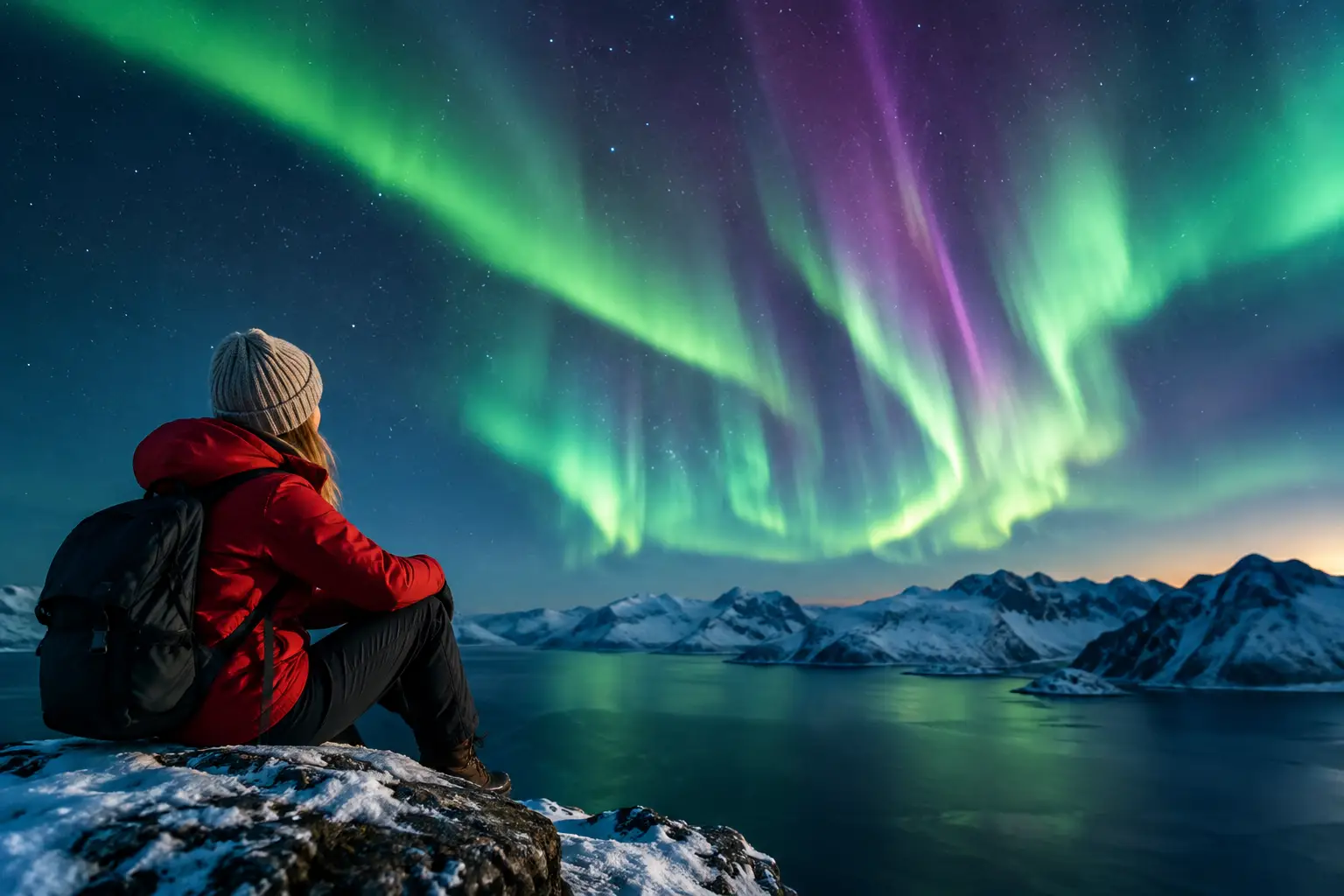
A solar storm can turn an ordinary Arctic night into a sky filled with moving green arcs, but solar storm travel is not about chasing dramatic headlines. It is about putting yourself in the right place, with enough flexibility to respond when space weather, clouds, darkness, and local conditions align.
For aurora travelers, the best trips are planned around opportunity rather than one promised night. A strong geomagnetic event can improve the odds, especially at lower latitudes, but it cannot clear clouds over your hotel or replace a safe driving plan on an icy road. Treat the storm as one part of a larger decision.
What a Solar Storm Means for Aurora Travelers
Solar storms begin on the Sun. When the Sun releases charged particles and magnetic fields toward Earth, some of that energy can interact with our magnetic field and upper atmosphere. That interaction excites gases high above the planet, producing the Northern Lights.
The phrase “solar storm” covers several different events. A coronal mass ejection can send a large cloud of solar material toward Earth, while high-speed solar wind streams from coronal holes can create recurring periods of auroral activity. Neither guarantees a visible display from the ground. The timing, strength, and magnetic orientation of the incoming solar wind all matter.
For travelers, the practical question is simple: will conditions create a visible aurora where you are tonight? A major storm may make aurora visible farther south than usual, but Iceland, northern Norway, Finnish Lapland, Alaska, and northern Canada already sit well within the auroral zone. In those destinations, a modest but well-timed event under clear, dark skies can outperform a bigger storm hidden by cloud.
Solar Storm Travel Requires More Than the KP Index
The KP Index is useful as a broad measure of geomagnetic activity, but it is not a minute-by-minute visibility forecast. It is calculated from magnetic observations over a three-hour period, which makes it valuable for context but limited for deciding whether to leave dinner, pack the camera, and drive toward a clear patch of sky.
Real-time solar wind data provides a more immediate view. Faster solar wind can transfer more energy into Earth’s magnetic environment, while higher density can add pressure to the system. The most watched factor is IMF Bz, the north-south direction of the interplanetary magnetic field. A sustained southward Bz generally supports stronger coupling between the solar wind and Earth’s magnetic field. A northward Bz can weaken the opportunity, even when the solar wind speed looks impressive.
Cloud cover, local weather, moonlight, and darkness complete the picture. Bright moonlight does not stop the aurora, but it can reduce contrast, particularly during a faint display. Thick cloud, by contrast, blocks the view completely. That is why AuroraVision combines a Live Aurora Score with real-time solar wind, IMF Bz, KP Index, cloud cover, moon phase, and weather instead of treating one number as the entire forecast.
Choose a Base That Gives You Options
A solar storm forecast should influence your itinerary, not force you to gamble on a single remote location. Choose a base with open horizons, nearby low-light viewing areas, and more than one road direction if conditions change. In Iceland, travelers often benefit from staying outside central Reykjavík while remaining close enough to services and winter-maintained roads. In northern Scandinavia, a town with reliable accommodations and access to surrounding valleys or coastlines can offer the same advantage.
Hotels matter more than many first-time visitors expect. A room with a dark exterior area, clear northern exposure, and staff familiar with local weather can save valuable time. Some rural properties offer aurora wake-up service, although you should still monitor conditions yourself. If you are booking a tour, ask whether the operator actively relocates for cloud breaks, how long the outing lasts, and whether they prioritize photography, education, or simply transportation.
Independent travelers need a realistic transportation plan. A rental car provides flexibility, but winter driving in Iceland, Norway, Sweden, Finland, Greenland, Alaska, and Northern Canada can be serious. Check road conditions, wind warnings, fuel availability, parking access, and daylight driving routes before nightfall. Never let a promising aurora alert push you onto a road that is closed, unfamiliar, or unsafe.
Build Flexibility Into Your Aurora Schedule
Give yourself at least three nights in an aurora region when possible. Five or more nights is better if seeing the lights is a central goal. This is not because every night needs a solar storm. It is because cloud patterns, weather systems, and solar activity all vary. More nights create more chances to catch a clear window.
Keep your evenings lightly scheduled. A late dinner reservation an hour from your lodging can become frustrating if aurora activity rises at 9:30 p.m. Plan one primary viewing area and one backup area before dark. Download offline maps, bring warm layers, and know where you can legally and safely pull over.
For photographers, flexibility also means preparing before the action starts. Set up your tripod, test your focus on a distant light or star, and protect batteries from the cold by keeping spares close to your body. A solar storm may produce fast-moving structures that change within minutes. The person adjusting settings in a warm car can miss the best part of the show.
Know When to Go Outside
Aurora can appear any time the sky is dark, but the strongest opportunities are often concentrated around local magnetic midnight. That does not make midnight a fixed appointment. At high latitudes, activity can arrive early in the evening or intensify near dawn, especially during active space-weather conditions.
Check the forecast after sunset, then check again. Solar wind can change quickly as new measurements arrive, and cloud forecasts are never perfect at a small local scale. If the Live Aurora Score rises while clouds are thinning, that is a meaningful reason to get outside. If solar wind conditions look favorable but your area is fully overcast, use the forecast map to assess whether a short, safe drive could reach clearer skies.
Do not wait for a perfect forecast. A faint arc may be visible before the score peaks, and cameras can reveal colors and structure that your eyes initially miss. Step outside periodically, face north when activity is low, and scan the sky for a pale band that seems more defined than ordinary cloud. During stronger displays, the aurora can spread overhead or appear in multiple directions.
A Practical Solar Storm Travel Checklist
Before heading out, confirm four things: conditions are worth monitoring, skies are reasonably clear or improving, your route is safe, and you have enough warm clothing for a long wait. Add a charged phone, headlamp with a red-light mode if available, camera batteries, water, and a thermos if you expect to be outside for hours.
Give your eyes time to adapt. Avoid staring at bright screens, and reduce phone brightness when checking updates. Choose a location away from streetlights, but do not sacrifice safety for darkness. A parking area, established turnout, or open area near your lodging is usually better than an unplanned stop beside a narrow road.
When a Guided Tour Is the Better Choice
A guided Northern Lights tour is often the best option for travelers who do not want to drive on winter roads, have only one or two available nights, or are unfamiliar with local cloud geography. Experienced guides can interpret terrain, weather, and road conditions while you concentrate on the sky. They may also help with camera settings and explain what you are seeing.
That said, tours are not magic. No guide can remove clouds or create a solar storm. Book operators that communicate clearly about conditions, safety, pickup logistics, and realistic expectations. If your schedule allows, pairing one guided night with independent viewing from your hotel gives you both local expertise and extra chances.
The Northern Lights reward prepared travelers, not just lucky ones. Watch the data, respect the weather, keep your plans flexible, and be ready to step into the cold when the sky opens.