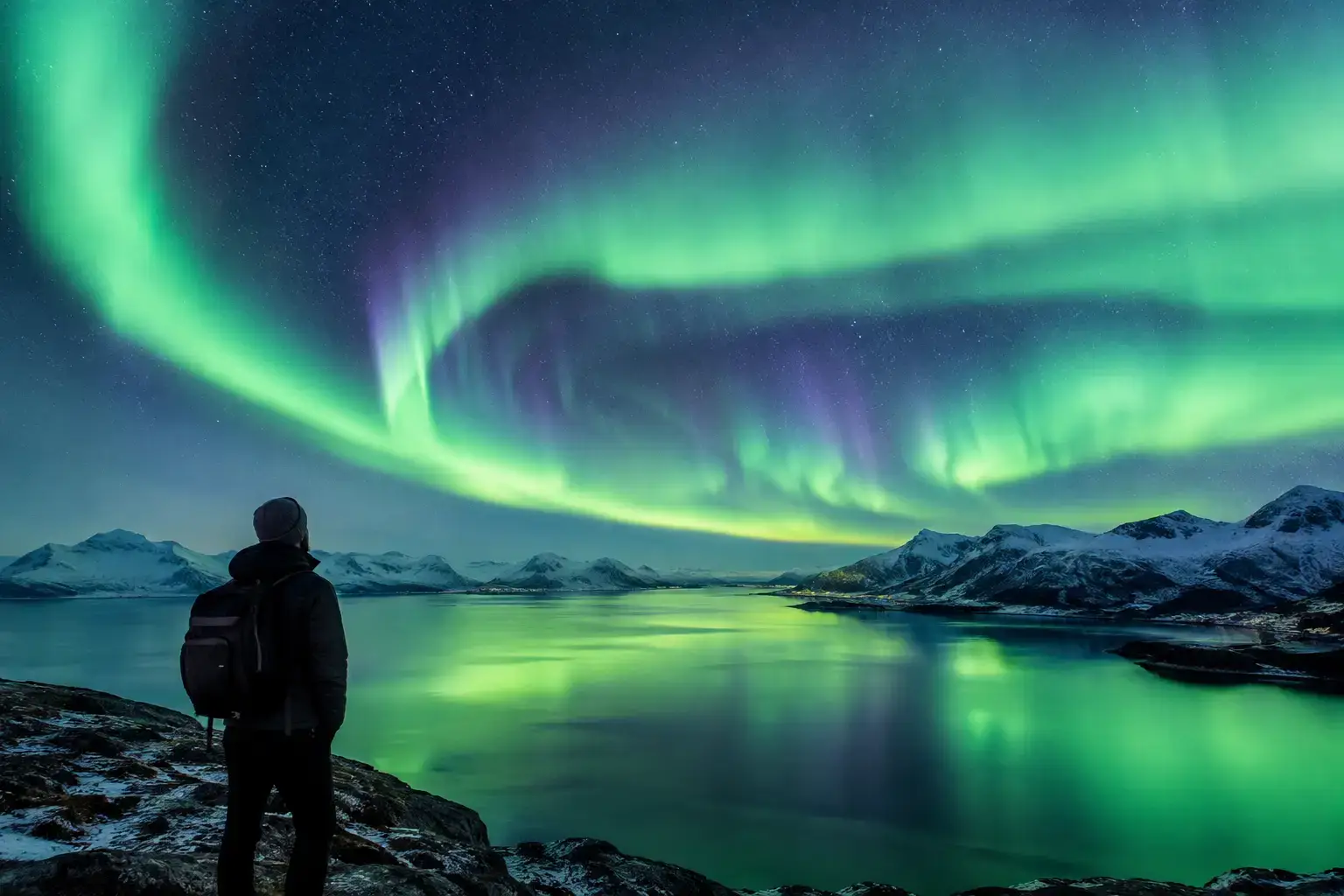
The aurora does not sit in one fixed ring around the poles. It expands, contracts, brightens, and shifts latitude as Earth responds to changing conditions in space. If you have wondered what causes aurora oval movement, the short answer is the changing interaction between the solar wind and Earth’s magnetic field. For travelers, that movement can decide whether the lights remain far north or appear overhead at your viewing location.
What Is the Aurora Oval?
The aurora oval is a band-shaped region surrounding each magnetic pole where auroras are most likely to occur. It is not a solid line, and it is not perfectly circular. Think of it as a constantly changing zone of increased aurora probability, shaped by Earth’s magnetic field and the stream of charged particles arriving from the Sun.
The northern oval normally sits over high-latitude areas. On quiet nights, its strongest activity may stay over northern Greenland, Svalbard, northern Canada, or the Arctic Ocean. During stronger geomagnetic activity, the oval can widen and move toward lower latitudes. That is why Iceland may see aurora during moderate activity while locations farther south sometimes need a stronger event.
The oval also has a nighttime side and a daytime side. The nighttime oval is especially important for aurora chasers because that is where the familiar arcs, curtains, rays, and active displays are most often visible against a dark sky. Its position changes continually, sometimes over hours and sometimes much faster.
The Solar Wind Pushes the System
The Sun continuously releases a flow of electrically charged particles called the solar wind. This flow carries its own magnetic field, known as the interplanetary magnetic field, or IMF. When the solar wind reaches Earth, it presses against the planet’s magnetic shield, the magnetosphere.
A faster solar wind transfers more energy into the magnetosphere, especially when other conditions cooperate. Increased density and pressure can also compress Earth’s magnetic field on the sunward side. These changes do not guarantee a visible aurora by themselves, but they can help create the conditions for the auroral oval to become more active and expand.
Solar wind conditions are never completely steady. A coronal hole can produce a high-speed stream that lasts for days. A coronal mass ejection can bring a more abrupt disturbance. Smaller variations occur all the time. Because the oval responds to this incoming energy, its location is dynamic rather than fixed on a map.
Why IMF Bz Matters So Much
IMF Bz describes the north-south direction of the magnetic field carried by the solar wind. When Bz turns southward, it points in the opposite direction from Earth’s dayside magnetic field. This makes it easier for the two magnetic fields to connect through a process called magnetic reconnection.
That connection lets solar wind energy enter Earth’s magnetic environment more efficiently. Energy is then stored and redistributed through the magnetosphere, helping power auroral activity. Sustained southward Bz is often more useful than a brief southward dip because the system needs time to respond.
When Bz is northward, the connection is generally less efficient. Aurora can still occur, particularly in the high Arctic, but the oval is less likely to expand dramatically toward lower latitudes. This is one reason a single index cannot tell the whole story. Two nights with the same general geomagnetic level can look very different depending on solar wind speed, density, and the recent behavior of IMF Bz.
How the Oval Moves During Activity
As energy enters the magnetosphere, the aurora oval commonly expands equatorward, meaning toward lower magnetic latitudes. Its boundaries widen, and places near the usual edge of the oval may suddenly have a better view. The expanded oval can also become brighter and more structured, although brightness depends on where you stand relative to the most active part of it.
The movement is not always smooth. The oval can bulge in one sector, brighten along an arc, or intensify rapidly after a quieter period. Local time matters too. The aurora is often strongest in the hours around magnetic midnight, which is not always the same as midnight on your clock. A map showing the oval’s current position can be more useful than assuming that activity is evenly spread around the pole.
During quiet conditions, the oval contracts poleward. This does not mean the aurora has disappeared. It may simply be concentrated farther north, lower on the horizon, or limited to a narrow band. In Tromsø, for example, a contracted oval may still be visible as a low northern glow, while a traveler in southern Iceland may need stronger activity for a meaningful display.
Substorms Create Sudden Changes
One of the most exciting causes of rapid aurora oval movement is a geomagnetic substorm. During a substorm, energy that has built up in Earth’s magnetotail is released. The result can be a fast brightening of aurora, more movement across the sky, and an expansion of the active region.
A substorm may turn a faint arc into a lively display within minutes. It can also make the oval appear to push southward temporarily. But substorms are not perfectly predictable at the traveler level. Space weather forecasters can identify favorable conditions, yet the exact timing and visual intensity remain variable.
This is why patience matters. If solar wind conditions are supportive and the sky is clear, do not leave after ten quiet minutes. Aurora often arrives in pulses. A calm sky can become active later, especially near the local magnetic midnight window.
Earth’s Magnetic Field Shapes the Oval
Earth’s magnetic field is tilted and uneven compared with a simple geographic globe. The magnetic poles are not the same as the geographic North and South Poles, and the aurora oval is organized around magnetic latitude rather than ordinary latitude alone.
That difference explains why some locations are naturally favored for aurora viewing. Fairbanks, northern Norway, Finnish Lapland, northern Sweden, and parts of Canada sit near or under the typical aurora oval more often than destinations farther south. Iceland is slightly closer to the oval’s usual southern edge, so it can be excellent during active periods while still requiring attention to real-time conditions.
The oval’s shape also changes with local time. A destination may be well positioned early in the evening but sit outside the most active sector later on. There is no universal rule that says the aurora will always be overhead at a particular hour. Conditions in space and your position beneath the oval both matter.
Why the KP Index Is Only Part of the Answer
The KP Index is a useful broad measure of geomagnetic disturbance, but it is not a live map of the aurora oval and it is not a direct visibility guarantee. It is derived from magnetic observations over a three-hour period, so it can lag behind fast changes. It also does not tell you whether clouds, moonlight, precipitation, or local horizon obstructions will hide the display.
A moderate KP level can still produce an excellent show if you are beneath the oval, IMF Bz is favorable, and a substorm develops. Conversely, a higher KP reading may not help much if thick clouds cover your location or the strongest activity is concentrated elsewhere.
For a night outside, use KP as context rather than a final decision. Check the current oval position, recent solar wind behavior, Bz direction, and the weather at the exact place where you plan to stand.
Turn Oval Movement Into a Better Viewing Plan
The practical question is not simply whether the oval is moving. It is whether that movement brings active aurora closer to your location during darkness and clear skies. Start by checking your latitude and your local forecast. If the oval is contracted north of you, choose a site with an open northern horizon. If it is expanding over your region, get away from city lights and prepare for activity in more than one part of the sky.
Cloud cover is often the deciding factor in Iceland, coastal Norway, and the Faroe Islands. A strong geomagnetic event above a solid cloud deck is still invisible from the ground. Travelers with a rental car may improve their chances by moving toward a clear-sky gap, but only if road conditions are safe and the route is familiar. In winter, weather and driving conditions should always take priority over chasing a short-lived display.
Moon phase changes how easily faint aurora is seen. A bright moon can wash out subtle green arches, but it is less of a problem during an intense display and can improve foreground photography. Clear skies, dark surroundings, and an unobstructed view remain more valuable than waiting for a perfectly moonless night.
AuroraVision helps bring these moving pieces together by combining Live Aurora Score, real-time solar wind, IMF Bz, KP Index, cloud cover, moon phase, and local weather rather than treating one number as the whole forecast. Use the free app before you leave your hotel, activate alerts when conditions improve, and check the Best Time Tonight view again if the sky stays quiet early in the evening.
What to Watch for Once You Are Outside
When the oval is near your location, the first sign may be less dramatic than photos suggest. Look for a pale gray-green arc, a low glow with a defined edge, or a band that slowly changes shape. Cameras often reveal green color before your eyes do, especially during weak activity, so a quick test photo can help confirm what you are seeing.
As activity increases, the arc may rise, develop vertical rays, or begin to ripple across the sky. If the oval expands overhead, look south as well as north. Travelers sometimes miss a stronger display because they keep watching only one horizon after conditions have changed.
Give yourself time. Dress for standing still, bring a warm drink if practical, preserve night vision by dimming screens, and stay ready through the most favorable window. Aurora oval movement is a reminder that the Northern Lights are not a scheduled attraction. They are an active response to space weather, and the best nights reward travelers who watch the data, respect the weather, and stay outside long enough for the sky to change.