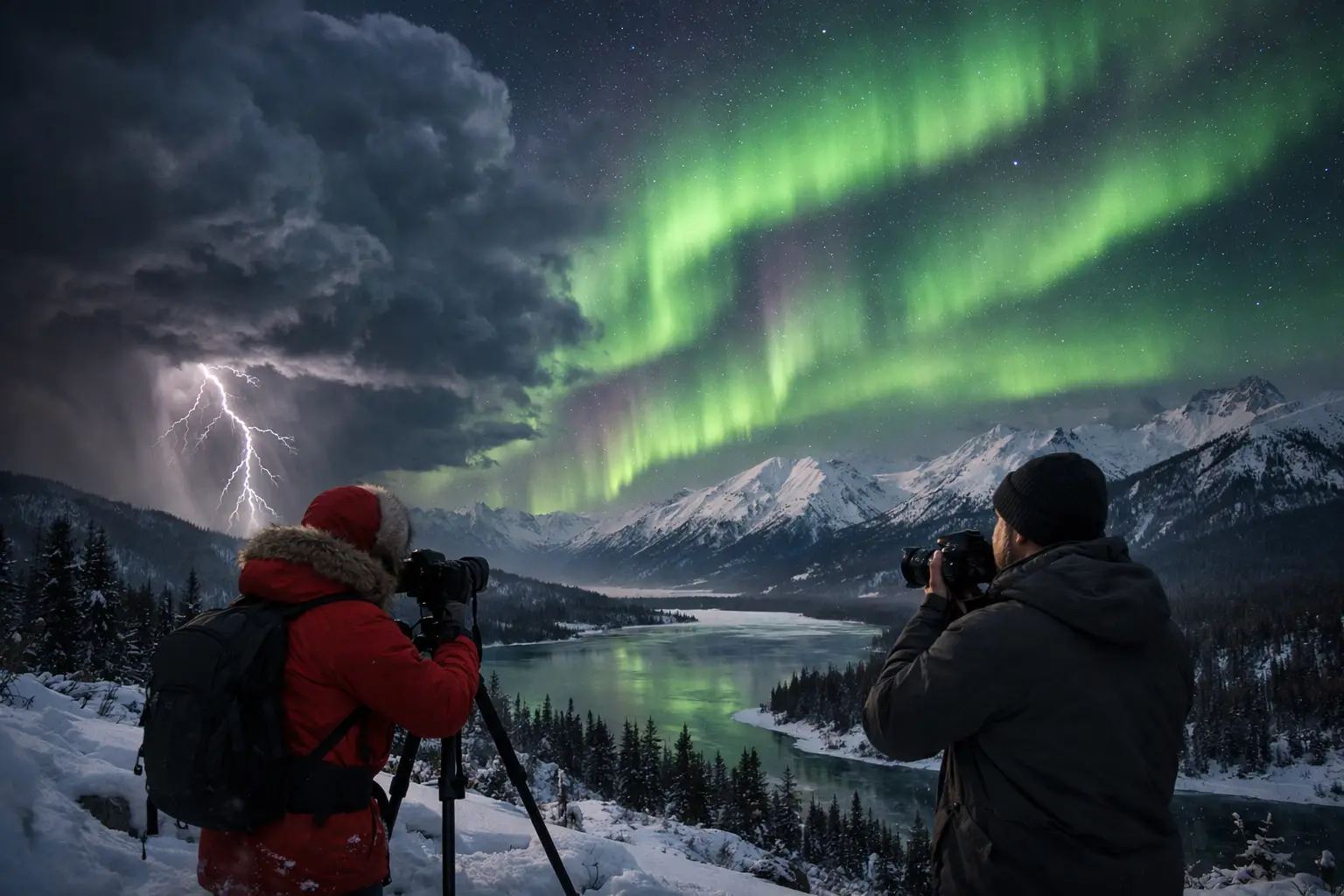
A winter night in Alaska can look perfectly calm from a hotel window and become a whiteout 20 miles down the road. That is why an Alaska storm chase for Northern Lights is not about chasing danger or driving farther than everyone else. It is about making fast, informed decisions when space weather, clouds, road conditions, and daylight all compete for your attention.
For aurora travelers, Alaska offers huge skies, long dark nights, and a road network that can lead quickly from town lights to genuinely dark viewing areas. It also demands restraint. The best chase is the one that gets you under a clear sky, gives you time to watch, and gets you back safely.
What an Alaska storm chase actually means
In aurora travel, “storm” can refer to two very different things. A geomagnetic storm is increased activity in Earth’s magnetic field, driven by conditions in the solar wind. It can create brighter, more widespread Northern Lights. A winter weather storm brings clouds, snow, wind, poor visibility, and difficult roads - all conditions that can prevent you from seeing those lights.
The difficult nights are often the most tempting. Solar activity may be strong, social media may be full of reports, and a clear break may appear on the edge of a weather map. But a high aurora potential is useless if thick cloud covers your location, and a clear patch is not worth reaching if roads are closing or visibility has collapsed.
A productive chase treats these as separate questions: Is the aurora active? Is there a clear sky within safe driving range? Can you get there and return without taking unnecessary risks?
Read the conditions in the right order
Travelers often start with the KP Index. KP is useful as a broad indication of geomagnetic disturbance, but it is not a complete visibility forecast and should not decide your evening on its own. Alaska is already far enough north that the aurora can be visible during relatively modest activity, especially around Fairbanks and other Interior locations.
Start with clouds and local weather. If your immediate area is clear, you may not need to drive at all. If it is overcast, look for a nearby break rather than a distant blue patch that requires hours of winter driving. Wind, blowing snow, temperature, ice, and road advisories matter as much as the cloud forecast.
Then assess the space-weather picture. Stronger solar-wind speed can provide energy to the system, while a southward IMF Bz often allows that energy to couple more effectively with Earth’s magnetic field. Those terms can sound technical, but the practical lesson is simple: several measurements together tell a more useful story than a single KP number.
AuroraVision combines a Live Aurora Score with solar wind, IMF Bz, cloud cover, moon phase, and weather, so you can check the conditions that affect what you can actually see rather than reacting to one dramatic metric. Use the free app before leaving your accommodation and again before committing to a longer drive. Conditions can shift quickly.
Moonlight changes the kind of show you see
A bright moon does not switch the aurora off. Strong displays can still be striking, and moonlit snow can make landscapes easier to photograph. The trade-off is contrast: faint green arcs and subtle detail are harder to see against a bright sky.
On moonlit nights, prioritize clearer skies and a view away from direct streetlights. During a dark moon phase, give your eyes time to adapt and watch patiently for low, faint bands toward the northern horizon. In Interior Alaska, the lights can begin quietly before building into a much more active display.
Build a chase plan before dark
The most reliable Alaska chases are prepared in daylight. Choose two or three viewing options at different distances from your base, then decide what conditions would justify each one. A nearby turnout or lodge viewing area may be enough for a partly cloudy night. A more distant dark-sky location may make sense only when roads are stable and the cloud advantage is meaningful.
Do not depend on a single pin dropped from a photo post. Confirm that the location is publicly accessible, legal to park at, away from active traffic, and suitable in winter. Many scenic pullouts are narrow, unplowed, or hazardous after dark. Never stop in a travel lane, on a blind curve, or where snowbanks make your vehicle difficult for other drivers to see.
For independent travelers, a rental car can add flexibility, but only if you are comfortable with winter driving. Ask specifically about winter tires, emergency equipment, mileage limits, and restrictions on unpaved or remote roads. Four-wheel drive helps with traction, but it does not improve braking on ice or make a closed road passable.
A guided Northern Lights tour can be the better choice when weather is unstable, you are unfamiliar with local roads, or you want someone else monitoring changing conditions. A good guide brings local route knowledge and can decide when a cloud break is worth pursuing. It is not a guarantee of aurora, but it can remove the most stressful part of a weather-driven night.
Your vehicle is part of the forecast
Cold changes the practical limits of a chase. Batteries lose performance, tires behave differently, and a short stop can feel much longer when wind rises. Keep your fuel tank well above empty, carry warm layers in the vehicle rather than packed away in luggage, and bring water, food, a headlamp, a phone power bank, and a basic emergency kit.
Tell someone where you are going and when you expect to return. Download maps for areas with weak service, but do not assume your phone will be your only navigation or communication tool. If you are traveling farther from town, check road updates immediately before departure.
There is a useful rule for decision-making: if you are debating whether conditions are too bad to leave, they probably are. The aurora will return. A risky road situation can become serious in minutes.
Best timing is more flexible than travelers expect
Many visitors plan to be outside from 10 p.m. to 2 a.m., and that window is often productive. Still, aurora activity does not follow a fixed nightly schedule. A strong substorm can develop earlier, later, or in short bursts between quieter periods.
Give yourself a realistic viewing block instead of chasing a single predicted minute. Check the sky regularly, especially when clouds are moving. If you can see stars through openings, keep watching. A partly cloudy sky is not automatically a failed night, particularly when breaks move across the northern half of the sky.
Avoid spending every minute looking at camera screens or forecast charts. The aurora can begin as a pale arc that is easier to recognize after several minutes of dark adaptation. Once your eyes adjust, movement, vertical rays, and a gradual brightening become more obvious.
Photograph without missing the moment
Bring a tripod, spare batteries kept warm in an inside pocket, and a wide-angle lens if you have one. Start with a moderately wide aperture, a short-to-medium exposure, and an ISO that preserves detail without turning the sky into noise. Exact settings depend on the brightness and movement of the aurora.
When the lights are quiet, longer exposures can reveal green that your eyes barely detect. When curtains begin moving quickly, shorten the exposure to preserve shape and texture. Take a few test frames, then put the camera down periodically. The best part of an Alaska night is not always the image you bring home.
Know when not to chase
Cancel or stay close to your accommodation when visibility is poor, winds are strong, road alerts are active, fatigue is setting in, or your group lacks winter-driving confidence. This is not losing an aurora opportunity. It is making the same disciplined choice that experienced guides make when conditions turn against them.
If the weather is poor for several nights, shift your plan rather than waiting in frustration. Book flexible activities during the day, choose lodging with a dark outdoor viewing area if possible, and keep one evening uncommitted for a late decision. Travelers with several nights in Alaska have a much better chance than those treating one forecast as a promise.
A well-run Alaska storm chase ends with warm hands, a safe return, and the confidence that you acted on the best information available. Watch the clouds, read the real-time space weather, respect the road, and be ready when the sky opens.