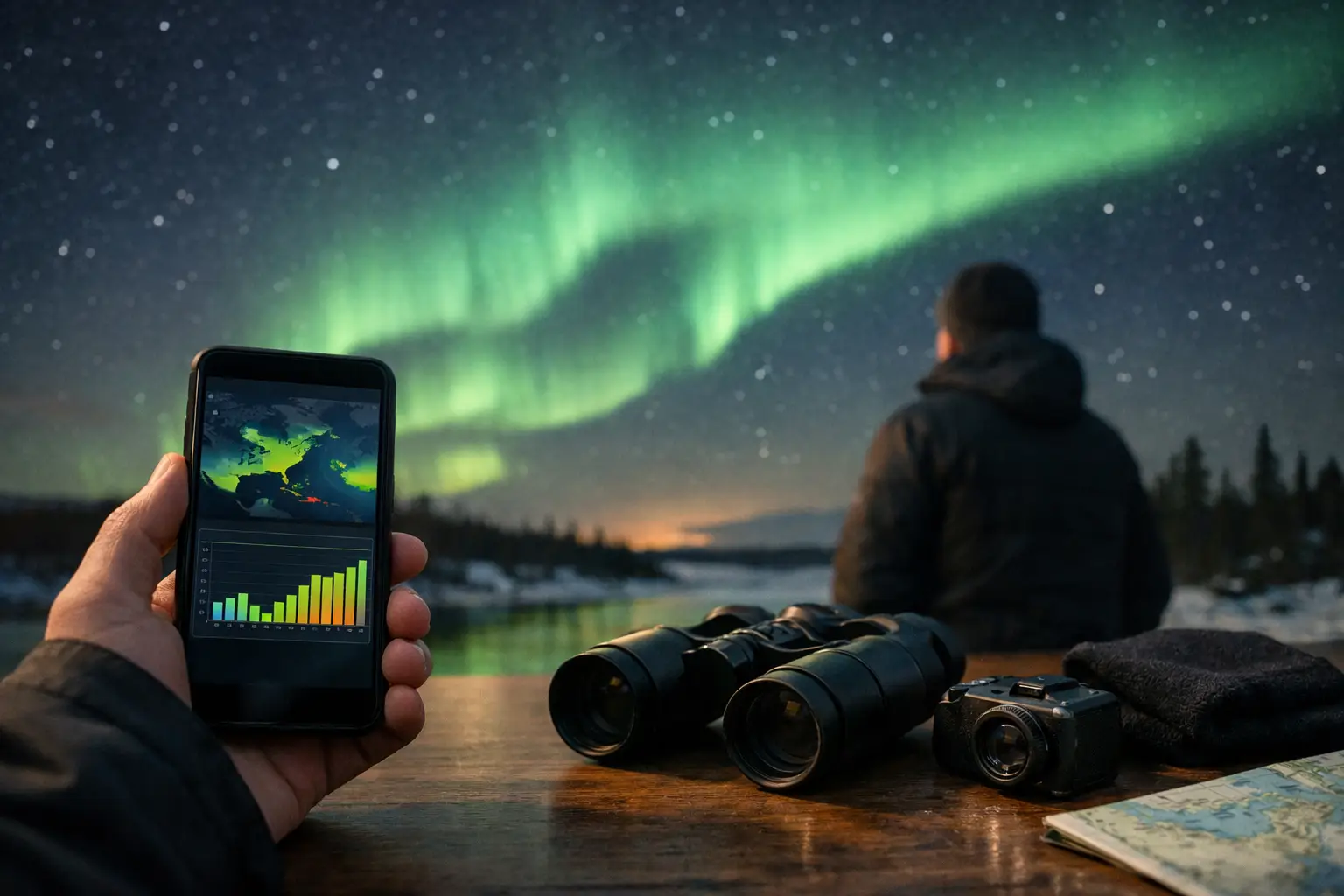
A bright-looking KP number can be frustratingly useless if thick clouds cover your location. A low KP can also produce a memorable display when solar wind conditions improve overhead and the sky opens at the right time. That is the practical lesson behind how to read aurora alerts: treat every alert as a decision tool, not a promise.
For travelers, the question is rarely “Will there be an aurora somewhere?” It is “Should I leave my hotel now, wait another hour, book a tour, or drive to clearer skies?” A useful alert helps answer that question by combining space weather with the conditions that determine whether you can actually see the sky.
Start With the Alert Type
Not every aurora alert means the same thing. Some alerts report geomagnetic activity, some predict a possible increase in activity, and others indicate that conditions are favorable at your specific location. Before reacting, identify whether you are seeing a forecast, a live measurement, or a local visibility recommendation.
A forecast is an estimate based on incoming solar wind and recent solar activity. It can help you plan the evening, but conditions can change quickly. A live measurement reports what is happening now in the solar wind or Earth’s magnetic environment. Local viewing guidance adds cloud cover, darkness, weather, and sometimes nearby reports. For a traveler deciding whether to go outside, local guidance is usually the most actionable layer.
Think of a forecast as the evening’s potential and a live alert as the reason to check the door. Neither replaces looking at the sky.
How to Read Aurora Alerts Beyond KP
The KP Index is the number most visitors recognize. It measures global geomagnetic disturbance on a scale from 0 to 9. Higher numbers generally mean the auroral oval may expand farther from the poles and displays may become more active. That makes KP useful, especially for travelers in southern Iceland, southern Norway, or locations farther from the Arctic Circle.
But KP has limits. It is calculated from a network of ground stations, reported in time blocks, and designed as a broad planetary measure. It does not tell you whether clouds are blocking your view, whether the aurora is currently active above your exact location, or whether a short-lived burst is developing right now.
Near the auroral oval, a modest KP can be enough. In northern Finland, northern Sweden, much of Alaska, and parts of northern Canada, people regularly see aurora during quiet or moderate geomagnetic conditions if the sky is clear and dark. A traveler who waits only for KP 6 or 7 may miss excellent displays.
Use KP to understand reach, not certainty. A higher number can improve odds in lower-latitude destinations, but it should never be the only number guiding your plans.
Read the live activity signal
A live aurora score or activity rating is more helpful when you need an immediate answer. It should reflect several inputs rather than simply repeating KP. Look for whether activity is rising, stable, or falling, and whether the alert identifies a best viewing period.
Rising conditions deserve attention. Auroral activity often arrives in waves, with quiet intervals followed by a bright arc, moving bands, or a sudden active substorm. A declining score does not mean the night is over, either. The aurora can return if solar wind conditions remain supportive.
Avoid treating a score as a percentage chance that you will see lights. It is an indication of current potential. Clear skies and a good horizon still determine whether that potential becomes a sighting.
Check Solar Wind Speed and Density Together
Solar wind is the stream of charged particles flowing outward from the Sun. When it interacts effectively with Earth’s magnetic field, it can energize the aurora. Two readings commonly appear in detailed alerts: solar wind speed and density.
Higher solar wind speed can deliver more energy into the system, particularly when other conditions line up. A speed above roughly 500 kilometers per second is often encouraging, but there is no single magic threshold. A lower speed with favorable magnetic conditions can outperform a faster stream that is poorly aligned.
Density measures how many particles are present. A density increase can act like a push on Earth’s magnetic environment, sometimes triggering brighter activity or a rapid change in the display. Short density spikes are worth watching, although they do not guarantee a long show.
Read these values as context. Speed tells you about the flow’s energy, density can signal pressure and change, and neither is enough on its own. The direction of the magnetic field is often the deciding factor.
Why IMF Bz matters so much
IMF Bz describes the north-south orientation of the interplanetary magnetic field carried by the solar wind. When Bz turns southward, shown as a negative value, it can connect more efficiently with Earth’s magnetic field. This allows more energy to enter the magnetosphere and increases the chance of stronger aurora.
A sustained negative Bz is generally more meaningful than a brief dip. For example, Bz near -10 nanoteslas for an extended period, combined with healthy solar wind speed, is a stronger sign than a two-minute drop to -20. The aurora responds to a changing system, not a single dramatic number on a screen.
Positive Bz, or northward Bz, is less favorable. It does not make aurora impossible, especially in high-latitude areas, but it can limit activity. If an alert shows strong solar wind but positive Bz, manage expectations and keep watching for a southward turn.
Put Clouds Ahead of Space Weather
For most travelers, cloud cover is the metric that decides the night. You cannot see an aurora through an overcast sky, no matter how strong the solar activity is. Check both the cloud percentage and the cloud map, because conditions can differ sharply over short distances in Iceland, coastal Norway, Greenland, and other Arctic regions.
High clouds may soften stars and dim a weak aurora while still allowing a bright display to show through. Low, thick clouds are more likely to end the viewing opportunity. A weather map also reveals whether a clear gap is moving toward you or whether a short drive could place you beneath open sky.
Do not chase every small break in the cloud layer. Consider road conditions, wind, visibility, fuel, and your comfort driving at night. In winter, a safer clear location nearby is better than a risky trip toward a marginal forecast. Guided tours can be a sensible choice when local weather patterns and roads are unfamiliar.
Use Darkness, Moonlight, and Timing
An alert can show excellent activity at 5 p.m. and still be irrelevant if the sky is too bright. Check the local darkness window first. The best period is often between late evening and early morning, but it varies by season and latitude. During the Arctic summer, many northern destinations do not become dark enough for aurora viewing.
Moonlight does not stop the Northern Lights. A full moon can make faint green arcs harder to notice and reduce contrast in photographs, but a strong aurora remains visible. Moonlit snow and landscapes can also make images easier to compose without artificial light. Treat the moon as a visibility factor, not a reason to cancel an otherwise promising night.
Timing matters because space weather and local weather rarely peak together. If the alert shows clear skies from 9 p.m. to 11 p.m. but the strongest solar conditions are expected after midnight, go out during the clear period anyway. Aurora forecasts are uncertain; the clear window in front of you is real.
Turn the Data Into a Go or Wait Decision
A practical alert routine takes less than a minute. First, confirm darkness and look at cloud cover for your exact area. Then check the live activity trend, solar wind, and IMF Bz. Finally, assess whether conditions are improving during a realistic viewing window.
Go now when the sky is clear or clearing, it is dark, and activity is active or trending upward. Go even with moderate readings if you are within the auroral oval. Wait nearby when clouds are expected to break soon, or when Bz has recently turned southward and solar wind is supportive. Reassess rather than giving up.
Stay in when thick cloud is widespread, roads are unsafe, and there is no credible clearing window. That is not a failed aurora night. It is good travel judgment. Save your energy for the next opportunity, especially on a multi-night trip.
AuroraVision brings these layers together in one free app: Live Aurora Score, KP, solar wind, IMF Bz, cloud cover, moon phase, weather, best-time guidance, and smart alerts. The goal is not to make the forecast look more dramatic. It is to help you decide when conditions justify heading outside.
Read Alerts Differently in Different Destinations
Location changes the meaning of every alert. In Reykjavík or southern Iceland, higher geomagnetic activity may be needed for a strong overhead show than in Tromsø, Abisko, Fairbanks, or Yellowknife. Yet a clear sky in Reykjavík with moderate activity can still produce a visible northern horizon glow, while clouds can hide a powerful event in the north.
Coastal areas often have fast-changing clouds and weather. Inland regions can offer more stable winter skies but may require longer drives, colder temperatures, and more advance planning. If you are renting a car, choose viewing areas with legal parking, an open northern view where relevant, and a safe route back to your accommodation.
Photographers should read alerts with an additional question: will the aurora be bright enough to show structure? A faint arc may be visible to the camera with a long exposure, while an active display produces movement and shapes that are easier to capture. Keep expectations realistic, use a tripod, and avoid stopping where your vehicle creates a road hazard.
Common Alert Mistakes That Cost You a Viewing Night
The first mistake is waiting for a perfect score. Perfect conditions are uncommon, and aurora viewing rewards people who give good conditions time. If the sky is clear and activity is moderate, spend at least 20 to 30 minutes outside. Your eyes need time to adjust, and faint activity can strengthen quickly.
The second is confusing a forecast with a sighting report. A predicted KP 5 is not proof that lights are visible from your hotel. Conversely, a lower forecast is not proof that nothing will happen. Read the time stamp, the type of data, and the location the alert applies to.
The third is ignoring the horizon. Buildings, mountains, trees, and streetlights can conceal a low aurora. Move to a darker place with a broad view, let your eyes adjust, and scan beyond the obvious green. Early activity can appear as a pale gray-green band, a faint arch, or subtle vertical texture before it becomes dramatic.
The most satisfying aurora nights often begin with an imperfect forecast and a clear patch overhead. Read the data, choose the safest realistic window, dress for waiting, and step outside when the sky gives you a chance.